Digital Awareness, Empowerment and Storytelling

By Prof. G. “Hari” Harindranath

Digital Awareness, Empowerment and Storytelling: A Digital Literacy, Online Safety and Video Storytelling Training Programme for Migrants, Refugees and Asylum Seekers in Cape Town, South Africa, 29 June – 4 July 2026

Prof. Harindranath was awarded £3660 Impact Support Funding from Royal Holloway, University of London to support impact activities delivered through partner organisation, Scalabrini Institute for Human Mobility in Africa (SIHMA), in Cape Town aimed at addressing critical digital literacy challenges affecting migrants, asylum seekers and refugees in South Africa, focusing especially on the safe, wise and secure use of digital tech. Building on the collaborative work undertaken with migrants in Cape Town and Johannesburg during the UKRI GCRF Migration for Development and Equality (MIDEQ) Hub’s ‘Digital Technologies and Inequalities’ work package led by Prof G. Hari Harindranath, Prof Tim Unwin and Dr Maria Rosa Lorini, this project delivered training activities to strengthen migrants’ digital competencies to ensure inclusion, protection, and participation. The training involved digital literacy, including the use of social media and online safety, and video storytelling, to provide vulnerable migrants with the ability to communicate effectively, share their experiences, and access opportunities.

Prior research through MIDEQ’s work package on digital technologies and inequality had highlighted the risks that result from limited digital literacy including online scams, misinformation, and exclusion from economic and social opportunities. Several intervention activities were delivered through MIDEQ including digital literacy training and video storytelling training to empower migrants to directly communicate their experiences in a context characterised by high levels of online and offline xenophobia and where migrant voices are often under-represented in mainstream narratives. The current project extended our MIDEQ work through another tranche of training, on this occasion led by our partner SIHMA, ensuring that such activities are embedded within their ongoing organisational activities and priorities.

The training was delivered under difficult circumstances as it coincided with a period of acute national tension around migration and anti-immigrant violence in South Africa during the last week of June 2026. The training was therefore compressed into five days rather than the six originally planned and due to safety concerns it was attended by 12 migrants rather than the 20 who had initially signed up. However, the project was still able to deliver important outcomes for those who participated and helped extend and sustain the legacy of our digital intervention work with migrants in South Africa and with SIHMA. Participant testimonials attest to improved technical digital and video storytelling skills acquisition, growth in confidence and self-awareness, better understanding of online consent and safety awareness (see their videos on videos Introspection and Thank you). In addition, this project also helped reconnect the participants with some of the migrants we had originally worked with during the MIDEQ project, facilitating continued community engagement and advocacy with institutional support from SIHMA. Their reflections on our ongoing work provide a very important source of understanding about the impact such initiatives can have, particularly when it is appreciated that everyone trained will then go on and share their knew knowledge with their families, friends and peers.

We thank Royal Holloway for the opportunity to continue our work in South Africa through this impact activity that helped reconnect with migrants previously trained through our MIDEQ project, build digital skills among a new and diverse group of vulnerable migrants, all while helping to embed and institutionalise such activities within the partner organisation in South Africa [for our related work in South America and Asia, see our country-level research pages for Brazil and Nepal)

A full report by our partner SIHMA is available here.
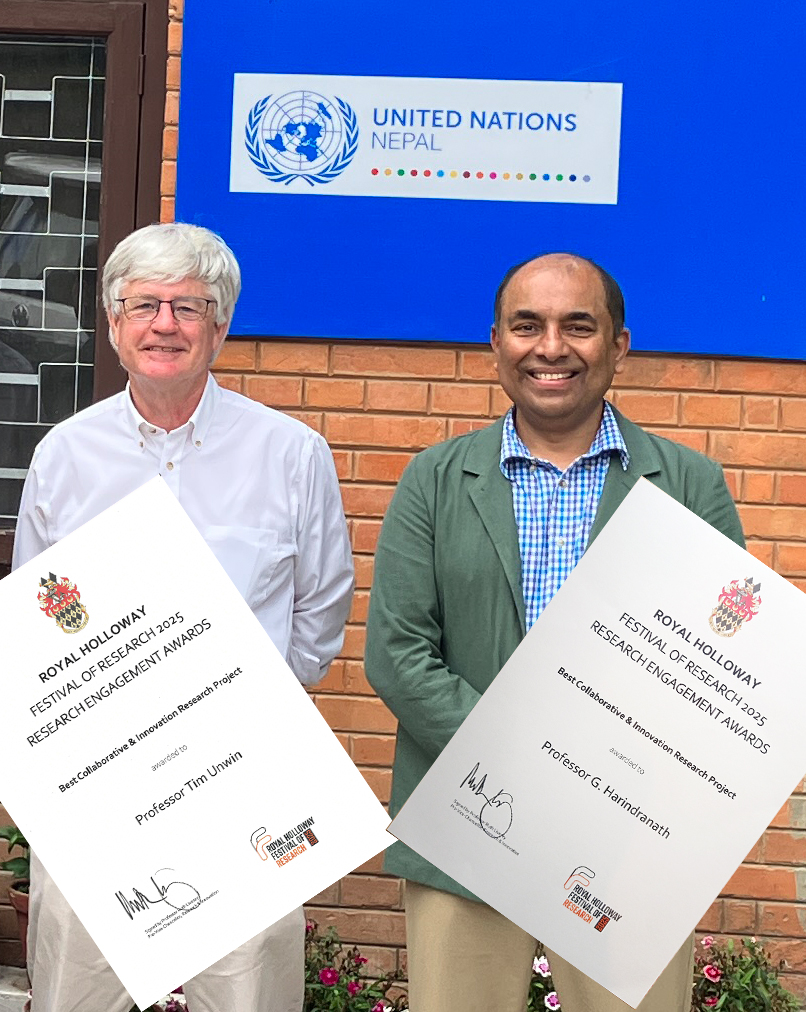
Hari Harindranath and Tim Unwin receive “Best Collaborative and Innovation Research Project” award

We are delighted to share the news that Profs G. ‘Hari’ Harindranath and Tim Unwin have received the award for “Best Collaborative and Innovation Research Project” from Royal Holloway, University of London for 2025 at their annual Festival of Research on 19th June for their ongoing research-practice with many other organisations across four continents on the safe, wise and secure use of digital tech in marginalised/peripheral communities, working especially with migrants and refugees. [The background to the image on the right is from one of their visits to the UNESCO offices in Nepal in 2023]

Their ‘project project was informed by social science research and resulted in the generation of interventions and training resources that were adopted by community groups and NGOs’ … To deliver outputs at scale, they have ‘engaged innovatively with international stakeholders, including third sector organisations (NGOs), international bodies (UNESCO, IOM, ILO) and key industry partners (community tech organisations). The sheer size, scale and duration of project activities are testament to the hard work’ they have invested. ‘Generating partnerships on such a global scale will not have come without its challenges, so [they] should be incredibly proud of [their] achievements in undertaking such a huge project’

Awards citation for research collaboration and innovation, Royal Holloway, University of London

More details of their work can be seen as follows:

Many organisations are contributing to this ongoing research, and full acknowledgement to them all is given in the links above.

A list of selected academic publications relating to this research:

  • Lorini, M.R., Harindranath, G. and Unwin, T. (2025) Responsible Digital: Co-Creating Safe, Wise and Secure Digital Interventions with Vulnerable Groups, Information Systems Frontiers, https://link.springer.com/article/10.1007/s10796-025-10611-4
  • Harindranath, G., Unwin, T., Lorini, M.R. (2024). The Design and Use of Digital Technologies in the Context of South–South Migration, in: Crawley, H. and Teye, J.K. (eds) The Palgrave Handbook of South–South Migration and Inequality, Cham: Palgrave Macmillan. https://doi.org/10.1007/978-3-031-39814-8_23
  • Unwin, T., Casentini, G., Harindranath, G. and Lorini, M.R. (2023) What works for migrants: reflections on research practice in the interests of migrants, Egham: ICT4D Collective, Working Paper 1
  • Harindranath, G. , Unwin, T. and Lorini, M.R. (2023) Rethinking digital tech policy for (and with) migrants, Chapter 8 in: UNRISD (United Nations Research Institute for Social Development) and MIDEQ (Migration for Development and Equality) Migration and Inequality in the Global South: Evidence from the MIDEQ Hub, Geneva: UNRISD, 36-40.
  • Unwin, T., Harindranath, G.H., Lorini, M.R. (2023) Migrants and digital tech: policy recommendations, Egham: ICT4D Collective, Policy Brief 1.
  • Harindranath, G. and Unwin, T. (2022) Digital technologies, migration and the SDG agenda, in: Piper, N. and Ditta, K. (eds) Elgar Companion to Migration and the SDGs, Cheltenham: Edward Elgar (in press)
  • Unwin, T., Marcelin, L.H., de Souza e Silva, J., Otero, G., Lorini, M.R., Anyadi, C., Gonçalves, D.M., Sato, D.P. and Harindranath, G. (2022) Uses of digital technologies by migrants from Haiti and to Brazil, Egham: UNESCO Chair in ICT4D, Royal Holloway, University of London, Working Papers No.4.
  • Unwin, T., Garba, F.,  Musaba, M.L., Lorini, M.R. and Harindranath, G. (2021) Uses of digital technologies by migrants in South Africa, Egham: UNESCO Chair in ICT4D, Royal Holloway, University of London, Working Papers No.3.
  • Majidi, N., Kasavan, C. & Harindranath, G. (2021) In support of return and reintegration? A roadmap for a responsible use of technology, in: McAuliffe, M. (ed.) Research Handbook on International Migration and Digital Technology, Cheltenham: Edward Elgar, pp. 220-236.
  • Unwin, T., Ghimire, A., Yeoh, S-G., Lorini, M.R. and Harindranath, G. (2021) Uses of digital technologies by Nepali migrants and their families, Egham: UNESCO Chair in ICT4D, Royal Holloway, University of London, Working Papers No.2.
  • Unwin, T., Ghimire, A., Yeoh, S-G., New, S.S., Kishna, S.S., Gois, W., Lorini, M.R. and Harindranath, G. (2021) Uses of digital technologies by Nepali migrants in Malaysia, Egham: UNESCO Chair in ICT4D, Royal Holloway, University of London, Working Papers No.1.
  • Harindranath, G. and Unwin, T (2019),  Digital technologies and migration: Reducing inequalities or creating new ones?, TREO Talk, International Conference on Information Systems, 15th December, Munich, Germany.
  • Harindranath, G. (2019) Digital technologies, migration and inequality, Presentation, Copenhagen Business School-Royal Holloway School of Management Joint Workshop, 16th September, Royal Holloway, UK.

To find out more about our work, do get in touch through our Contact Page.