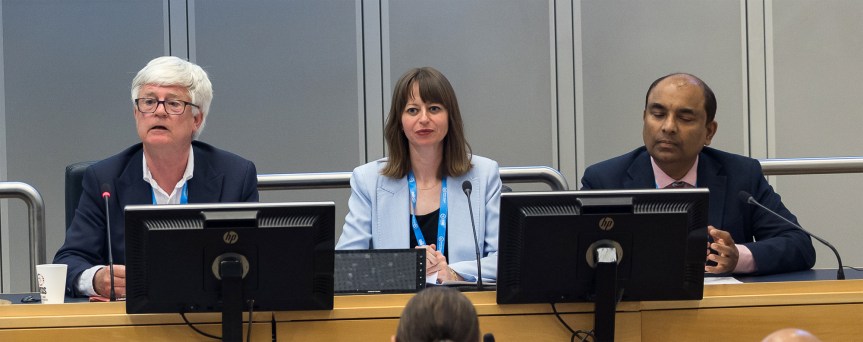
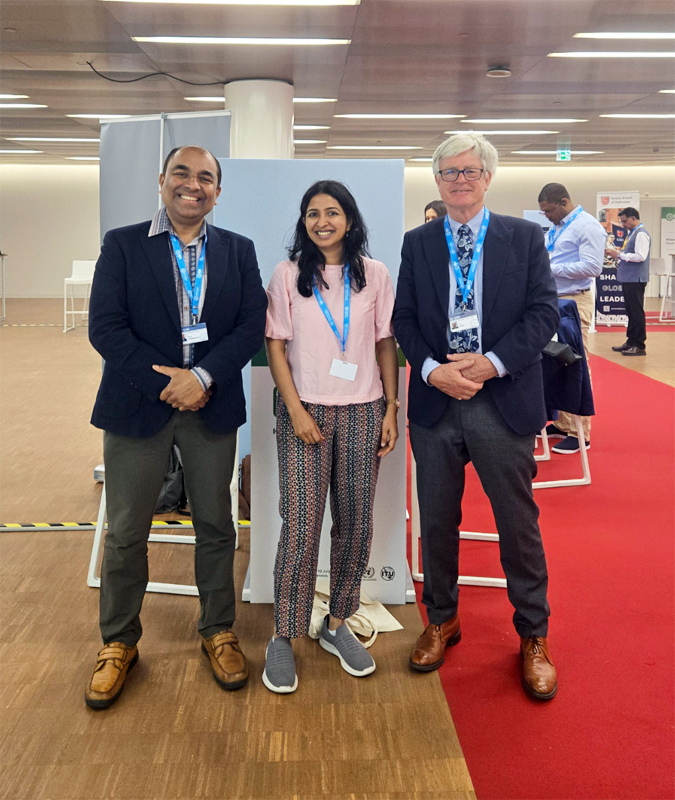
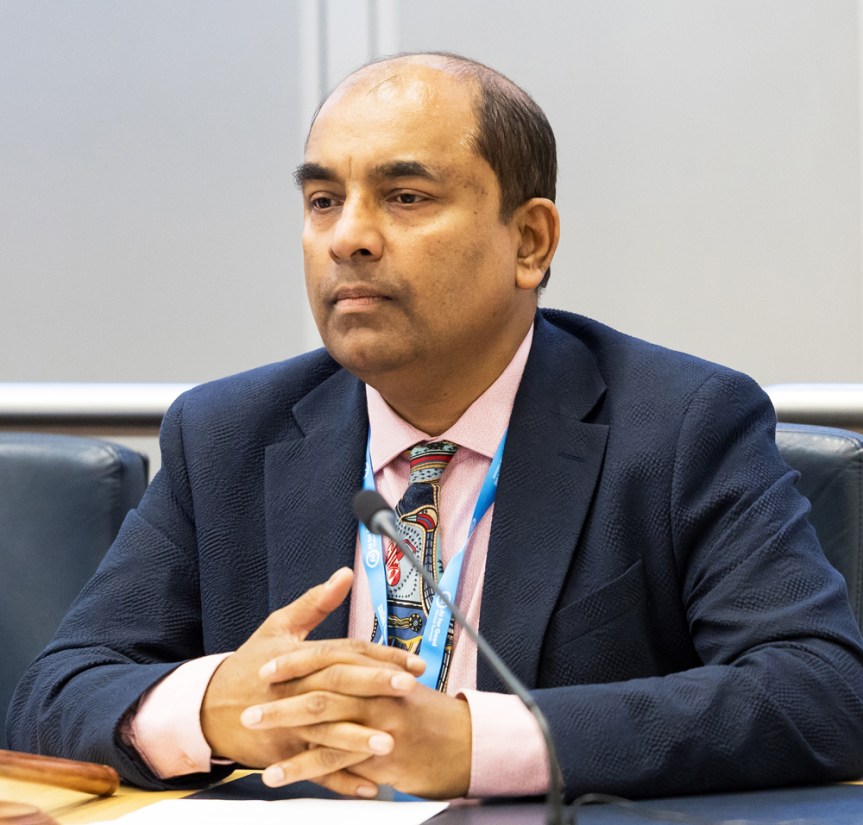
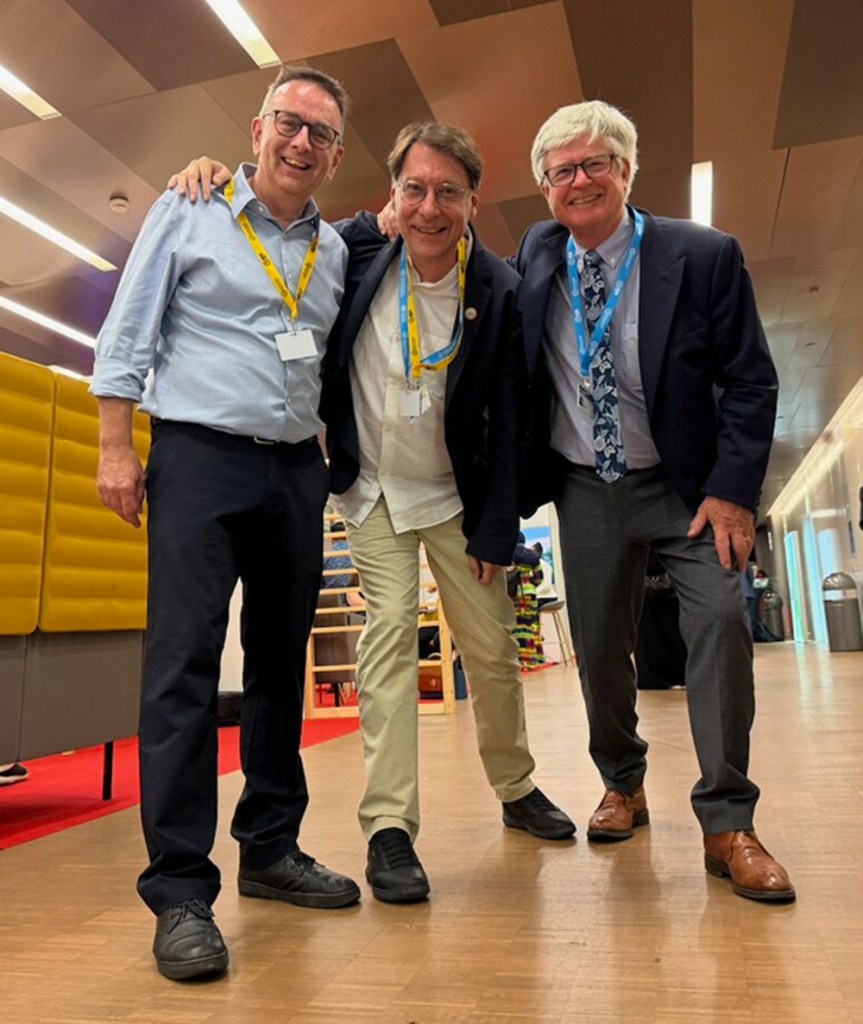
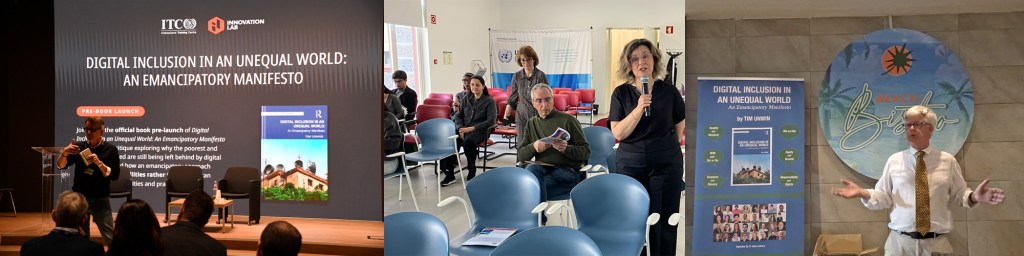
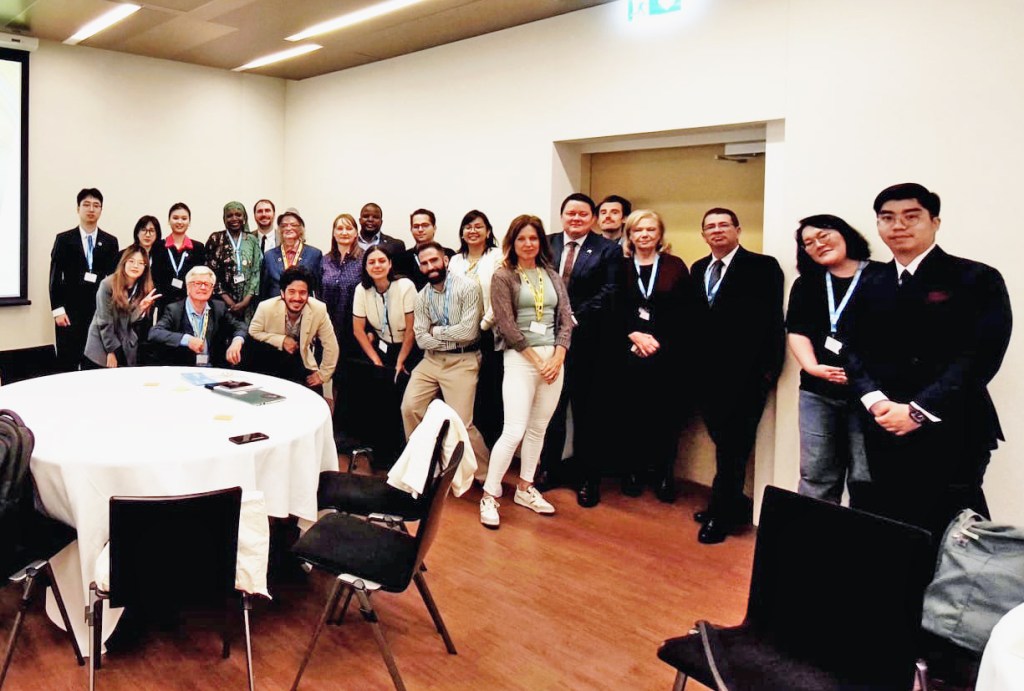
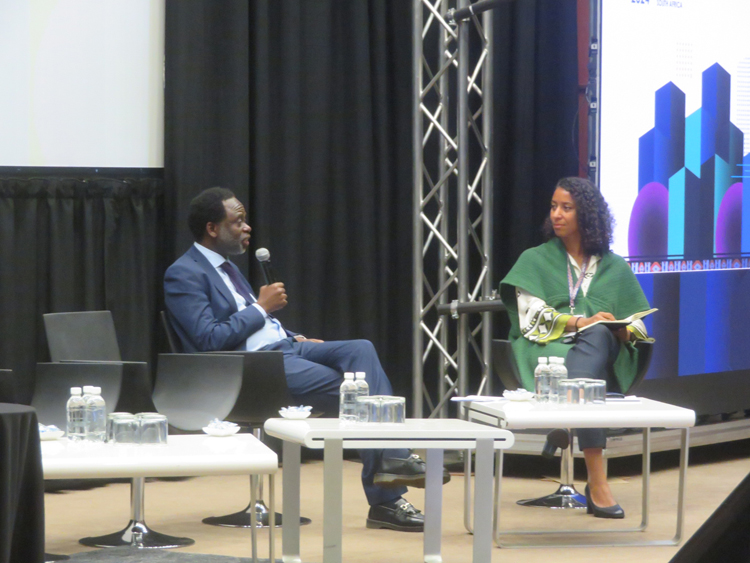
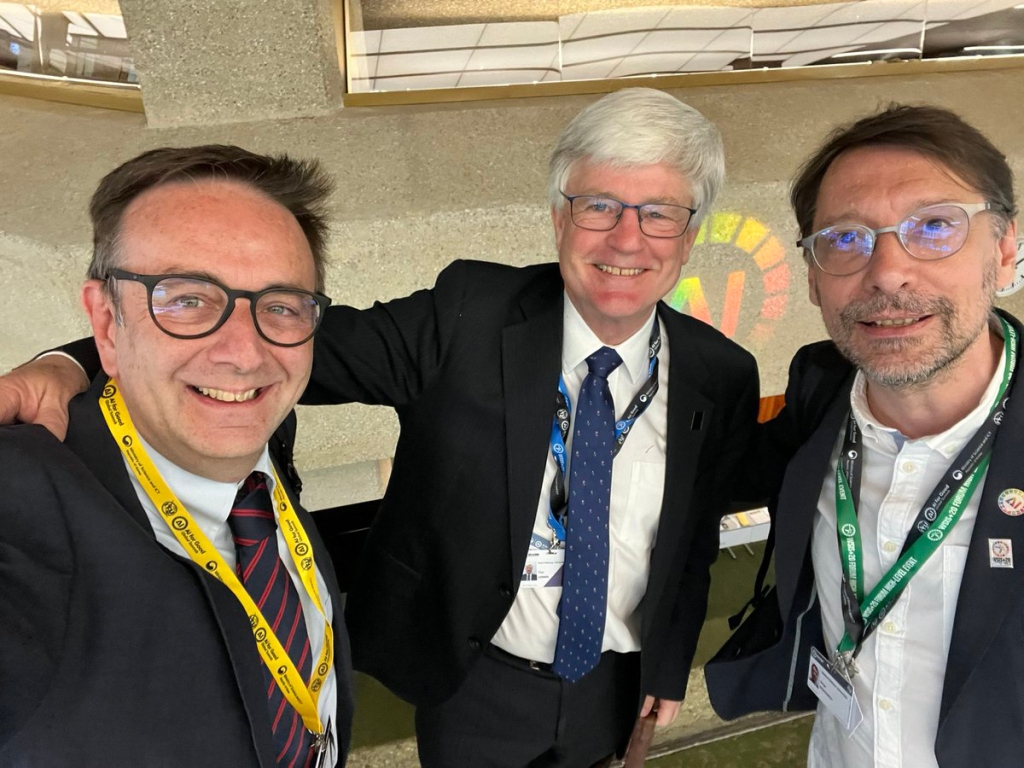
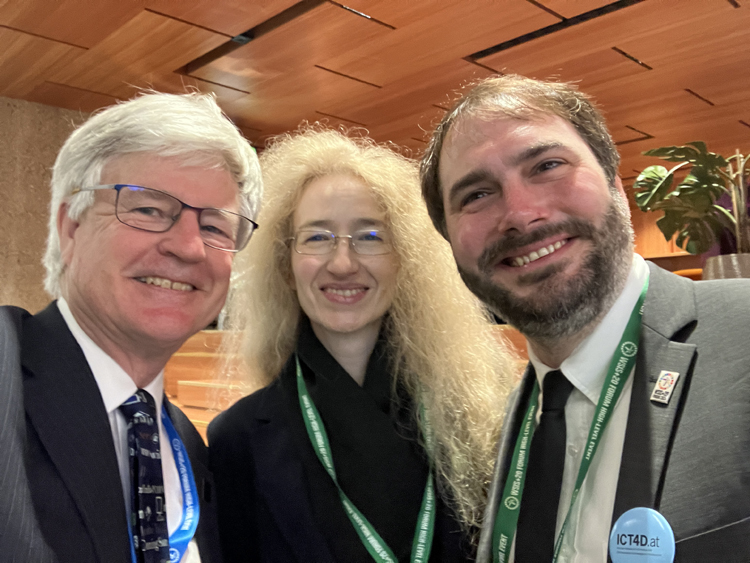
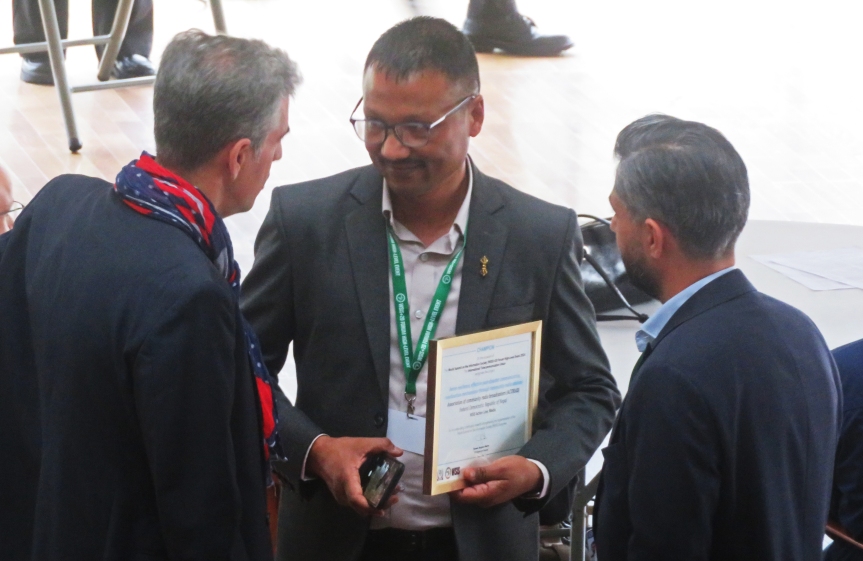
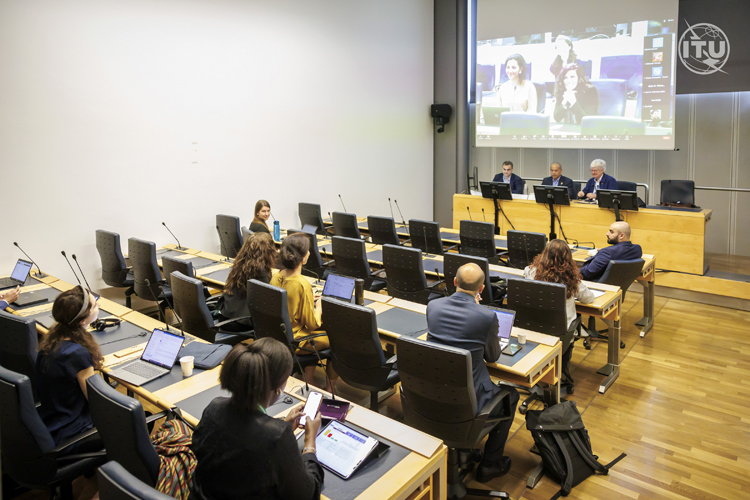
Three of the 32 authors who helped craft the tapestry: Digital Inclusion in an Unequal World: An Emancipatory Manifesto, speaking in our Session 347 (Credit: ITU Official Photographer)
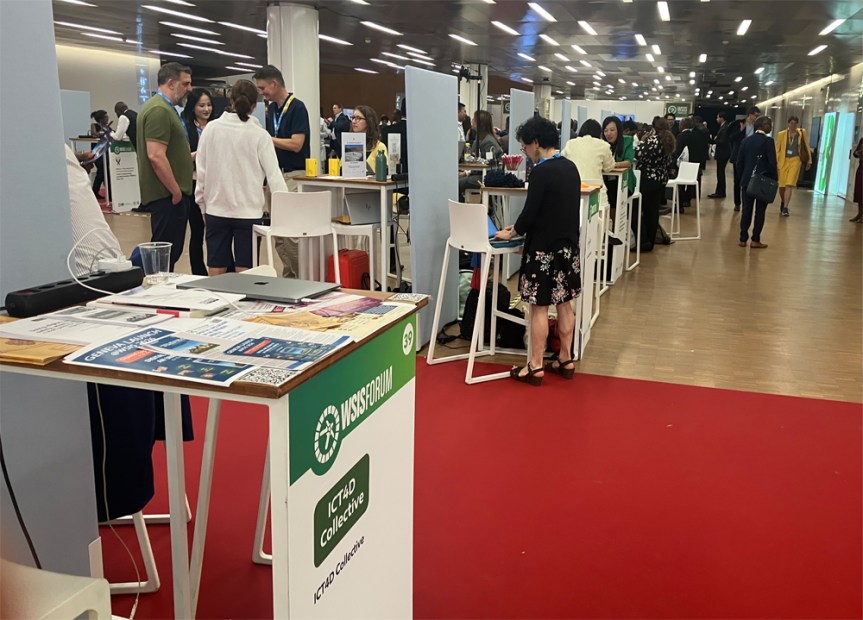
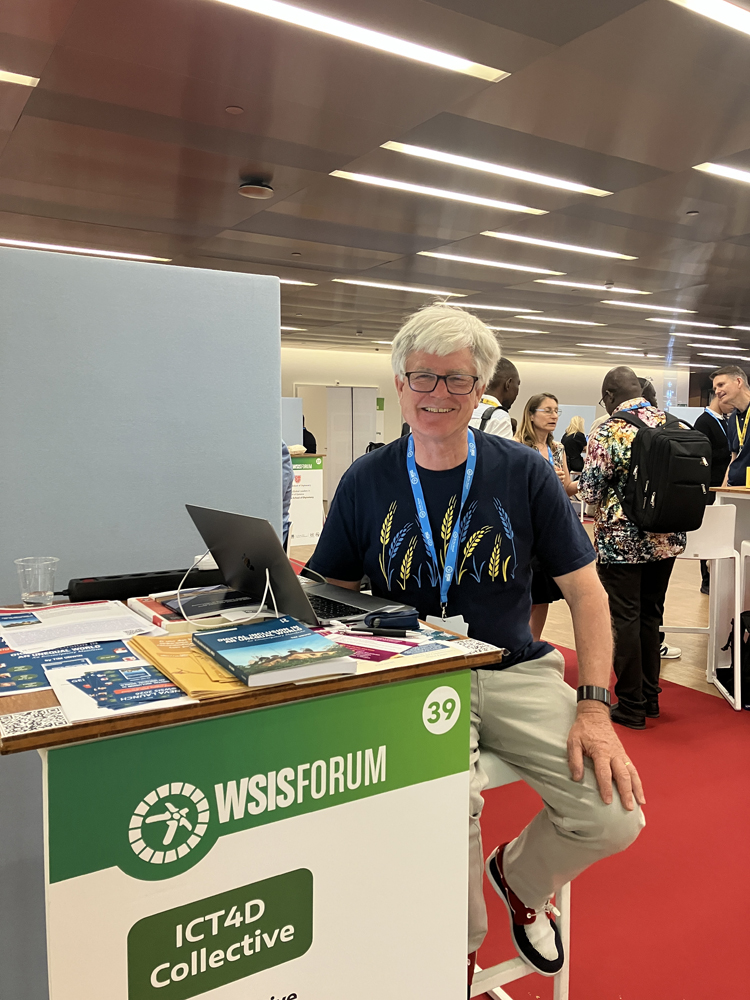
It is a long time since the ICT4D Collective last had a booth at the WSIS Annual Forum, but given our active involvement in both WSIS and AIforGood in 2026 we were delighted to have been allocated Booth 39 in this year’s much redesigned exhibition area. We are so grateful to Gitanjali Sah and Sarah El Omari for making this possible (and thanks too for the t-shirts to add to our collections).
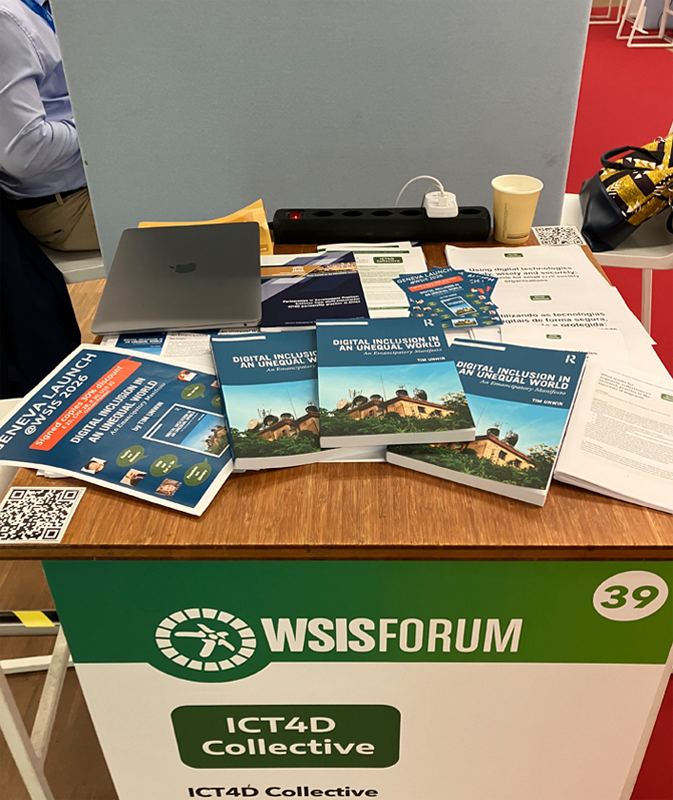
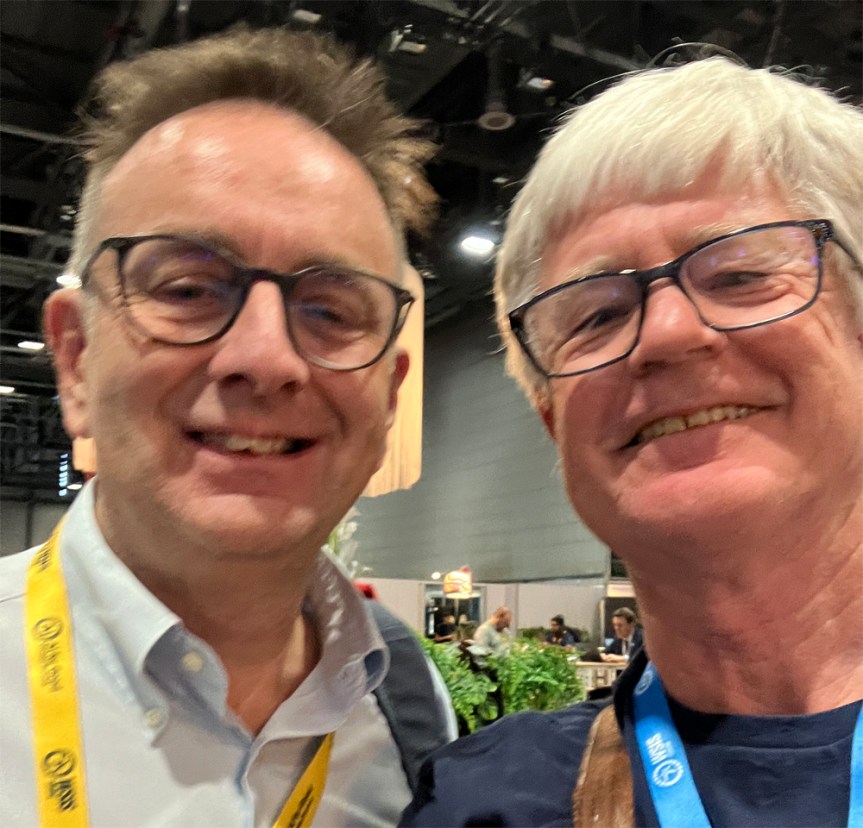
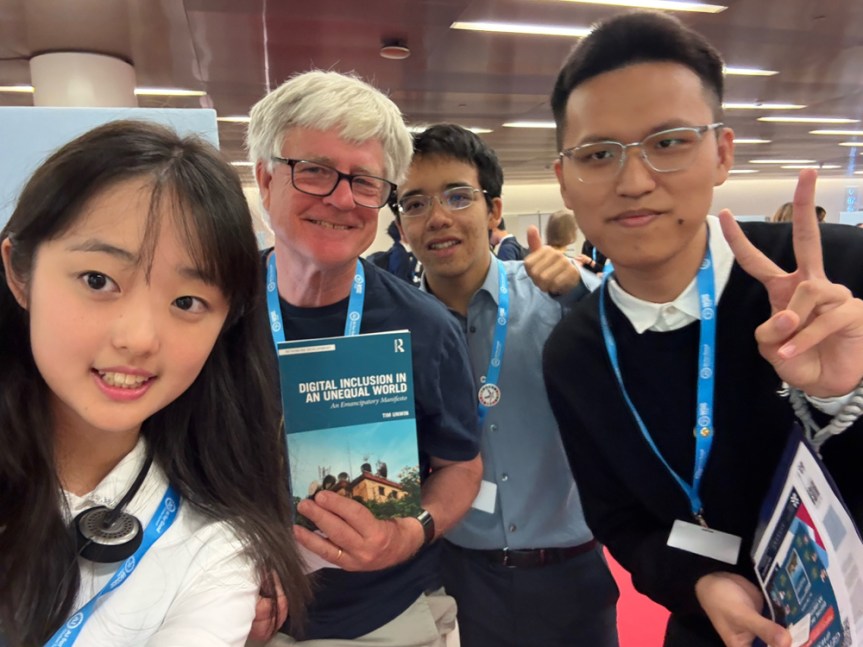
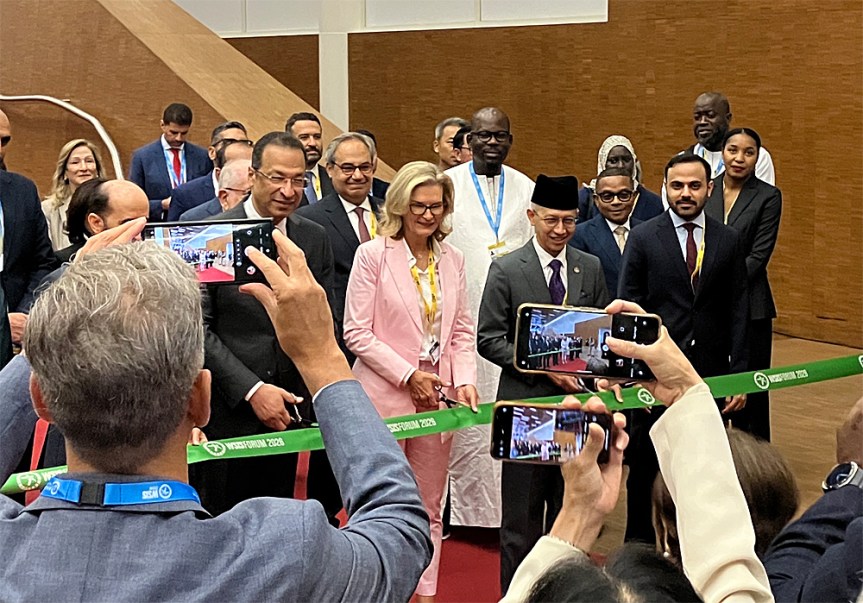
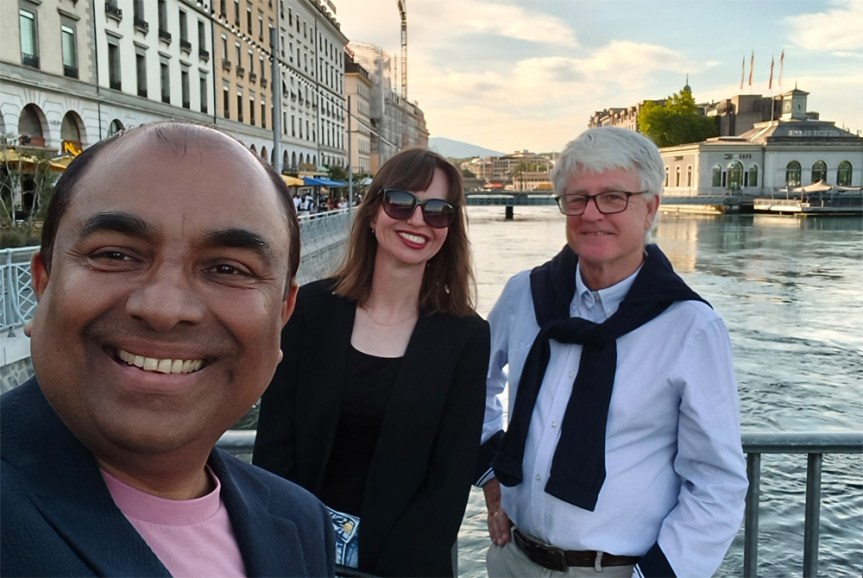
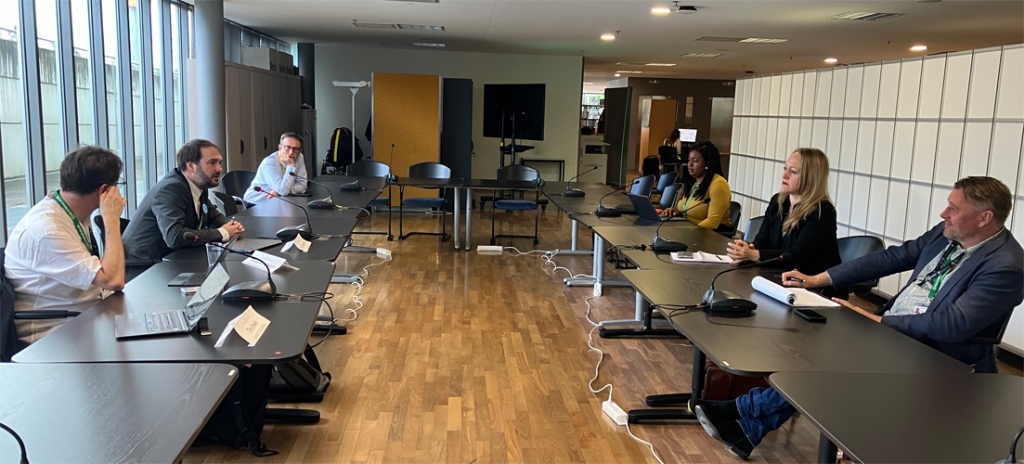
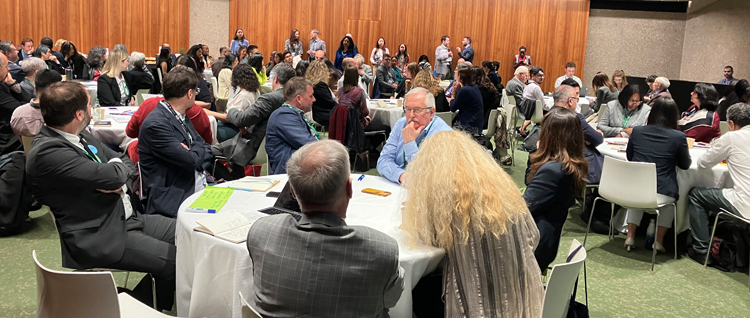
Booth 39 provided a great opportunity to catch up with friends made since the ICT4D Collective was established in 2004 as well as the chance to meet many new faces working in similar areas and sharing similar values. It also provided an excellent base from which to foray out into the many sessions in which we were involved during the week (see link to our programme of activities at WSIS). For Tim, Booth 39 also provided a great opportunity to raise the profile of his new book among those engaged in the WSIS process. The pictures below share glimpses of what members of the collective engaged in mainly around Booth 39 during the week.
Some of the resources we had freely available on the stand are also available online:
The ICT4D Collective and its members are taking an active role in this year’s WSIS Forum as we have done ever since the first WSIS summits in Geneva in 2003 and Tunis in 2005. If you are in Geneva then, do please join the sessions in which we will be involved, visit our stand in the Exhibition, or meet us for a drink in one of our favourite hostelries!
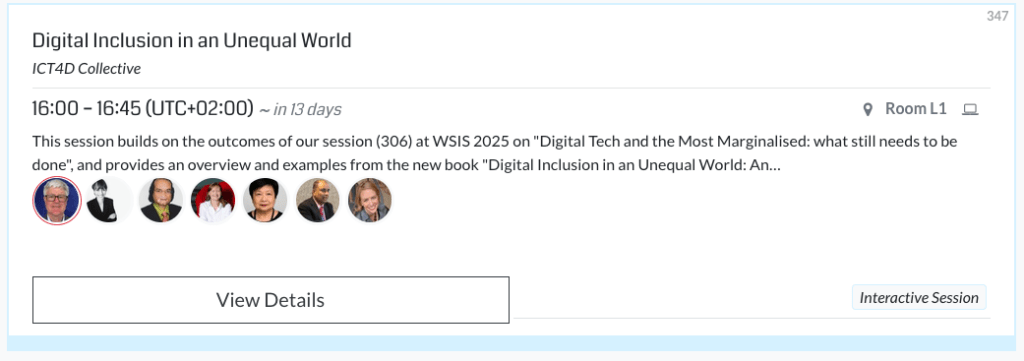
Session: Digital Inclusion in an Unequal World, 6th July
Join the ICT4D Collective’s session on Monday 6th July from 16.00-16.45 in Room L1 Montbrillant for a lively discussion about what we all need to do if the poorest and most marginalised are indeed to benefit from, rather than being enslaved through, the use of digital tech. See the great speakers lined up below!
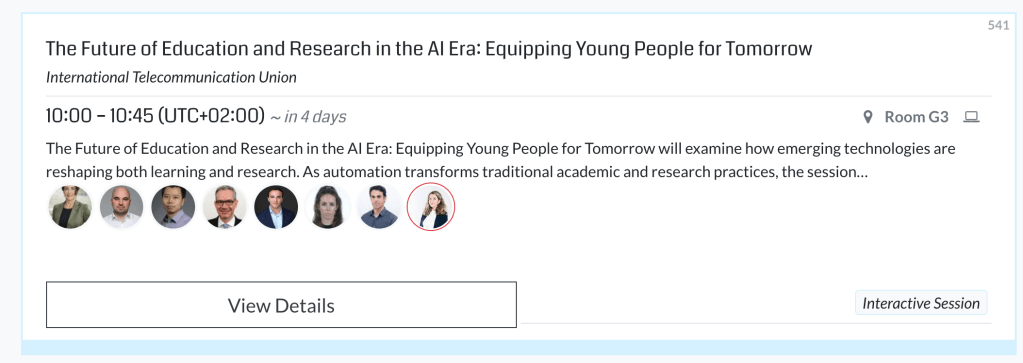
Session: The future of education and research in the AI era: equipping young people for tomorrow
Tim Unwin is a panellist in Session 541 being convened by the ITU from 10.00-10.45 on Tuesday 7th July in Room G3, ITU Varembé.
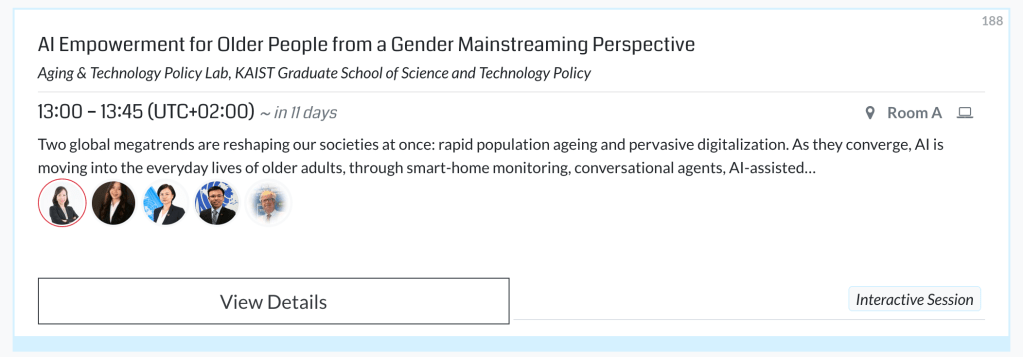
Session: AI Empowerment for Older People from a Gender Mainstreaming Perspective, 7th July
Tim Unwin is a panellist in Session 188 being convened by the Aging & Technology Policy Lab, KAIST Graduate School of Science and Technology Policy (South Korea), from 13.00-13.45 on Tuesday 7th July in Room A, ITU Tower Building.
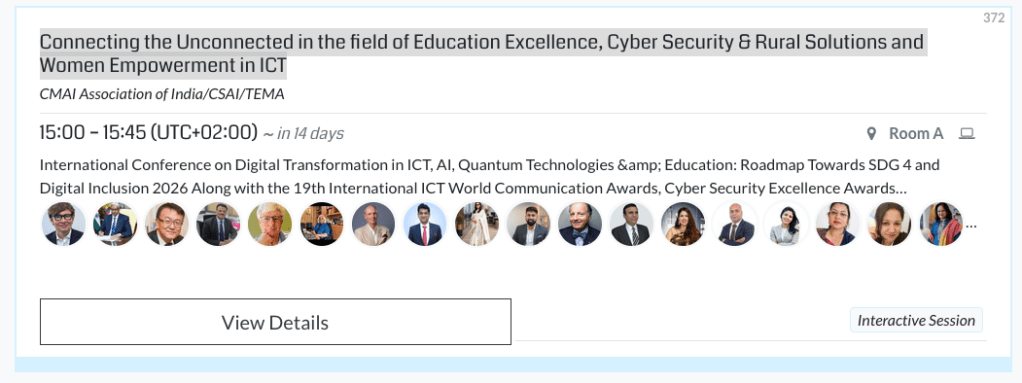
Session: Connecting the Unconnected in the field of Education Excellence, Cyber Security & Rural Solutions and Women Empowerment in ICT, 7th July
Members of the Collective will be participating in this session being convened by Prof. N.K. Goyal from the CMAI Association of India, along with CSAI and TEMA in Room A on Tuesday 7th Juk from 15.00-15.45. As in previous years, Tim Unwin will have the enjoyable but challenging task of moderating a very full session of Indian speakers.
Session: Foresight for FAIR Cities – Exploring AI Risks and Mitigation Strategies, 9th July
This important session in Room B Palexpo from 16.00-16.45 on Thursday 9th July is being convened by UNU-EGOV to address some of the risks of AI and strategies that can be put in place to mitigate them in the context of their project on “FAIRCities: Foster AI for Inclusive and Responsible Cities“. Tim Unwin has been invited to be a speaker.
Celebrating the publication of Digital Inclusion in an Unequal World: An Emancipatory Manifesto
Following successful pre-launch and launch events for Tim Unwin’s latest book at the ITCILO in Turin (Italy), at UNU-GOV’s headquarters in Guimarães (Portugal), and during eLearning Africa in Accra (Ghana) several of the authors are going to be present during WSIS including Benita Rowe, G. ‘Hari’ Harindranath, Mei Lin Fung, Revi Sterling, and Yuliya Morenets and will be talking about during and after our session on 6th July. A small number of signed copies of the book will also be available at the >30% discounted price (of £25, CHF 28, €30, US$35) during the session and at our Exhibition stand. We may well also celebrate together at a local hostelry (probably Les Brasseurs) on the evening of 6th July.
The ITU’s Partner2Connect initiative is convening a session on Building the future we want: scaling inclusive AI solutions through collaboration on 9th July from 14.00-15.00 during the AI for Good Summit and Tim Unwin has been asked to moderate the session on “Children, Youth, and Online Protection”. This should be an exciting and highly interactive “engagement”.
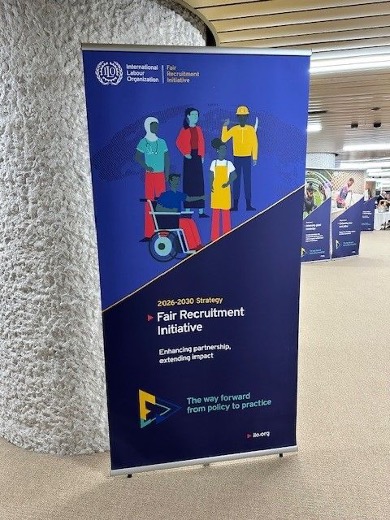
Prof. G. ‘Hari’ Harindranath was delighted to to moderate the ITCILO Labour Migration Academy webinar on Digitalisation and Fair Recruitment – Sharing Experiences held on 23 October 2025. This was attended by over 50 practitioners from around the world representing governments, employers, trade unions, and civil society groups. They were joined by three experts who shared national experiences of digitalising fair recruitment processes in Bangladesh, India, and Nepal:
Neha Choudhary discussed Nepal’s Foreign Employment Information Management System (FEIMS), designed to reduce information asymmetries in the labour migration supply chain by connecting migrant workers, recruiters, employers, and other relevant actors.
Rahnuma Salam Khan introduced Bangladesh’s Recruitment Agents’ Information Management System (RAIMS), which enhances oversight of recruitment agencies and intermediaries, promoting transparency and accountability.
Dr. K.V. Swamy (former GM, Overseas Manpower Company of Andhra Pradesh, India) shared his experiences with India’s eMigrate system, which connects and monitors all stakeholders involved in labour migration.
Key insights from the discussion
Key insights from the discussions were:
Digitalisation can be transformational for fair recruitment. It enables more integrated engagement across stakeholders in the labour migration cycle, improving data collection and analysis, increasing transparency and accountability, reducing migration costs, and offering quicker access to grievance resolution mechanisms.
However, these benefits cannot be taken for granted. Labour migration recruitment is complex and risk laden. Digital tools alone cannot eliminate exploitation or structural inequities. Successful digitalisation of fair recruitment requires significant groundwork, including:
A migrant-first approach, aligned with the principle of “nothing about us without us”
A whole-of-government approach to ensure policy coherence and a data governance approach to match
Organisational cultural change across stakeholders to enable new ways of working
Commitment to digital skills development and ensuring accessibility for all migrant workers
Complementary on-the-ground interventions to ensure inclusion of the most vulnerable, who are often least likely to benefit from digital systems
Ethical and privacy safeguards that underpin digital systems, ensuring compliance with data protection regulations and safeguarding migrant workers’ rights.
Hari would like to thank the ITCILO for convening this panel, all the participants and staff for their engagement, and particularly Elton Di Tommazi Maciel and Michela Albertazzi for inviting him to moderate the session.
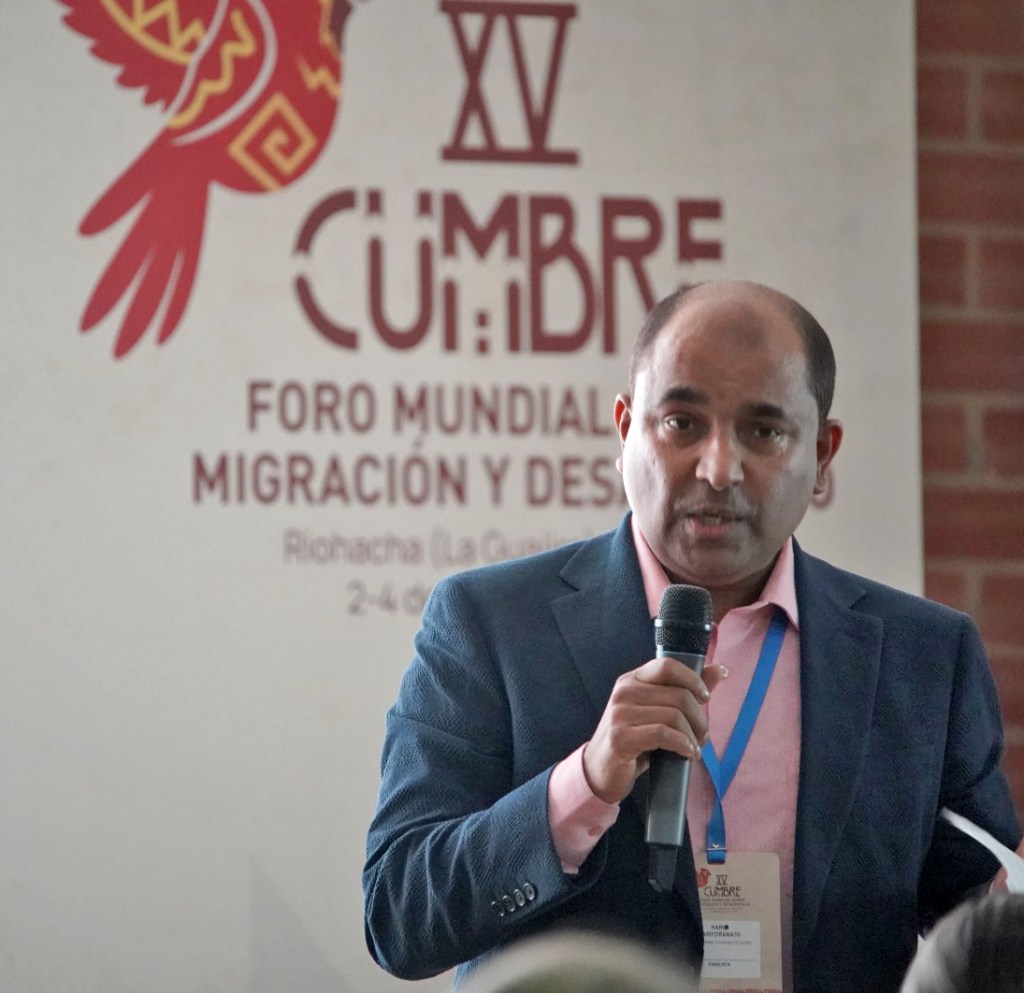
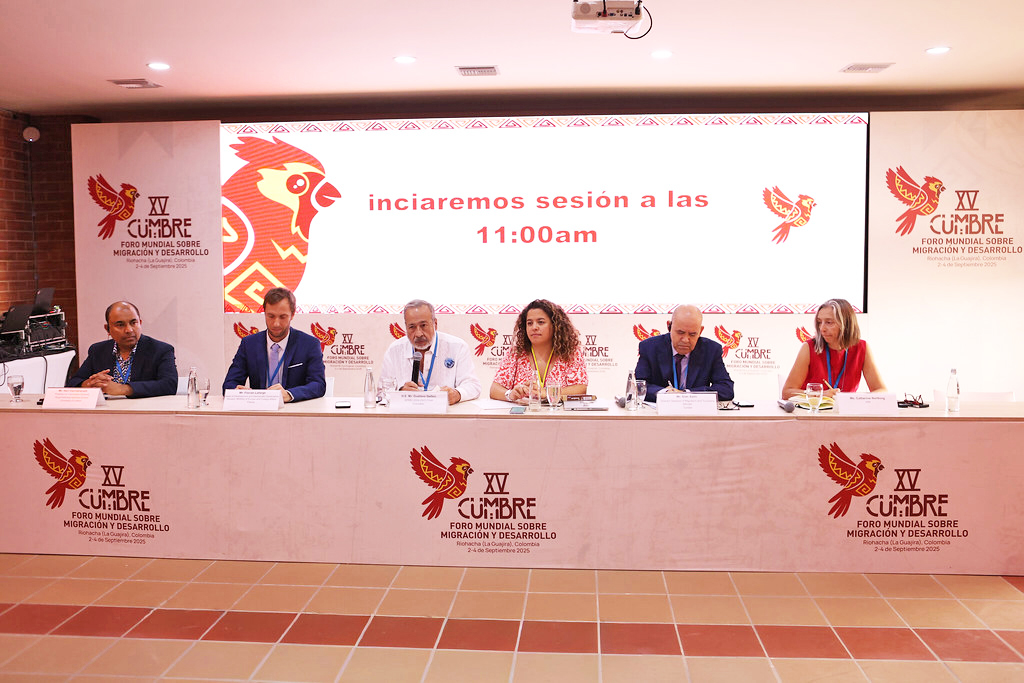
The 15th Global Forum on Migration and Development (GFMD) held between 2 and 4 September 2025 brought together in Riohacha, Colombia, more than 800 delegates representing governments, city mayors, businesses, civil society, youth and academia to exchange ideas on some of the most pressing challenges in global mobility.
The Colombia Chairship deserves huge recognition for putting together an ambitious and thoughtful programme shaping dialogue around six thematic pillars spanning mobility and women, children and young people on the move, media and culture for changing narratives, the promise and perils of new technologies, climate mobility, and the critical importance of regional cooperation and partnerships between origin and destination countries.
Prof. G Hari Harindranath comments that “it was a privilege to contribute remarks on behalf of academia at the session on the Future of the Summit on the final day and to speak in Round Table 6 on the digitalisation of migration management alongside colleagues from the governments of Ecuador and Georgia, the Institute of Employers, and technology and immigration services organisations”.
In the digital space, the opportunities are clear: technology can contribute to making migration safer and more efficient. But without safeguards, it can deepen inequalities. Many labour migrants already face precarious conditions, and now digital insecurity adds another layer of vulnerability, particularly so as they often lack the capacity to use digital tech safely, wisely and securely.
If we design digital systems with simplicity, accessibility, transparency, accountability and proportionality at the centre, we can then bring the benefits of digitalisation to those who are most likely to be disempowered by it. Getting it right for the most vulnerable means getting it right for everyone.
Thank you to the GFMD and for creating space for academic voices throughout this process, from the preparatory roundtables through to the summit. Evidence-based perspectives are essential in a field that is increasingly politicised and polarised, and GFMD’s unique framework is one of the few places where all stakeholders can meet together as equals.
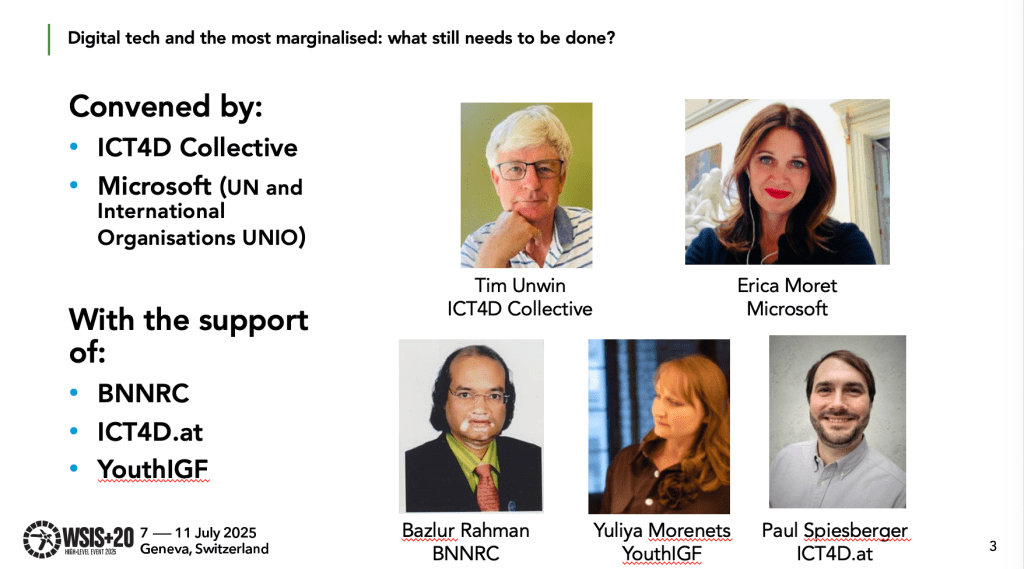
The ICT4D Collective and Microsoft (UN and International Organisations UNIO) (supported by Bangladesh NGOs Network for Radio and Communication, ICT4D.at, and YouthIGF) convened a very lively and interactive Session 360 this morning at the WSIS+20 gathering at Palexpo in Geneva. This began by recognising that digital tech will not be used successfully to deliver the SDGs (especially SDG10) by 2030, but then focused in a very positive way on what governments, the private sector and civil society can indeed do to try to ensure that the poorest and most marginalised can use digital tech to improve their lives.
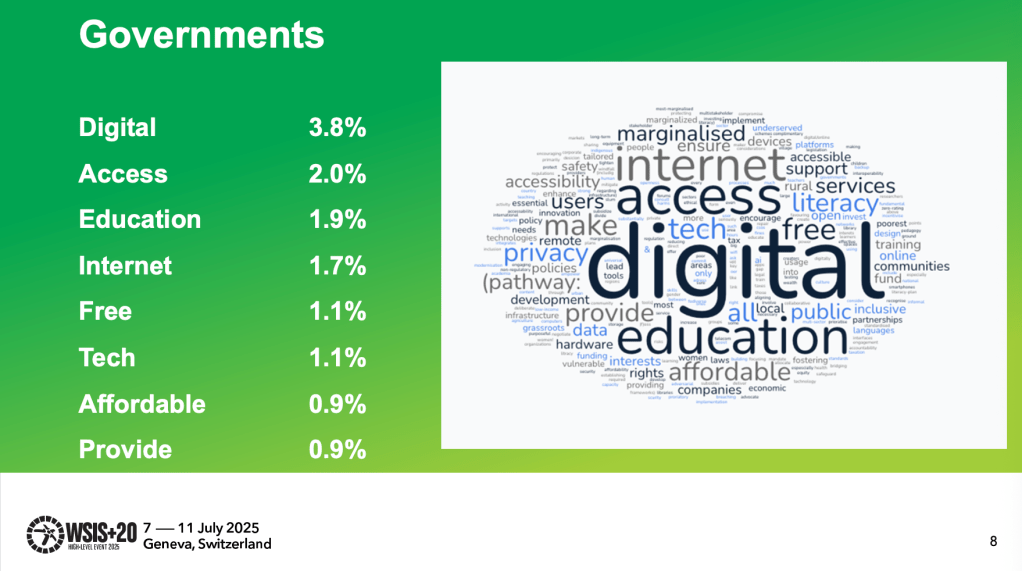
The session built on an online survey conducted in advance of the gathering to explore what people in our networks consider are the most important actions that can be done by governments, the private sector and civil society (as well as international organisations and academia). This is summarised in the slide deck used to guide the sessions (the whole deck is also available by clicking the image below).
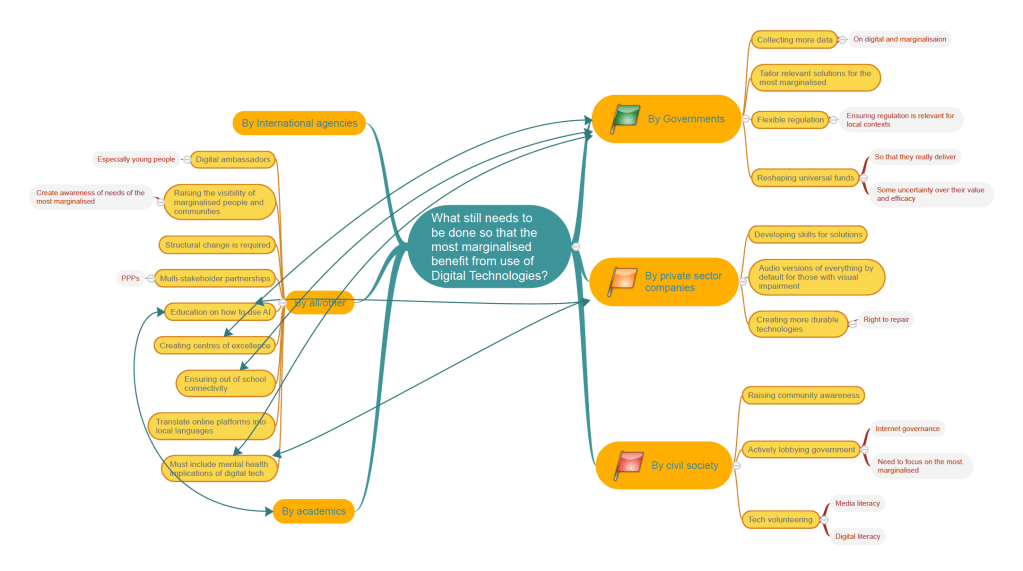
Lively introductory thought-provocations were given by Erica Moret (Microsoft), Bazlur Rahman (BNNRC), Paul Spiesberger (ict4d.at) and Yuliya Morenets (Youth.IGF), and the main focus of the session was then to create together a mind map from brainstorming by participants both in the room and also online (as well as using post-its). This generated a wide range of positive and constructive ideas for what we all need to do if we really care about helping the most marginalised use digital technologies to improve their lives. This discussion is summarised below (click on image for full sized .pdf file):
The session ended by participants re-committing themselves to doing something different in the interests of the poorest and most marginalised.
The multistakeholder digital tech communities associated with the UN system seem unlikely to deliver on the SDGs by 2030, despite the efforts of those involved in developing and implementing the Global Digital Compact (2024). In particular, SDG10 on reducing inequalities remains insufficiently addressed, with much emphasis instead continuing to be placed on maximising economic growth through innovation. All too often the most marginalised, especially those with disabilities, LGBTIQ communities, women in patriarchal societies, the elderly, ethnic minorities and refugees, are in practice made yet more marginal through the adoption of the latest digital tech by those more powerful and richer than they are.
UNDESA, ECOSOC/CSTD, many other UN agencies, and the IGF process are all conducting widespread consultations about the future of “digital and development” and the WSIS Process, but these have still not sufficiently addressed the tendency for digital tech to be used to increase inequalities, rather than to address issues of inequality and equity. Our interactive session is the culmination of a consultation process during the three months before the annual WSIS Forum through which people across our different networks have contributed their ideas to what the five highest priorities should be for governments, the private sector, civil society and the UN system in creating greater equity in the use of digital tech. The findings of this process will be presented during the session, and participants invited during the session to add to the recommendations through the interactive development of a mind map on marginalization that will provide a very specific output to feed into the wider ongoing debate within the UN system about digital tech and equity.
Please make your voice heard beforehand
Everyone is invited to contribute before the session through a short (max 10 minute) online survey available at: https://app.onlinesurveys.jisc.ac.uk/s/rhul/digital-equity-wsis2025. This will form the basis of our conversations in Geneva, and so even if you cannot attend in person please do copmplete this survey about what needs to be done to ensure that the poorest and most marginalised can indeed benefit from the use of digital tech.
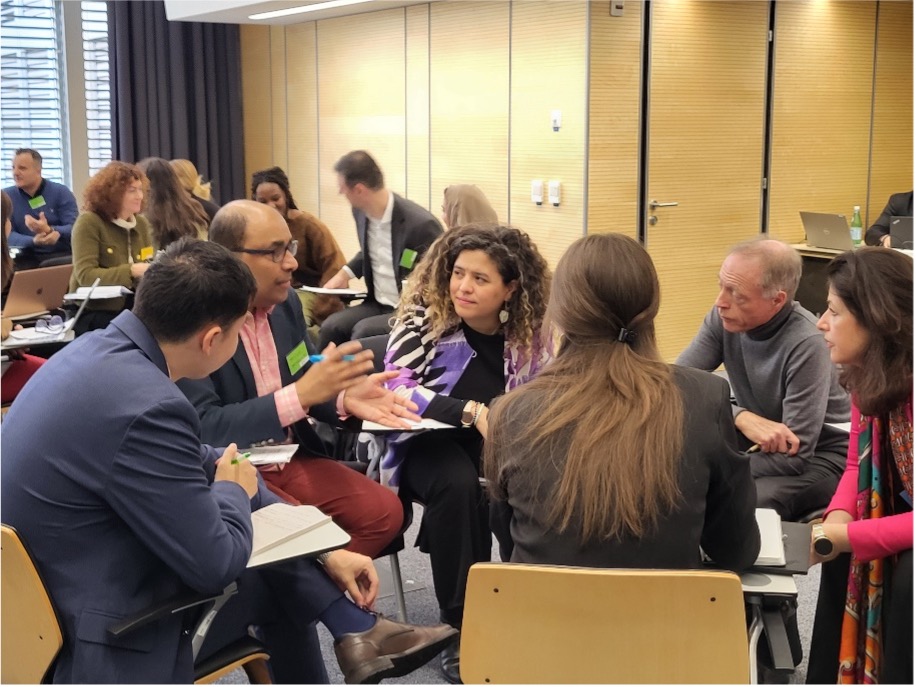
Digital technology is rapidly transforming the way migrant workers are recruited, bringing both new opportunities and serious risks. The interactive panel session examined emerging digital solutions that aim to promote fair recruitment – from tools used by workers to platforms leveraged by governments, inspectors and employers – and unpacked the associated risks and opportunities, and discussed actionable insights from participants on what works, what doesn’t, and how digital tech can be better harnessed to protect migrant workers.
Hari participated in a panel that also included representatives from the International Trade Union Confederation and The Adecco Group, one of the world’s largest human resources and temporary staffing firm.
Hari’s contribution questioned the uncritical application of digital tech in contexts of vulnerability that can cause harms, exacerbate existing inequalities and even create new ones. If digital technologies are to be used to advance fair recruitment of labour migrants, then it requires responsible digital practices that balance tech with supportive human interventions and a sustained focus on the safe, wise and secure use of digital tech by migrants.
Hari had previously been invited to contribute to the Global Forum on Migration and Development’s (GFMD) preparatory roundtables on ‘New Technologies and Digitalization: Improving Migration Management and Regular Migration Pathways’ in Geneva during February 2025 (and online in November 2024) in preparation for the 2025 GFMD Summit in Colombia.
Created in 2007, the Global Forum on Migration and Development (GFMD) is a state-led process connecting governments with civil society, the private sector, local and regional governments, youth, the UN system and other relevant stakeholders to helps shape the global debate on migration and development.
These significant policy engagement opportunities evidence the impact of our research-practice with vulnerable groups including migrants undertaken over the past six years, initially funded through a major UKRI GCRF grant and then through Royal Holloway’s Research England ODA and Social Purpose Research and Innovation Hub (SPRIH) grants (all in Nepal and South Africa) and through SSIA funding (in Brazil). Further details of this ongoing work can be found here (on the safe, wise and secure use of digital tech) and here (on our research-practice with migrants).
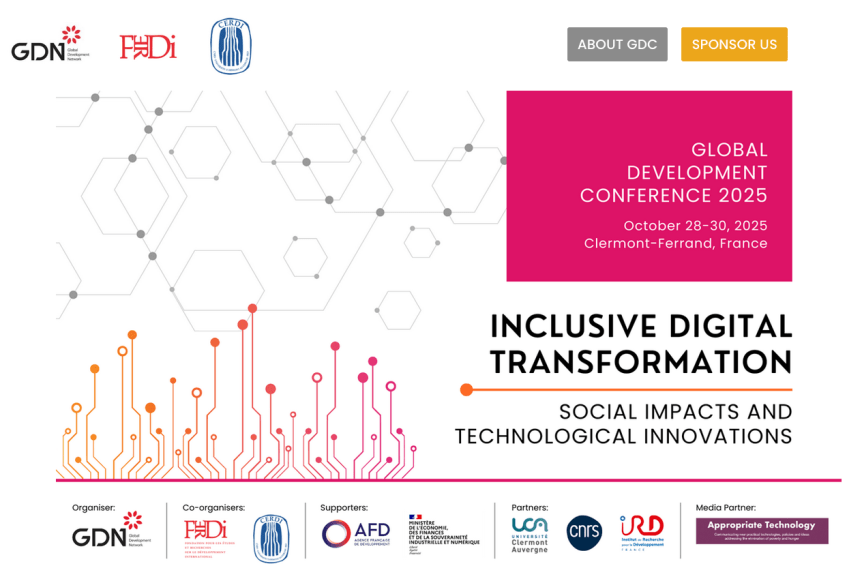
The ICT4D Collective is delighted to be assisting The Global Development Network (GDN) deliver its flagship Global Development Conference (GDC) 2025, taking place October 28-30 in Clermont-Ferrand, France, and virtually. Co-hosted by FERDI and CERDI, this year’s conference focuses on “Inclusive Digital Transformation – Bridging the Gap Between Promise and Reality.”
As ICT4D researchers and practitioners, we know technology holds immense potential for development, but we also see the risks of deepening inequalities and reinforcing existing power structures. GDC 2025 aims to foster a critical, evidence-based dialogue that moves beyond the hype. We’ll explore the complex interplay of social, economic, political, and ethical forces shaping our digital world, with a strong emphasis on learning from diverse global experiences, particularly within low- and middle-income countries (LMICs).
Get Involved Now! Call for Papers: this is the chance for researchers to share original research on digital inclusion, governance, the digital economy’s impact on social development, or technology for climate action. Contribute your evidence to inform policy and practice! Deadline: May 16, 2025.
What to Expect: GDC 2025 will feature inspiring keynotes, thought-provoking plenary discussions, and engaging, practical sessions designed for interaction. It’s a prime opportunity to connect with fellow researchers, policymakers, civil society representatives, and practitioners from across the globe.
Registration Coming Soon: Interested in attending, either in person or online? Participant registration will open shortly!
Stay updated and find all details on the official GDC 2025 website: conf2025.gdn.int
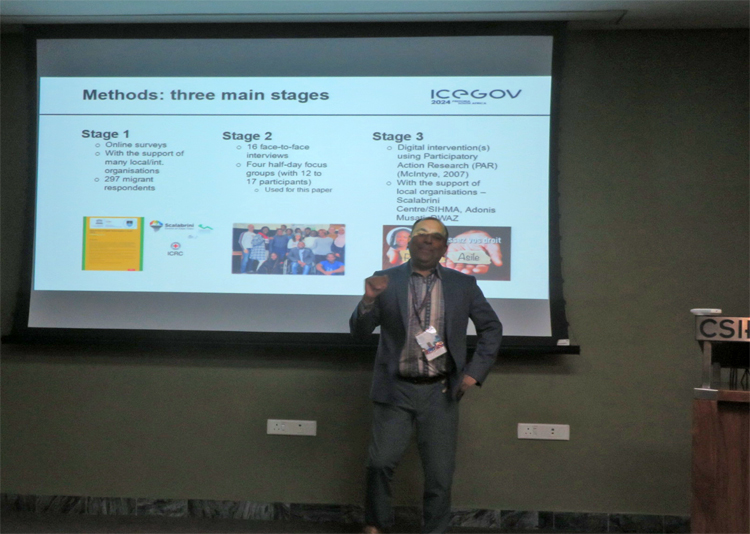
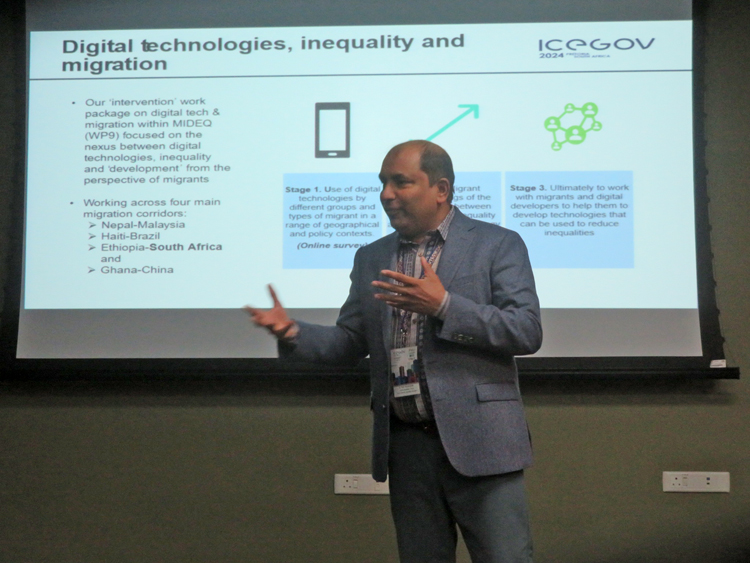
“Hari” Harindranth and Tim Unwin from the ICT4D Collective were delighted to have had the opportunity to participate actively in this year’s ICEGOV (International Conference on Theory and Practice of Electronic Governance) held in Pretoria from 1st to 4th October, and convened by our good friends at UNU EGOV, under the patronage of South Africa’s Department of Public Service and Administration, and organised jointly with the Univeristy of the Witwatersrand and South Africa’s Centre for Public Service Administration. The organising committee created a very convivial atmosphere, in which we were able to meet with acquaintances from the past and also made many new friends from across the world. On a more personal level, it was great being able to walk to and from the conference centre at CSIR every day which served to keep us fit, and we had just about adjusted to the altitude (c.1350 m) by the time we had to leave!
We were kept busy by the organisers, chairing a third of the conference’s paper sessions between us! Hari was joint session chair for two of the conference sessions (click on link for the detailed programme):
Hari also presented a joint paper on behalf of Maria Rosa Lorini and Tim on Mitigating Risks: Safe, Wise and Secure Use of Digital Technologies by Migrant Communities in South Africa. To our delight, this was one of three papers nominated by the conference panel for the best ongoing research! The proceedings will be published in digital format only as part of the ACM International Conference Proceedings Series (ICPS) so watch out for this if you want to read the full paper.
Highlights of the conference included keynotes by Prof. Tshilidzi Marwala (Rector of the UNU) on Digital Cooperation: International Governance of Emerging Technologies & the Global Digital Compact, and by Prof. Judy Dlamini (the Chancellor of Wits University) who gave an inspiring closing keynote. We were also richly entertained to a traditional South African braai and music at ithe conference dinner, where together we all sought to put to rights the world of global digital governance!
Particular thanks are due to the entire organising team, and especially to the tireless Flávia Barbosa who did so much behind the scenes to make our participation in the conference so productive and enjoyable.
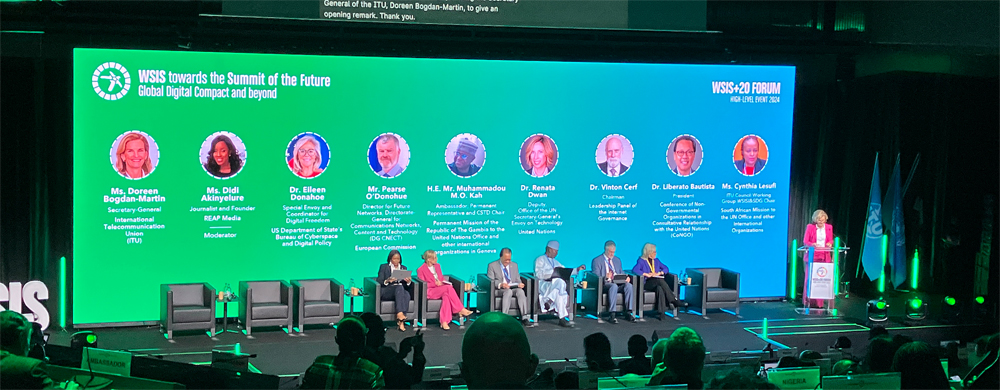
Members of the ICT4D Collective and friends had an exciting and very busy time in Geneva during the 20th anniversary meeting of the World Summit on the Information Society between 26th and 31st May, 2024. Our full agenda is available here, but we summarise below details of the two main sessions that we convened.
Community Media Networks: envisioning the future (Session 331)
We convened this session on 29th May with ACORAB/CIN , BNNRC, TaC-Together, Youth IGF, Cape Town TV, CEMCA, and ICT4D.at, highlighting the importance of community media in reaching some of the world’s most isolated and marginalised people. Our very distinguished line-up of speakers and moderators included (in order of speaking): Pramod Tandukar (Executive Director, ACORAB, Nepal), AHM Bazlur Rahman (CEO, Bangladesh NGOs Network for Radio and Communication), Dr. R Sreedher (Tele Learning and Community Radio Practitioner), and Philomena Gnanapragasam (CEO Asia-Pacific Institute for Broadcasting Development), with Tim Unwin (ICT4D Collective) and Paul Spiesberger (ICT4D.at) also being moderators.
Towards a better understanding of the interface between digital tech and the physical environment (Session 332)
This session (convened by The Digital Environment System Coalition, ICT4D.at and TaC-Together with YouthIGF) provided an overview of the agenda being developed by the Digital-Environment System Coalition (DESC), and an outline of our proposed contribution to the ITU’s Partner2Connect initiative. It emphasised the need for a completely new was of understanding the interactions between digital tech and the environment, that is much more holistic than the existing emphasis of the “global community” mainly on climate change, carbon emissions, and e-waste.
The ICT4D Collective is delighted to be participating actively in the upcoming WSIS+20 week of activities in Geneva, especially since 2024 is also the 20th anniversary of the foundation of the Collective, which was created in 2004 to conduct the highest possible quality of research in the field of ICT4D primarily in the interests of poor people and marginalised communities, and making the results of this available freely to the global community.
Geneva from the ITU
Members of the Collective are actively engaged mainly in the following sessions at WSIS+20:
All of these events have been convened jointly with our partners and friends or we have been invited to participate in their sessions as speakers and moderators, and we are most grateful to them for such collaboration. Please do join us at WSIS+20 – we promise to try to make our involvement exciting, interactive and challenging. Should you wish to contact us and arrange meetings during WSIS, do please use our contacts page.
Participants in the workshop (without the convenors!)
Members of the ICT4D Collective have been actively involved as Work Package 9 in the MIDEQ Hub since 2019, focusing especially on ways through which migrants can use digital tech to improve their lives, and thereby reduce the inequalities associated with migration. The Hub held its final major symposium in Rio de Janeiro in September 2023, and Tim Unwin, Hari Harindranath and Maria Rosa Lorini from the Collective, together with Guilia Casentini from SOAS took this opportunity to convene a highly interactive workshop/roundtable for members of MIDEQ on the theme of “What works for migrants: reflections on research practice in the interests of migrants”. The fundamental purpose of this was to explore how migrants may have benefited from our work, and how we might know what impact we may actually have had on them.
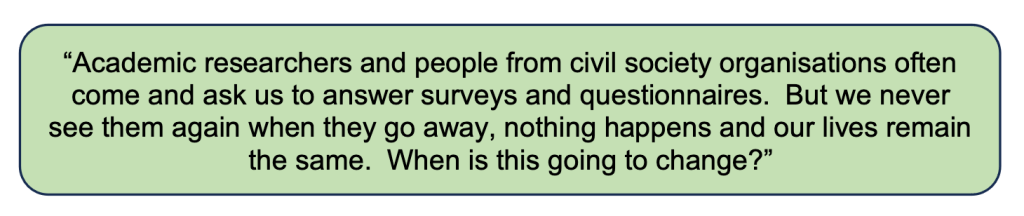
Heard in passing during our research… When will such often heard comments be consigned to the past?
The workshop addressed four main themes:
How do we really know what migrants think about our work?
What have we found to be effective ways of gathering empirical evidence about outcomes experienced by migrants?
What have we found to be effective ways of disseminating our outputs so that migrants benefit from them?
What are good forms of “output”/intervention to improve migrant lives?
We very much hope that this will promote discussion and further interaction on the crucial subject of the extent to which academic research can positively impact the lives of poor and marigalised communites and how we can know what migrants actually think of what we do. Do share your views by adding a comment to this post, or please get in touch with us directly to carry the conversation forward,