
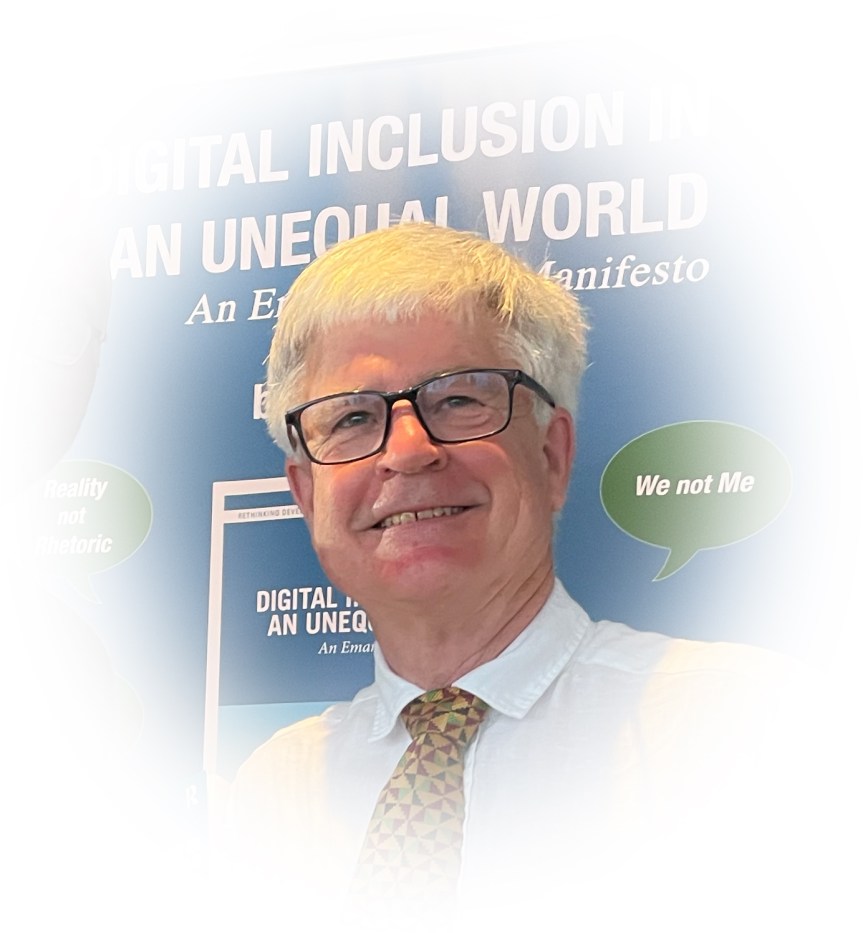
This is the twenty-fifth and final episode of our podcast based on the vignettes contributed by friends and colleagues to Tim Unwin’s new book Digital Technologies in an Unequal World: An Empancipatory Manfesto. In it, Tim Unwin provides a summary of his perspectives on leading Imfundo: Partnership for IT in Education between 2001 and 2004 in the UK’s Department for International Development, and asks why, despite Imfundo making al of its information and lessons learnt available online and in hard copy, so many digital tech for development initiatives still tend to start again from scratch instead of drawing on the experiences of previous such interventions
The full vignette can be listened to here.
All audio files relating to the book are also available on our podcast with a new episode every week.
Tim is the Catalyst of the ICT4D Collective, and Emeritus Professor of Geography at Royal Holloway, University of London, and was the editor of ICT4D: Information and Communication Technology for Development (Cambridge University Press, 2009) and author of Reclaiming Information and Communication Technologies for Development, (Oxford University Press, 2017).
Full details of his new book are available through the following links:
- An overview
- What others are saying about the book
- Chapter summaries
- Draft of opening chapter
- Full drafts of all the 31 vignettes contributed by other leading researchers and practitioners
- Flyer about the book
Other recent episodes

Digital Inclusion in an Unequal World (Episode 25) – Tim Unwin on “Lessons from Imfundo: Partnership for IT in Education” – ICT4D Collective » ICT4D
- Digital Inclusion in an Unequal World (Episode 25) – Tim Unwin on “Lessons from Imfundo: Partnership for IT in Education”
- Digital Inclusion in an Unequal World (Episode 24) – Tom Wambeke on “Beyond the Cable: ‘The embrace of co-designed, plural futures'”
- Digital Inclusion in an Unequal World (Episode 23) – Ugo Vallauri on “The Right to Repair”
- Digital Inclusion in an Unequal World (Episode 22) – Jamie Proctor on “The Right People, Building Things They Understand, and Striving to Deliver Directly for Citizens”
- Digital Inclusion in an Unequal World (Episode 21) – Ettie Unwin on “Crafting a More Equitable Framework for Global Epidemiological Research Practice: Working With Not On”




 een a very active member of the Young Women Writers Forum, and had recently passed away battling Multiple Sclerosis. The Forum did not have any funding available and so they contacted Sightsavers with whom they had an existing MoU to help and support Blind Women Writers in Pakistan. The first “award” (but not in a physical sense) was a small gathering of like minded people who supported the cause of empowering women and overall inclusion more generally. As the years passed by this gathering which always took place around the 15th of October began a regular feature to honour visually impaired people who had done substantial work within the community. For the last 3-4 years they have also sought nominations from the wider community to include sighted people working for the service of visually impaired people.
 Akber writes “I am deeply humbled and thankful to my vision impaired friends who recommended my name for this award. This is very special for me as it links me to the memory of the late Saima Ammar. She was a symbol of activism and defiance; she is someone who fought the cause for access to education for people with disabilities in Pakistan. She is someone who did not let blindness be a burden on her life, but rather used it as a motivation. She did not lead a very comfortable and luxurious life herse


