The ICT4D Collective at the WSIS Annual Forum 2026

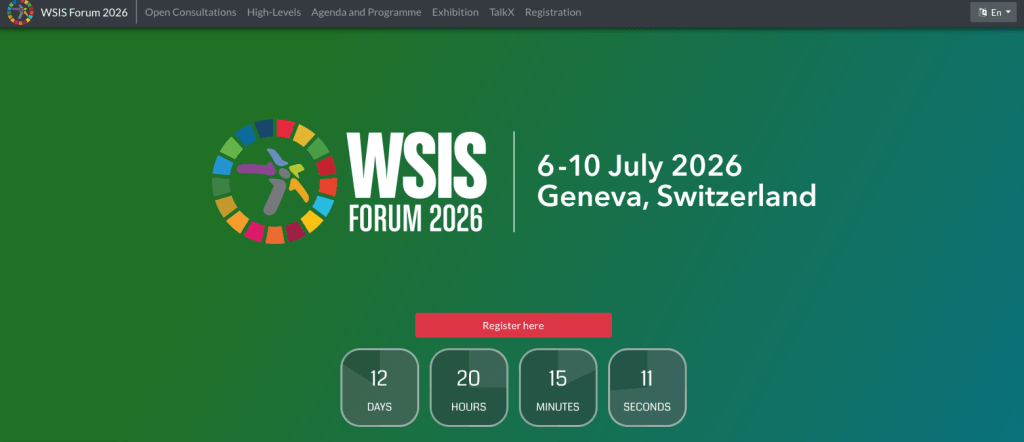
The ICT4D Collective and its members are taking an active role in this year’s WSIS Forum as we have done ever since the first WSIS summits in Geneva in 2003 and Tunis in 2005. If you are in Geneva then, do please join the sessions in which we will be involved, visit our stand in the Exhibition, or meet us for a drink in one of our favourite hostelries!


WSIS 2026 Exhibition, 8th-9th July

The ICT4D Collective has a stand in the small exhibition area on 8th and 9th July (although sadly our specially prepared banners have been banned!). This is only the second time that we have participated in the exhibition, and Prof G. ‘Hari’ Harindrath and Tim Unwin will be present at the stand for much of the time when they are not involved in sessions. Other members of the Collective will also be there at vsrious times during WSIS. Find out more about our research and practice at the stand, take away some of our resources (especially those prepared on safe wise and secure use of digital tech jointly developed with our colleagues in the LBT community in Rio de Janeiro), read some of our working papers (and take them away on the evening of 9th), buy a copy of Digital Inclusion in an Unequal World: An Emancipatory Manifesto at a 30% discount (first come first served) or get a 20% discount voucher.


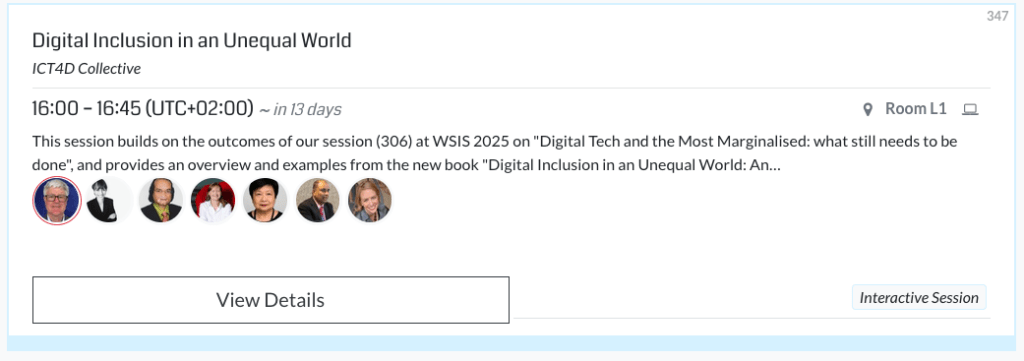
Session: Digital Inclusion in an Unequal World, 6th July

Join the ICT4D Collective’s session on Monday 6th July from 16.00-16.45 in Room L1 Montbrillant for a lively discussion about what we all need to do if the poorest and most marginalised are indeed to benefit from, rather than being enslaved through, the use of digital tech. See the great speakers lined up below!

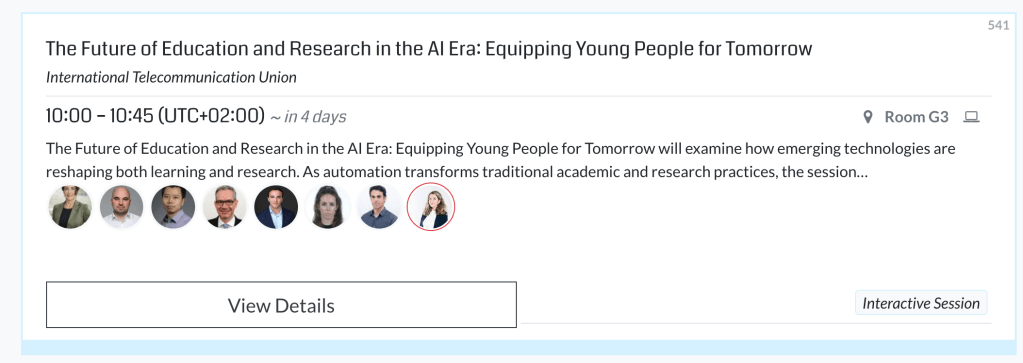
Session: The future of education and research in the AI era: equipping young people for tomorrow

Tim Unwin is a panellist in Session 541 being convened by the ITU from 10.00-10.45 on Tuesday 7th July in Room G3, ITU Varembé.

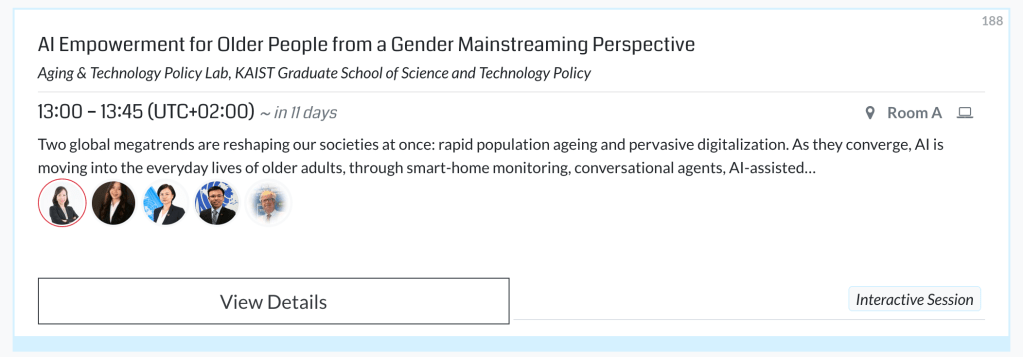
Session: AI Empowerment for Older People from a Gender Mainstreaming Perspective, 7th July

Tim Unwin is a panellist in Session 188 being convened by the Aging & Technology Policy Lab, KAIST Graduate School of Science and Technology Policy (South Korea), from 13.00-13.45 on Tuesday 7th July in Room A, ITU Tower Building.

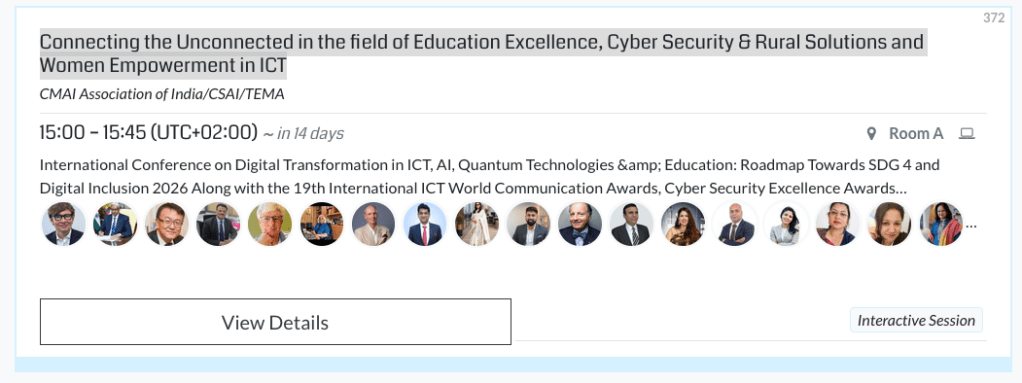
Session: Connecting the Unconnected in the field of Education Excellence, Cyber Security & Rural Solutions and Women Empowerment in ICT, 7th July

Members of the Collective will be participating in this session being convened by Prof. N.K. Goyal from the CMAI Association of India, along with CSAI and TEMA in Room A on Tuesday 7th Juk from 15.00-15.45. As in previous years, Tim Unwin will have the enjoyable but challenging task of moderating a very full session of Indian speakers.

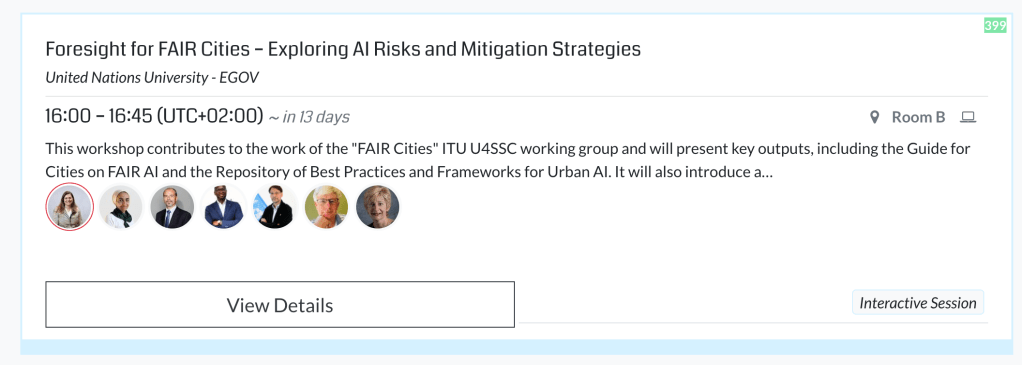
Session: Foresight for FAIR Cities – Exploring AI Risks and Mitigation Strategies, 9th July

This important session in Room B Palexpo from 16.00-16.45 on Thursday 9th July is being convened by UNU-EGOV to address some of the risks of AI and strategies that can be put in place to mitigate them in the context of their project on “FAIR Cities: Foster AI for Inclusive and Responsible Cities“. Tim Unwin has been invited to be a speaker.

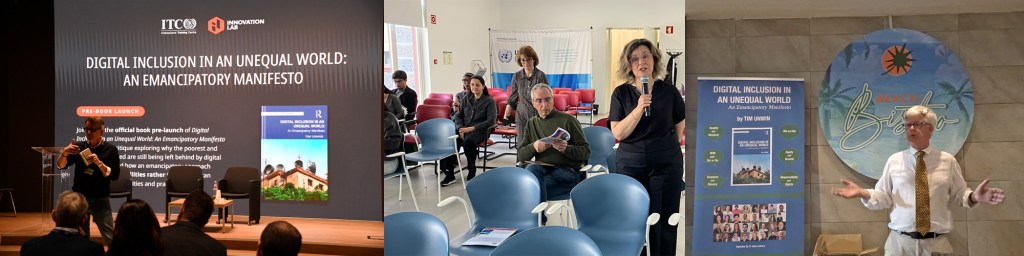
Celebrating the publication of Digital Inclusion in an Unequal World: An Emancipatory Manifesto

Following successful pre-launch and launch events for Tim Unwin’s latest book at the ITCILO in Turin (Italy), at UNU-GOV’s headquarters in Guimarães (Portugal), and during eLearning Africa in Accra (Ghana) several of the authors are going to be present during WSIS including Benita Rowe, G. ‘Hari’ Harindranath, Mei Lin Fung, Revi Sterling, and Yuliya Morenets and will be talking about during and after our session on 6th July. A small number of signed copies of the book will also be available at the >30% discounted price (of £25, CHF 28, €30, US$35) during the session and at our Exhibition stand. We may well also celebrate together at a local hostelry (probably Les Brasseurs) on the evening of 6th July.

Partner2Connect session at AI for Good

The ITU’s Partner2Connect initiative is convening a session on Building the future we want: scaling inclusive AI solutions through collaboration on 9th July from 14.00-15.00 during the AI for Good Summit and Tim Unwin has been asked to moderate the session on “Children, Youth, and Online Protection”. This should be an exciting and highly interactive “engagement”.

Guidance note for small civil society organisations on the safe, wise and secure use of digital tech

The latest revision (Version 7) of our guidance note designed mainly for small civil society orgnisations on the safe, wise and secure (or private) use of digital tech is now available here. This is essential reading for all such organisations, and indeed anyone interested in how to mitigate the potential harms of hacks on their digital systems.

As the guidance note begins,

This revised version makes minor revisions throughout, tidying up the text and simplifying it for non-technical users, and also includes the important recommendation of using passkeys rather than passwords that is now being widely advocated. On this issue, see for example the UK’s National Cyber Security Centre’s recent advice.

We are always looking to revise and improve this document, and we welcome any suggestions for future revisions. Please use our contact form to share your thoughts with us.

Translations of earlier drafts of the guidance notes are available in the following languages:

The guidance notes are available for free through a CC BY-SA license, and we welcome all offers to translate them into other languages.

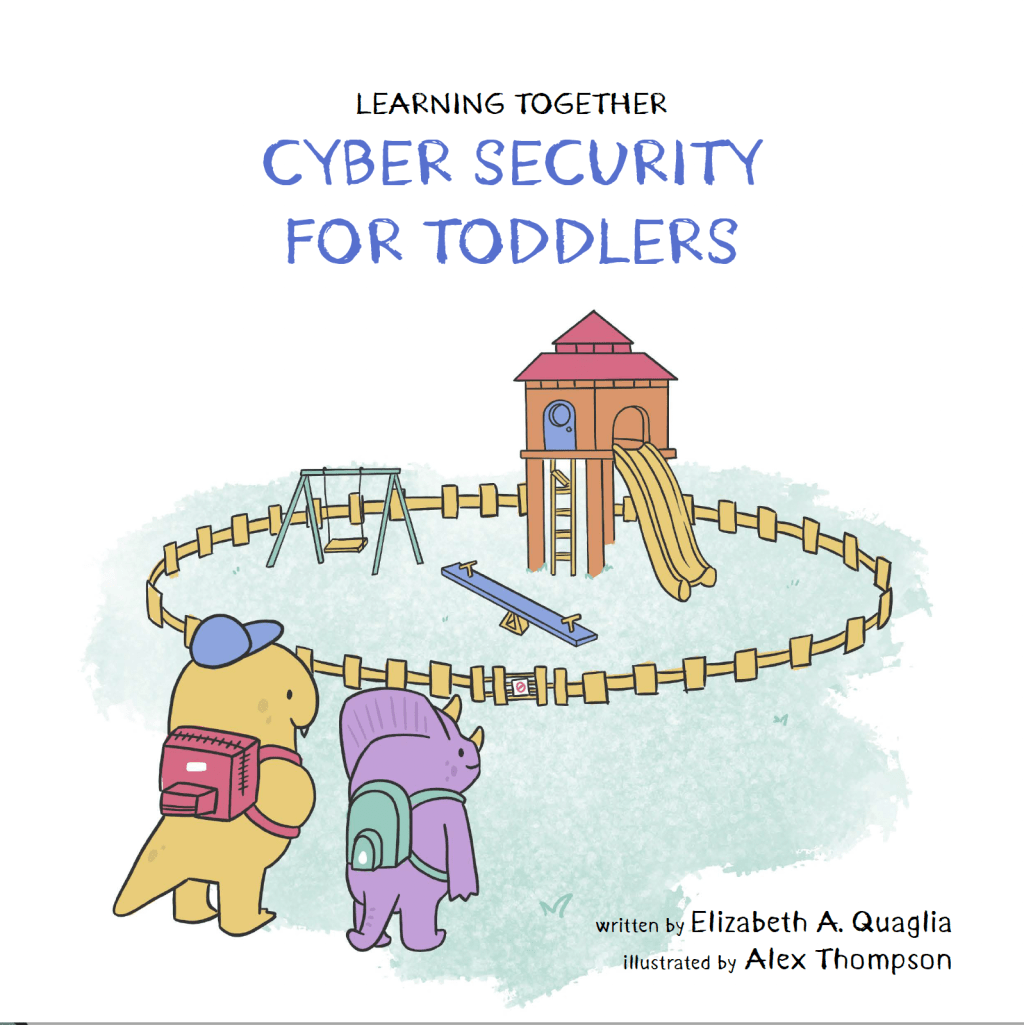
Cybersecurity and Cryptography for Toddlers – by Elizabeth Quaglia and illustrated by Alex Thompson

Elizabeth Quaglia, a member of the ICT4D Collective from Royal Holloway, University of London’s Information Security Group, has recently published two exciting and informative short books on cybersecurity and cryptography for young children, appealingly illustrated with dinosaurs by Alex Thompson.

These are excellent learning guides aimed at children and adults who care for them, and introduce fundamental concepts in cyber security and cryptography. Glossaries at the end of each book provide really useful, clear explanations of what key terms in cybersecurity and cryptography mean, and how they have been used in the books – as illustrated below:

These books are available in English, Portuguese (from Portugal and Brazilian: Criptografia para Infantes) and Ukrainian (Кібербезпека для малят).

Workshop/seminar on cybersecurity for community radio journalists in Nepal

The ICT4D Collective was delighted to be involved in delivering an online workshop/seminar with our partners ACORAB (the Association of Community Radio Broadcasters) and CIN (Community Information Network) in Nepal on 24th July. This drew on our previous work in Nepal, as well as the session on community radio that we ran earlier in the year at WSIS+20 together with other organisations and partners. These form part of our increasing work on cyber-security. Some 70 participants, mostly journalists from community radio stations, participated in the two-and-a-half hour workshop which had four main aims:

  • To share information and ideas about the work that members of the Collective have been doing, mainly with migrants, on the safe, wise and secure use of digital tech in Nepal, South Africa, Brazil and Mozamibique;
  • To provide participants with advice that will hopefully be of value to them both personally and in their professional lives;
  • To share resources on cyber-security that can be used through community radio to advise listeners in Nepal; and
  • An opportunity for discussion and dialogue between participants

The slide deck used for the workshop is available here, and we would love to hear any feedback or suggestions about the content through our contact page.

More details can also be found here about our latest related publication: Guidance for small civil society organisations on using digital tech safely, wisely and securely

Guidance for small civil society organisations on using digital tech safely, wisely and securely

During one of our research visits to South Africa in January 2024 it became abundantly clear that many small and poorly resourced civil society organisations have little experience of using digital tech safely, wisely and securely. Drawing on good practices across the world, as well as our subsequent experiences in and with colleagues from Brazil, Nepal and Mozambiaue, we have therefore produced a short (12 page) guide to help such organisations understand the risks they are at from the use of digital tech and how they can be mitigated. This contains useful tips, graphics that can be copied and reversioned into posters, as well as links to more detailed sourcers of information, and it is freely available in English under a Creative Commons CC BY SA license.

Please get in touch using our contact page should you have any comments on how this could be improved or to discuss developing versions in other languages or for other contexts, and do please share information about this resource through your own networks.

This forms part of the ICT4D Collective’s ongoing research-practice in the safe, wise and secure use of digital tech, further details of which are available here.

Uses of digital technologies by Nepali migrants and their families

Members of the UNESCO Chair in ICT4D are leading Work Package 9 of the MIDEQ hub (funded by UKRI GCRF and Royal Holloway, University of London) and are exploring how digital tech can be used to reduce the inequalities associated with migration, especially in four corridors: Nepal-Malaysia, Ethiopia-South Africa, China-Ghana, and Haiti-Brazil. The second of our working papers presenting data on the uses of digital technologies by Nepali migrants and their families has just been published within the UNESCO Chair in ICT4D’s publication series. Key findings and abstract are as follows.


Key findings

1. Nepali migrants and their familes make extensive use of digital technologies – especially smart phones and the Internet for a wide range of purposes, and not just for audio and video calls2. Very few migrants make any use at all of apps  that have been developed specifically for migrants – and even those 8.7% that claim to do so may not have actually used such apps      
3. Migrant use of digital technologies increases through the migration journey – only 46.4% had used digital tech daily before migrating, whereas 85.4% used them daily while in the migration destinations.        

Abstract

This working paper forms part of the output of Work Package 9 on technology, inequality and migration within the MIDEQ Hub, a multi-disciplinary research project in 12 countries of Latin America, Africa and Asia, including the Nepal-Malaysia migration corridor.  It presents the results of an online survey of 266 respondents in and from Nepal, 58.5% of whom identified themselves as migrants, with 28.1% being family members of migrants, and 13.4% being returned migrants.  Following a summary of the methodology, which explains why an online survey was used to replace the originally planned interviews and focus groups, the paper provides an overview of the most important results and analysis, focusing on the potential influence of age, gender, countries of origin and destination, migration status, and occupational status on the ways in which respondents use digital technologies and for what purposes.  Three important conclusions for Phase Two of our research are: first, the vast majority of Nepali respondents have smart phones and access the internet very frequently for a wide range of purposes; second, simply designing another new app may not be particularly valuable; and third, it might well be wise to work with, or build on, technologies and apps already in existence, so as to improve them in ways that could increasingly empower migrants.


To read this paper in full (v.5 .pdf) please use this link.

Other UNESCO Chair in ICT4D Publications are available here.