Enhancing research-practice impact and outcomes in Nepal

Projectitis is the bane of much good research and practice, whereby often well-intentioned people get caught up in a vicious cycle of bidding for project funding, delivering outputs, producing evidence of success, and then bidding again for new projects. All too frequently, insufficient effort is expended on supporting those involved to continue delivering positive outcomes in the years following the end of a project. In 2019 we were fortunate enough to be part of a successful bid for UKRI GCRF funding for a five year research Hub focusing on migration for development and equality (MIDEQ). By its end in 2024 it was clear that our work package on how migrants might benefit from using digital tech had only really just begun to generate outputs and outcomes to benefit the lives of the migrants and migrant organisations with whom we were working in Nepal and South Africa, and that more work needed to be done to help ensure that these outcomes became a lasting legacy of our work together.

Some of our reflections at the end of 2023 about how migrants might actually benefit from the millions of pounds spent on the academic research undertaken during MIDEQ were published as Unwin, T., Casentini, G., Harindranath, G. and Lorini, M.R. (2023) What works for migrants: reflections on research practice in the interests of migrants (Egham: ICT4D Collective, Working Paper 1). This reinforced our determination to try to find ways through which we could continue to support those with whom we had started working during MIDEQ, and we have been very fortunate to benefit from small amounts of continued funding from Royal Holloway, University of London (ESRC Social Science Impact Accelerator, and a Research England Block Grant) which has enabled us to revisit colleagues in South Africa and Brazil to encourage deeper and wider impact and outcomes. We are very grateful to the Research Impact team (Emily Gow and Rachael Kendrew) for all of their support and flexibility in helping us take this forward.

Most recently, we have also benefitted from a further small grant from Royal Holloway, University of London’s Social Purpose Research and Knowledge Exchange Funds to enable Hari Harindranath and Tim Unwin to return to Nepal for a short visit in January 2024 to help put in place structures that will enable the work we initiated to become further embedded within the activities of our partner organisations, thereby helping to ensure outcome continuity. This work initially focused on three main areas: the Pardesi portal (https://pardesi.org.np), training resources on the safe, wise and secure/private use of digital tech by migrants, and cybersecurity guidance for small civil society organisations. However, the visit also provided an opportunity to explore future collaborative initiatives, especially with our partner organisation ACORAB/CIN, the Association of Community Radio Broadcasters in Nepal.

Pardesi.org.np: a portal for migrants in and from Nepal

Our original meetings with migrant organisations in Nepal in September 2022 had emphasised the need that they had identified for an overarching portal for migrants to provide accurate access to relevant and reliable information about all aspects of the migration process. This was not at all intended to duplicate existing information, but instead to provide a simple way for migrants to access the important information that they needed and that is already available on various disparate sites. Originally, we had supported many of the main migrant organisations and people within the local tech community to come together collectively to create this resource, not least so that all of the important entities felt involved in its creation and maintenance. However, it had become evident over the year since the end of MIDEQ that this needed to be complemented by firm direction and leadership to ensure effective updating and development of the portal, and as a result of meetings held during our visit we are delighted that Pourakhi, a human rights defender organization run by and for returnee Nepali women migrants, has agreed to take on this role.

Resources for migrants on the safe, wise and secure use of digital tech
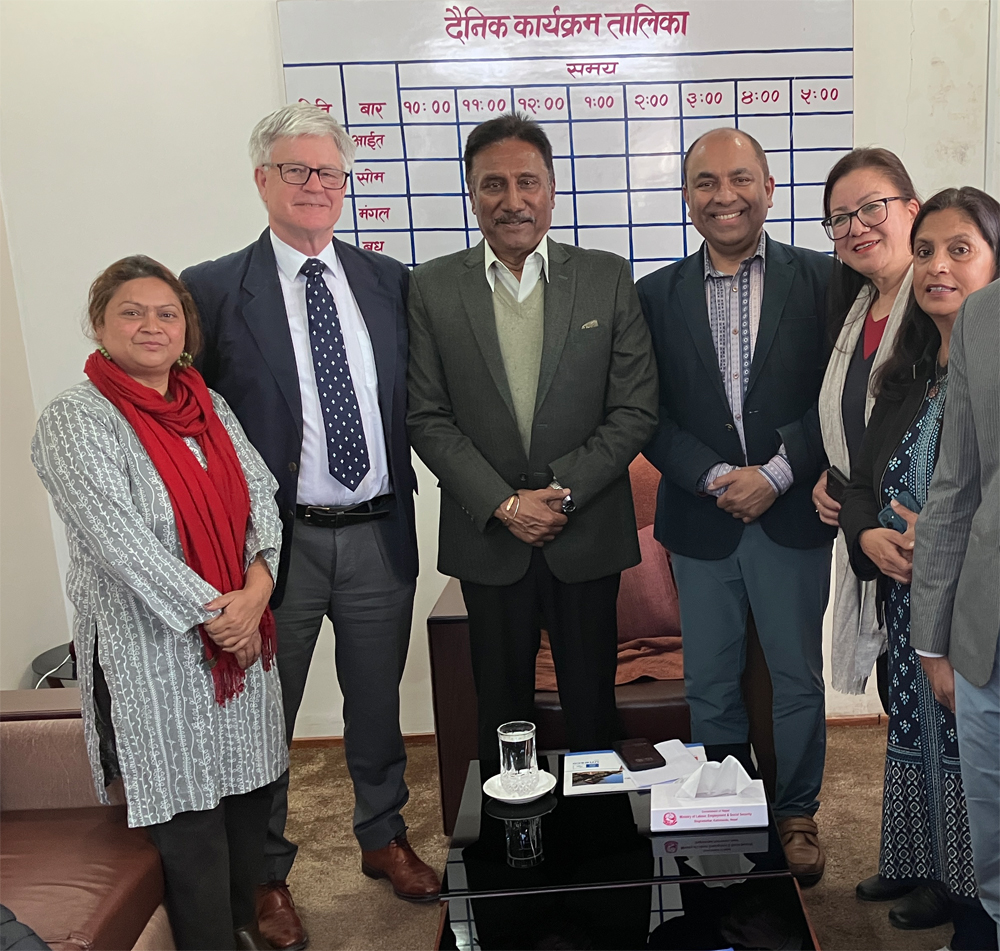
Meeting with Minister Sharat Singh Bhandari, Minister of Labour, Employment and Social Security, and colleagues from Pourakhi
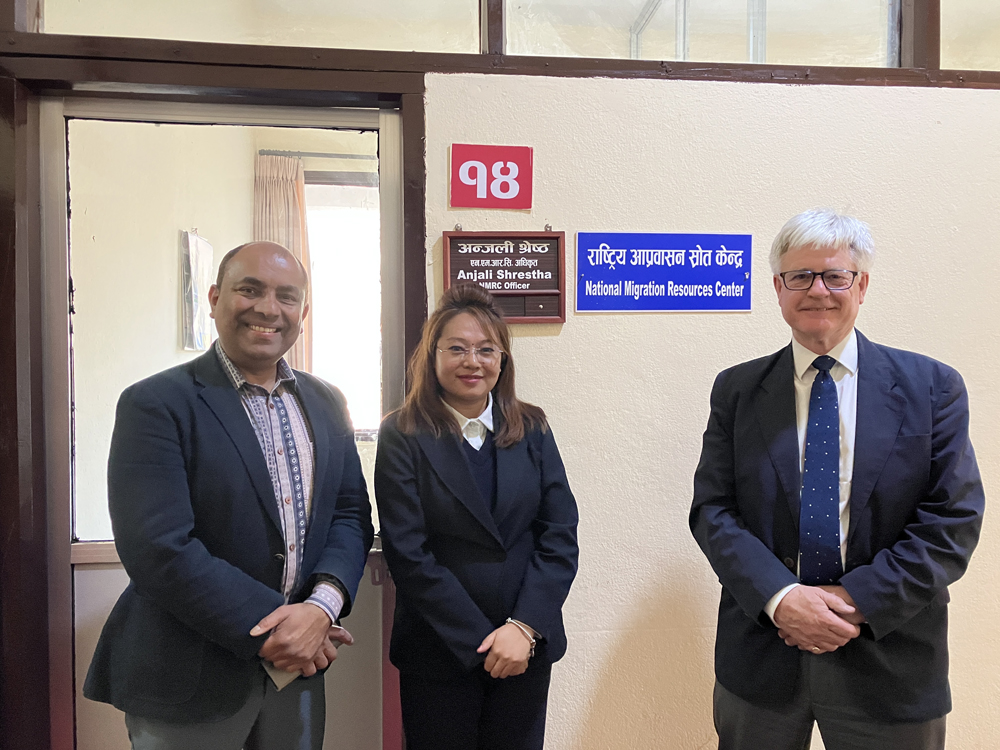
Meeting with Anjali Shrestha, National Migrant Resource Center Officer (NMRC)

During our original MIDEQ project we had developed a set of training resources in the six main languages used in Nepal to empower migrants to use digital tech safely, wisely and securely, with the original intention that these could be rolled out through the training provided by the Migrant Resource Centres (MRCs) in every province of the country. Despite previous meetings with government officials over the previous three years, changes in official roles and the evolution of government policies meant that we had not yet achieved this aim. Persistence and continued commitment nevertheless pays off, and we were delighted that we were able to share information about our work on this visit with the new Minister of Labour, Employment and Social Security, and that our good friend Anjali Shrestha (the National Migrant Resource Center Officer) has committed to finding ways through which counsellors at the MRCs can receive training based on the resources that we have already developed, supplemented by new posters and advice on key messages (see section on new resources being developed with ACORAB below).

Developing our partnership with ACORAB/CIN

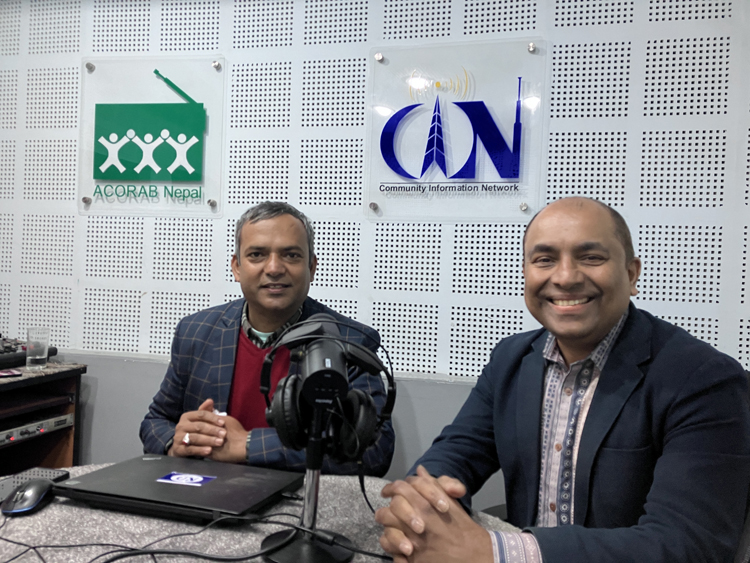
The ACORAB/CIN studio

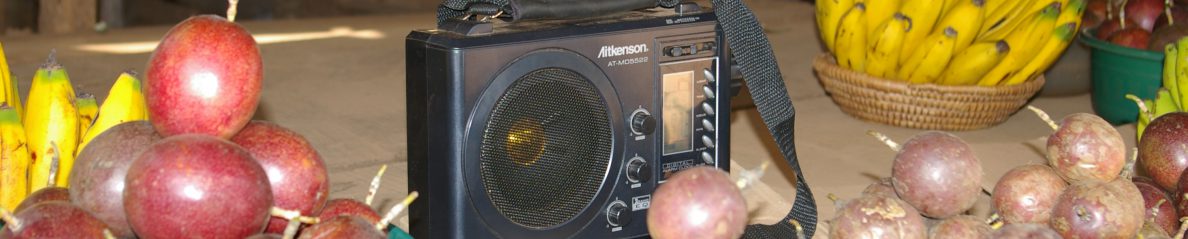
During our initial MIDEQ work we signed an official parntership Memorandum of Understanding with ACORAB/CIN, the Association of Community Radio Broadcasters in Nepal, who helped to disseminate our original resources on the safe, wise and secure use of digital tech to their regular audience of 6.7 million people across the country. We have comntinued to work together in training and advocacy, with ACORAB/CIN for example participating actively in the workshop we held at the WSIS+20 session on the future of community media in Geneva in May 2024. Our latest visit to Nepal helped to cement this relationship, with Tim Unwin delivering a seminar on Community Radio in an Increasingly Digital World, and agreements were also reached on the production and dissemination of new resources on the safe, wise and secure use of digital tech. These will include posters and podcasts on key issues of importance to migrant digital safety and privacy.
Sharing information and exploring new ideas with international organisations
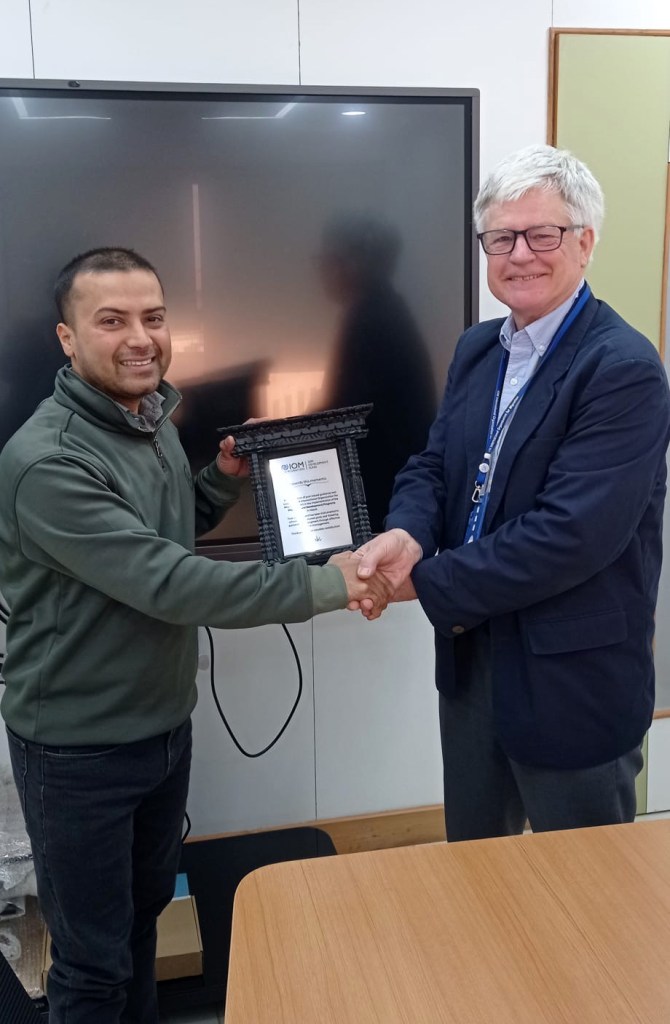
Tim Unwin receiving a certificate of appreciation from Prajwal Sharma at IOM
Meeting with Dollie Shaha at BBC Nepal

We worked closely with colleagues in international and bilateral organisations in Nepal during our original MIDEQ project and this visit provided a valuable opportunity to update colleagues in IOM, UNESCO, and the British Embassy about our work as well as to explore possible future synergies. All too often staff in these organisations move on to new roles and it is therefore very important to develop new personal relationships wtih their successors to ensure that valuable institutional links are maintained. This visit also provided a useful opportunity to meet with staff at BBC Nepal to learn about their work and relationships with ACORAB/CIN.

Meetings with migrant organisations and others involved in our MIDEQ work
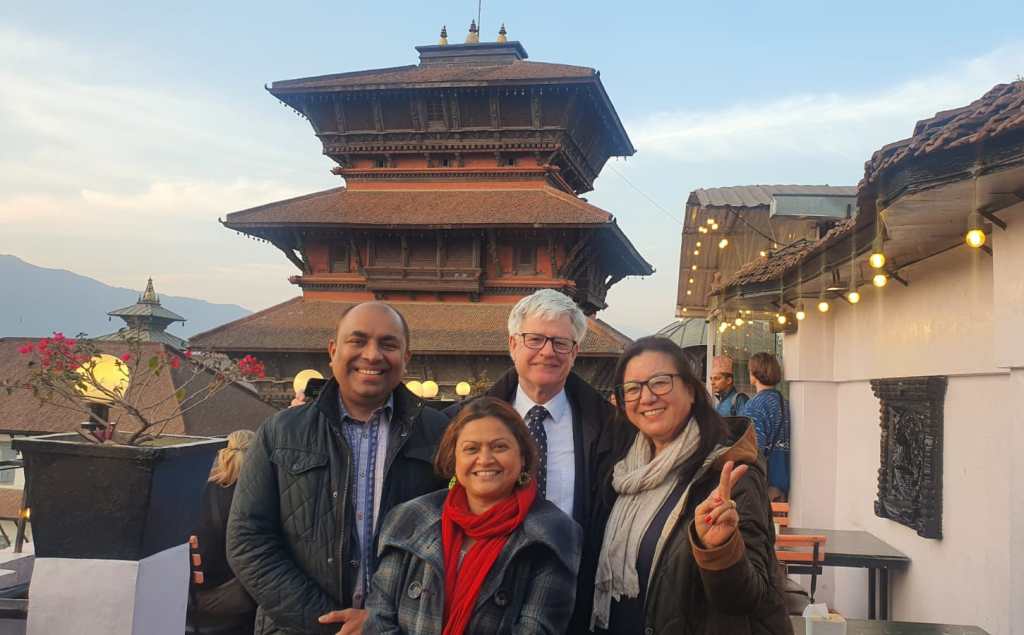
With Manju Gurung and Sindhu Aryal from Pourakhi
With Sanjay Poudel at the National Innovation Centre

One of the main purposes of our visit was to meet with the local migrant organisations wth whom we had worked during MIDEQ to learn more about their current activities and how we might continue to work together both on the pardesi.org.np portal as well as on propagating messages about the safe, and secure use of digital tech. In addition to thos colleagues depicted above and below, we also met with Bijaya Kimari Rai Shrestha from AMKAS and Anita Ghimire from ISER-N.

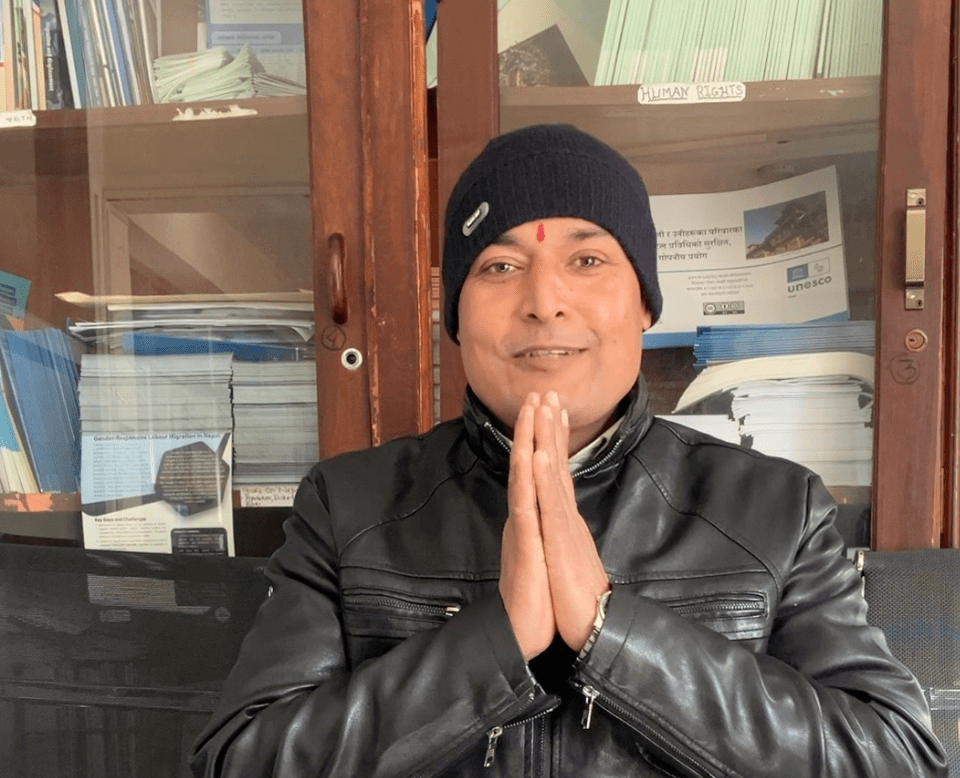
With Aviman Singh Lama from Pravasi Nepali Coordination Committee
With Swarna Kumar Sha from NNSM

Measuring impact and outcomes

Measuring the real outcomes of our work for the lives of individual migrants and their organisations remains difficult. We are very hopeful that as a result of our visit many new initiatives will take place that will help us together to achieve lasting outcomes:

  • Under Pourakhi’s oversight, working with many of our original MIDEQ colleagues, the pardesi.org.np portal will regularlly be updated and enhanced.
  • Our basic resources on the safe, wise and secure use of digital tech will be rolled out for all the counsellors in the 77 Migrant Resource Centres by the end of the year, and awareness raising posters and leaflets in relevant languages will also be made available for them.
  • Our cybersecurity resources for civil society organisations will be translated into Nepali and distributed to relevant organisations in Nepal.
  • ACORAB/CIN will continue to share information about the importance of cybersecurity at individual and organisational level through its support for local community radio stations.
  • At an organisational level, we will continue to work with ACORAB to help them engage appropriately in relevant digitalisation processes, and with IOM in the delivery of their Migration School.

Across all of these initiatives, we have put in place mechanisms to enable us better to understand the outcomes of our research-practice, not least so that we can share further information about what works and what challenges remain so that others can learn from our experiences. We believe that hearing from migrants themselves is one of the best ways to share such understandings (see videos here), and so this post closes with a short commentary from Swarna Kumar Sha from NNSM, the umbrella organization of civil society organizations in Nepal working in the field of labour migration and development, about his experiences of working with us.

Click on image for video

Our new identity as the ICT4D Collective

As of 1st August 2023, the UNESCO Chair in ICT4D at Royal Holloway, University of London has reverted to its original identity as the ICT4D Collective. We are a group of very diverse researchers and practitioners from across the world, bound together by our commitment to the highest possible quality of research-practice relating to the use of digital technologies in the interests of the world’s poorest and most marginalised people.

Meeting staff and students at the NIC's ICT and Electronics Innovation Lab in Pokhara,  Nepal, July 2023
Our last engagement as members of the UNESCO Chair in ICT4D: meeting staff and students at the NIC’s ICT and Electronics Innovation Lab in Pokhara, Nepal, July 2023

The Collective and the UNESCO Chair in ICT4D

The original ICT4D Collective was created in 2004, and evolved through an agreement in 2007 between UNESCO and Royal Holloway, University of London into the UNESCO Chair in ICT4D (Information and Communication Technologies for Development). UNESCO Chairs are groups of researchers in specific institutions undertaking work of direct relevance to UNESCO’s fields of competence, and they promote “international inter-university cooperation and networking to enhance institutional capacities through knowledge sharing and collaborative work”. Members of our UNESCO Chair have been very proud to have been associated with UNESCO for the last 16 years, and to have collaborated closely with many good friends in UNESCO’s Paris headquarters and field offices. We were also honoured that Houlin Zhao, the Secretary General of the International Telecommunications Union (ITU) between January 2015 and January 2023, and Jean Philbert Nsengimana, former Minister of Youth and Information and Communication Technology (MYICT) from Rwanda, were our Honorary Patrons.

The following are some of the things we have particularly enjoyed engaging in over the last 16 years:

  • Working together collegially in a truly multidisciplinary context, involving colleagues from Computer Science, Geography, Information Security, Law and Managament at Royal Holloway, University of London.
  • Creating one of the largest groups of postgraduates completing PhDs in the field of ICT4D during the late 2000s and early 2010s.
  • Crafting an extensive partnership network involving governments, the private sector and civil society, and sharing the lessons we have learnt about making partnerships successful.
  • Contributing our experiences in global discussions around the role of digital tech in international development, especially in the UN’s WSIS process (since its origins in 2003), and UNESCO’s many gatherings relating to education and technology.
  • Playing a leading role in the World Economic Forum and UNESCO’s Partnerships for Education initiative.
  • Working on the ground in support of diverse groups of marginalised people, especially those with disabilities, out of school youth, women in patriarchal societies, and migrants and refugees.
  • Being recognised as the 7th most influential global think tank in science and technology in the Go To Think Tanks Index Report for 2015 (we remained 15th in the 2020 index)

Quick links to aspects of our new identity

We are now re-energised as the ICT4D Collective, with 22 founding members drawn from 13 countries – we welcome new members who share our aims and principles. Quick links to our research and practice are available below:

An exciting future…

We all look forward to continuing the work started by the original ICT4D Collective almost 20 years ago, although we remain very sad that the new leadership team at Royal Holloway, University of London did not see value in the institution continuing to have a UNESCO Chair. Perhaps we represented voices from the past; perhaps we have been too critical and anarchic; perhaps we have just been honest and spoken truth to power. Whatever the reason, we will continue to have fun working together, we will continue to challenge the status quo, we will continue to point out the many harms caused by the use of digital tech, and we will continue to work with and support the world’s poorest and most marginalised peoples.

Digital Environment System Coaliton’s sessions at WSIS Annual Forum 2023

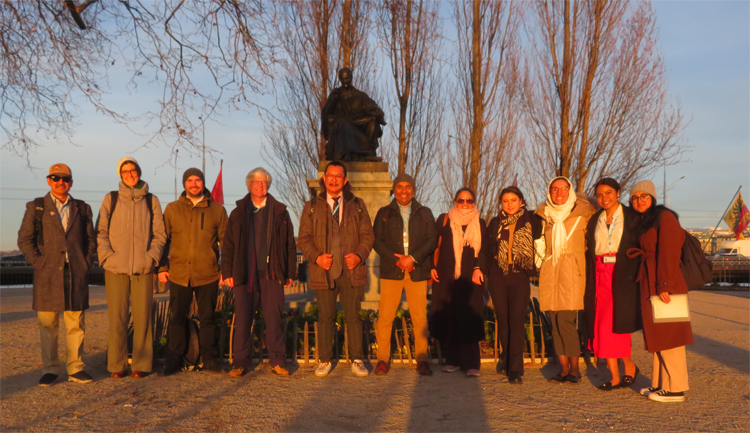
Participants under Rousseau's statue on the DESC Walk in Geneva, 16 March 2023

Particiants on the DESC walk photographes beneath the statue of Rousseau as the sun sets

The Digital Environment System Coalition (DESC) convened two sessions (403 and 204) on 16th and 18th March at this year’s WSIS Annual Forum held in Geneva. The first was a walk which we believe to be the first ever such event held during a WSIS annual forum, and the second was a more traditional session within the cavernous CIGG. Both sessions were convened by the UNESCO Chair in ICT4D at Royal Hollloway, University of London which provides the Secretariat to DESC, in association with INIT (the Inter-Islamic Network on IT), the WWRF (Wireless World Research Forum), ICT4D.AT, and RC-DISC (the Research Cluster for Digital Inequality and Social Change at the University of Canberra).  

Experiencing digital environment interactions in the “place” of Geneva (Session 403): the DESC Walk

We experience things differently when we walk, when we talk together, and when we interact with the real physical environment.  We feel the fresh air on our faces, smell the vegetation, hear the noise of running water, and touch the rough rocks on the slopes.  We interact differently with each other.  We pause and contemplate where we are.  Our minds engage in ways that are so, so different from when we sit in large conference halls.

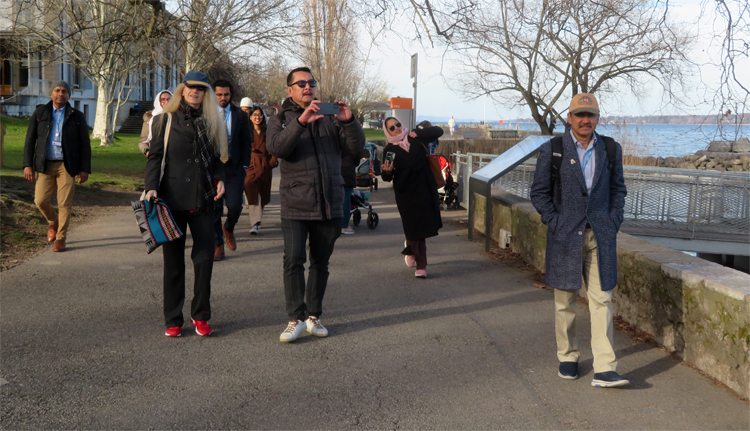
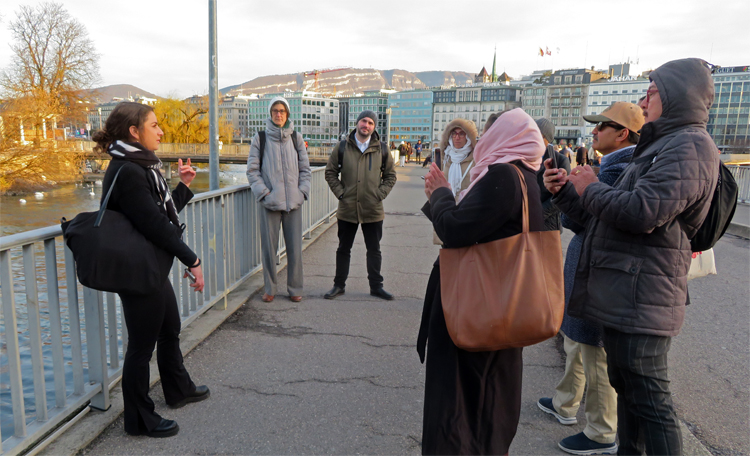
This DESC walk provided an opportunity for participants (i) to share their own research and practice relating to the interactions between digital tech and the environment, (ii) to discuss the positive and negative impacts of digital tech specifically on the biosphere, hydrosphere, atmosphere and lithosphere, and (iii) to make recommendations concerning the further development of YouthDESC.  In essence, individual participants brought the group to a halt at locations that they felt were most appropriate for them along the walk and shared information about themselves and their research/practice, and we also stopped at five pre-planned locations to discuss each of the main themes as a group.  Moderators of each main stop sought to encourage the participants to highlight three positive and three native interactions between digital tech and the environment.

  • Parc Mon Repos – the biosphere (led by Paul Spiesberger).  Issues discussed included the positives of being able to share nature through digital images, use of remote sensed imagery to monitor the biosphere, and the use of digital tech to enhance agricultural production.  Negatives included digital pollution of plants and green spaces, potentially adverse effects on human health (including mental health), and increased urban exploitation of rural environments through digital tech.
  • Poste Filial – YouthDESC (led by Tasfia Rahman).  This began with a visit inside the building to discover the ways through which it is now necessary to use virtual/digital systems to post a physical/real card.  We also recognized the important links between postal communication in the past and digital communication at present.  The Instagram account of @YouthDESC was discussed, alongside the pros and cons of different social media platforms for engaging youth
  • Pont des Bergues – the hydrosphere (led by Ahmed Imran).  It was recognised that unlike the biosphere and lithosphere, the impact of digital tech on the hydrosphere is less immediately visible.  However, negatives include the impact of deep sea mining for rare earth minerals, and the heating of water in cooling systems.  The use of water warmed by the heat produced by servers was, though, also seen as a benefit.
  • Ile Rousseau – the atmosphere (led by Zumana Imran).  Beneath the feet of the philosopher Rousseau, our thoughts turned to the atmosphere above us, and focused on the positives of the use of satellites for monitoring environmental change and enabling communication in isolated places, whilst also recognizing the harms of treating outer space as we used to treat the oceans (global commons), the impact on dark space, and space junk.  It was also recognised that different cultures have differing views about the environment, and we must engage with indigenous communities.
  • Auditoire de Calvin – the lithosphere (led by Tim Unwin).  As dusk came upon us, few people remained to walk up the steps to the Cathedral and Auditoire de Calvin, but we nevertheless discussed the impact of mining for minerals used in digital tech, the impact of waste especially in landfill, and also the potential benefits in land management.

Scenes from the DESC walk in Geneva, 16 March 2023

Reimagining the Interface between Digital Tech and the Physical Environment (Session 204)

This formal workshop session had three main aims:

  • to share an updated overview of DESC’s emerging model that challenges much existing work being undertaken on digital tech and climate change;
  • to provide an update on its ongoing activities since WSIS 2022; and
  • to do this in a lively and interactive way.

Official ITU photograph from WSIS Session 204

The session was structured as follows:

  • Introduction to DESC, highlighting the need to adopt a holistic approach focusing on the interaction between digital technologies and the totality of the physical environment (including the lithosphere, hydrosphere, biosphere and atmosphere – see diagram below) rather than just climate change.  Indeed, a focus primarily on  human-induced climate change is likely to lead to seriously adverse impacts on other dimensions of the physical environment.
  • Summaries of the key points of discussion explored during the DESC walk (WSIS Session 403) the previous day, presented by the five discussion moderators (including the YouthDESC session).
  • Highlights of two examples from the activities of DESC’s Working Groups emphasizing why these issues matter:
    • The indigenous DESC Working Group (Poline Bala’s sliodes were presented by Tim Unwin).  This highlighted that indigenous peoples are insufficiently represented at events such as WSIS, and that they can contribute significantly to new ways of addressing the interface between digital tech and the physical environment
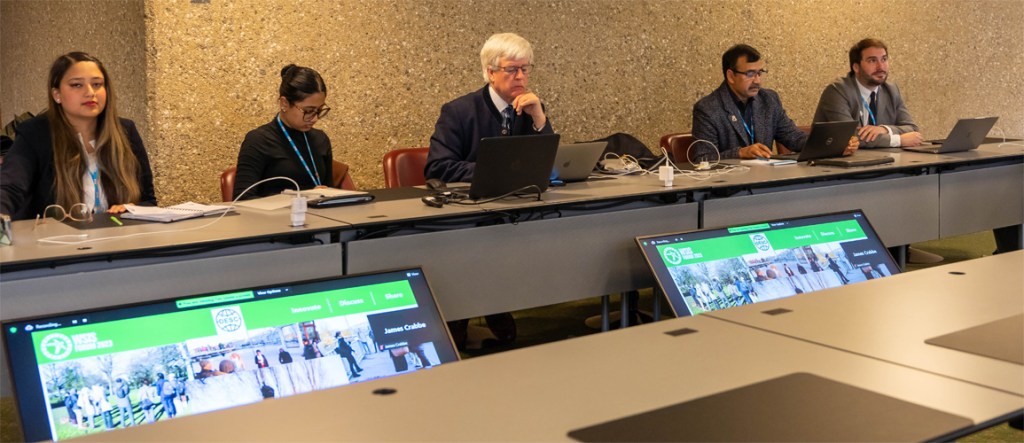
    • A video presentation by James Crabbe on the importance of omics for informing policy on deep sea mining.
  • This was followed by an introduction to the toolkit being developed by DESC for all those who have pledged to the ITU-led Partner2Connect initiative to enable them to consider and address the environmental impact of their proposed interventions.
  • The final element was a lively discussion around the issues raised, that included new commitments from participants to explore collaboration on implementing the DESC toolkit

DESC in Geneva

The general consensus from both sessions was that they were enjoyable and informative – and that DESC should offer to convene another walk in 2024 when we can delve once again into both the positive and negative impacts of the design and use of digital tech on the environment.

Get to know…GCRF and Professor G. Hari Harindranath and Professor Tim Unwin

This post was first published on the Royal Holloway, University of London Staff Intranet on 2nd March 2021, and is being reposted here since it provides a good overview of the work being done on migration, technology and development as part of the UKRI GCRF funded MIDEQ hub by Hari Harindranath and Tim Unwin from the UNESCO Chair in ICT4D.

Professor G. Hari Harindranath, School of Business and Management, and Professor Tim Unwin, Department of Geography, received GCRF funding for their project ‘South-South Migration, Inequality and Development Hub’. We recently caught up with Hari and Tim to ask more about the project and how they both got involved. 

1.  Can you tell us a bit about yourselves and your roles at Royal Holloway?

Hari – I am a Professor of Information Systems in the Department of Digital Innovation and Management, School of Business and Management. I also serve as the Director of Internationalisation for the School.

Tim –  My role is Emeritus Professor of Geography (since 2011) and Chairholder of the UNESCO Chair in ICT4D (since 2007). I was Head of Geography (1999-2001) and then went on secondment to DFID (2001-2004) where I led the PM’s Imfundo initiative, creating partnerships for the use of technology in education in Africa. Subsequently, I was Chair of the Commonwealth Scholarship Commission and then Secretary General of the Commonwealth Telecommunications Organisation (2011-2015).

2. GCRF funded the ‘GCRF South-South Migration, Inequality and Development Hub’ that you both work on, can you tell us more about the GCRF Hub?

The MIDEQ Hub (Migration for Development and Equality; 2019-2024) funded to the tune of £19,863,201 (FEC) by UKRI-GCRF and led by the PI Heaven Crawley (Coventry University) aims to understand the experiences of migrants in Africa, Asia and Latin America, focusing especially on six contrasting migration corridors (Haiti-Brazil, China-Ghana, Ethiopia-South Africa, Nepal-Malaysia, Burkino Faso-Côte d’Ivoire, and Jordan-Egypt).  MIDEQ involves some 40 organisations and includes 128 researchers, with eleven multi-disciplinary work packages cutting across these 12 countries, focusing on issues such as gender and childhood inequalities, migration intermediaries, resource flows and arts, creative resistance and wellbeing.

Hari contributing to research planning in Accra

Hari (in the pink shirt) contributing to the Hub’s research planning discussions in Accra (2019) (Photo by Tim).

3. Can you tell us about the parts you play in the Hub and the work package that you lead/are involved in?

We lead an “intervention” work package, focusing on the interface between digital technologies, inequalities and migration, but participate in all aspects of the Hub’s work and provide advice and support especially on the use of digital tech. Hari is also a member of the Hub’s Management Board and on the Data Management team, and Tim is one of the two safeguarding confidants. Our research is in three phases: understanding how migrants use digital technologies, understanding what inequalities they might like to change, and then working with migrants and tech developers to create some intervention that may help reduce inequalities.  We are in the first instance working in the first four of the corridors listed above, but may well only work in two of them for phase three, depending on logistics and the findings we make over the first three years.

4. The Hub award involved a number of universities and stakeholders working together, how did you collaborate and distribute the work?

Working together with so many partners has no doubt had its challenges! Overall, the matrix structure of having six corridors (each with two country leads) intersecting with 11 work packages (each with one or two CoIs) provides the basic framework for our work. The initial group of partners was brought together by the PI and we co-created the proposal to UKRI GCRF, but within the first year two of the country lead organisations had fallen by the wayside and had to be replaced. Two week-long face-to-face meetings of all partners in Ghana and Nairobi in 2019 were crucial to enabling us to get to know each other, and not least create some empathy and understanding of our varying skills and ambitions. This was important in helping us choose the priority corridors in which we would subsequently work. Challenges remain not least in relation to the difficulties of working on the ground with country teams due to the pandemic. 

Shaping empathy through storytelling

Shaping empathy through storytelling around the fire in Kenya (2019) (Photo by Tim).

5. Can you tell us about some of the difficulties faced by the migrants that you work with?

This is an enormous question, that has many different dimensions. COVID-19 has dominated everything over the last year, and has generally made the lives of migrants very much harder. For example, in Malaysia many migrants were rounded up in the early stages of the pandemic and put into camps so that they would not spread the disease to local citizens. Likewise, the lockdowns in South Africa have made life increasingly difficult, especially for migrants.  Across all of the corridors, legal movements of people have been drastically reduced, and this has made life very hard for migrants who were planning to return home. Interestingly, though, there is some evidence from Haiti that migrant remittances although hit significantly in the early days of the pandemic have now returned to levels similar to what they were before.

6. You were both looking at technological ways of improving the lives of migrants, can you give us an example of this?  

When we first joined the Hub our partners mostly thought that our role was to develop an app based largely on the research conducted in the early stages of MIDEQ. This is very far from our intention. Indeed, the early evidence of our research has shown that most apps developed “for” migrants are rarely if ever used by them! Instead, a key principle underlying our research and practice is that we should be the servants of the migrants, understanding how they would like to reduce inequalities, and then working with them and local tech developers to craft and implement some digital intervention. If we discover that one of the biggest fears of migrants is that tech will be used to track and control them, we might even suggest that alternative non-digital interventions might be wiser. Although that it is unlikely, we remain very open, and are working with international agencies such as the IOM, ILO and ICRC to explore how the apps that they are already developing might be improved. However, the pandemic has most certainly affected our work. It is not exactly easy to ask migrants about their digital technology use when migration and mobility have been the first to be impacted by COVID-19. 

7. What have we learnt most from working within the Hub?

Hari – I have found the experience of working in such a large multidisciplinary Hub both rewarding and challenging; rewarding because of the opportunities to work in such diverse contexts with some great colleagues and challenging because of the different assumptions people have about how that work should be done in the first place! I have learnt that perseverance is key to making any headway.

Tim – I have especially learnt to listen more! All of the partners come from very different backgrounds and have a wide range of experiences. This is an incredible opportunity for us to learn from each other – at least for those of us who realise that we still have much to learn! A project of this size has enormous challenges, and it is easy to criticize, but if we are going to be successful it is very important that we all try to pull together and be supportive of each other. We also come from very different cultures, and it is very easy to cause offence accidentally – so we must be willing to forgive others in the hope that they will also forgive us. However, none of us will ever get on with everyone, and so we need to recognise this and concentrate our efforts on working with those we like and respect.

Accra 2019

MIDEQ Hub soft launch (Accra, 2019).

8. Have you found ways to share experiences more widely within College? 

We have tried to be as open as possible in sharing our research practices and have also helped some colleagues across the College by providing advice about their own GCRF applications. We have collaborated in College workshops relating to GCRF activities, and Tim has also provided safeguarding training and advice to different groups of colleagues. We have also been able to secure College funds to bring some of our MIDEQ partners for wider networking on campus although this has had to be postponed due to the pandemic.

9. Is there anything you wish you had done differently?

Not really, other than having ensured we had enough funds to be able to do what we really wanted to! The budget for a project this size might seem a lot, but when broken down between the partners it is really insufficient to deliver what we would like. We have, though, been very flexible in our approach, and this has enabled us to act differently in order to ensure that we still deliver. Thus, in 2020 we had planned to spend much time in the field, especially in South Africa, Ghana, Nepal and Malaysia, where we had intended to undertake qualitative and hermeneutic research with migrants. COVID-19 prevented this, and so we had to rethink radically our approach. As a result we developed an online survey for migrants and their families in each of the countries with which we are working, and our partners (and many others) have helped share this widely. This has been more successful in some countries than in others, and the resultant quantitative data are very different from what we had intended, but this has at least enabled us to have evidence from the first phase of the research that we can then hopefully take with us into phase two when we are able to travel overseas again.

10. How do you both like to spend your time outside work?

  • Hari: The past year has been difficult as I have been shielding quite strictly. This has restricted possibilities but spending more time with the family has been a source of great comfort during the pandemic. Joining the RSPB and discovering the variety of avian life in our garden has been magical.  
  • Tim: I have always been lucky never to have drawn a real distinction between work and other aspects of my life.  I love my work-life, and the last year has been a great opportunity to write – including two 275-page reports!  However, I also enjoy wine – and have started writing a wine column again for a local magazine – and I am fortunate enough to have a garden where I grow some of the vegetables and fruit that we consume.  I also enjoy walking in the mountains, and exploring new places, but that’s not been something I have been able to do over the last year![1]

[1] This last section (10) from our draft response to the questions was not included in the originally published post, but we have added it here to provide a more rounded insight to our work – and play.

To find out more, do look at the MIDEQ site, and also the UNESCO Chair in ICT4D’s material on our work at the interface between digital technologies, migration and inequalities – this includes lots of resources (especially links to relevant materials) that we are making available through our research work. Do get in touch with us through our Contact Page.

Members of UNESCO Chair in ICT4D to play leading roles in DFID’s multi-country directorate for research and innovation hub on technology for education

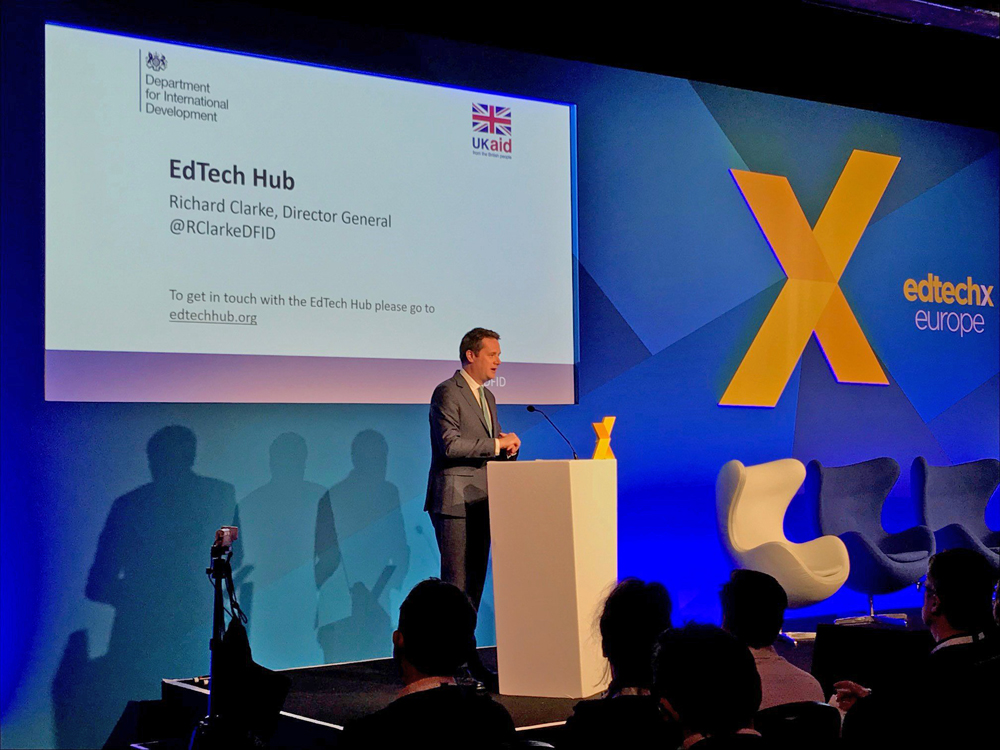
DFID AnnouncementRichard Clarke, Director General for Policy, Research and Humanitarian at the UK’s Department for International Aid (DFID) announced today that a consortium involving Dr. David Hollow and Tim Unwin, both from our UNESCO Chair in ICT4D, has been awarded the contract to lead its new £20 m research and innovation hub on technology for education.  This will explore how the world’s most marginalised children and young people can learn best through the use of new and innovative technologies.  The members of the consortium are the Overseas Development Institute, the Research for Equitable Access and Learning (REAL) Centre at the University of Cambridge, Brink, Jigsaw Consult, Results for Development, Open Development and Education, AfriLabs, BRAC and eLearning Africa.  David will serve as Research Co-Director and Tim as Chair of the Intellectual Leadership Group.

The new Hub aims to undertake and promote the highest quality of comparative and longitudinal research at the interface between technology and education, and then share the findings widely so that everyone is better aware about how technology can best serve the learning interests of the poorest and most marginalised.  This builds in part on the UNESCO Chair in ICT4D’s long established experience on technology and learning, dating back to Tim’s leadership of the UK Prime Minister’s Imfundo initiative (2001-2004) creating partnerships for IT in education in Africa, our DelPHE and EDULINK funded collaboration with African universities, the wider work of the World Economic Forum and UNESCO Partnership for Education initiative between 2007 and 2011, and the cohort of PhD students doing research at the UNESCO Chair in ICT4D on technology and learning in Africa in the latter 2000s , including David Hollow and Marije Geldof.

We are all very excited to be a part of this new initiative, which will be the largest ever education and technology research and innovation programme designed specifically to improve teaching and learning, especially in poorer countries.  It is a clear example of the ways through which research undertaken within the UNESCO Chair in ICT4D is having real global impact, and is the second £20 m grant to have been awarded to consortia that include members of the Chair in the last six months, the other being the UKRI GCRF South-South Migration, Inequality and Development Hub.

TEQtogether workshop at WSIS 2019: changing men’s attitudes and behaviours to women and technology

TEQtogether 1Members of TEQtogether, working with colleagues in the UNESCO Chair in ICT4D, were delighted to have convened a workshop on 11th April at WSIS 2019 in Geneva on Changing men’s attitudes and behaviours to women and technology.  This represents part of Royal Holloway, University of London’s commitment to the global EQUALS partnership designed to increase gender digital equality.  The session began with three short opening presentations:

  • An overview of the work of TEQtogether
    • informing men about how their actions impact digital gender inequality (see  Resources and Other Initiatives pages);
    • Identifying actions that men can take to enhance gender equality in the tech workplace (see  Guidance Notes)
    • Recommending actions that men can take to reduce digital violence against women
    • Encouraging reverse mentoring through which women mentor men at all levels in tech organisations.
  • An introduction to TEQtogether’s Guidance Notes by Paul Spiesberger (ict4d.at), focusing especially on guiding for when running a computer programing workshop
  • An overview of work on the use of mobiles for sexual harassment by Bushra Hassan (International Islamic University, Islamabad).

TEQtogether 2The main part of the workshop then built on these presentations to discuss what needs to be done to change men’s and boys’ attitudes and behaviours towards women and girls in technology.  The co-created mindmap developed during the workshop is illustrated below (link to detailed .pdf file of the mindmap).2 Changing men’s attitudes and behaviours to women & technologyThe four most important issues identified that require attention were:
  • Education (especially gender sensitivity materials and unconscious bias)
  • Family roles (especially in early life)
  • The resocialization of men
  • Tech industry and employment

A second tier of issues focused on:

  • Cultural change – takes time
  • Diversity and inclusion
  • Awareness raising
  • Role models (both men and women)
  • Virtual reality (so that men can experience the difficulties faced by women)
  • Legislation
  • Practical women’s empowerment.

TEQtogether is committed to take forward actions that will make a difference to all of the above, through its guidance notes and future workshops.

UNESCO Chair in ICT4D at WSIS Annual Forum 2019

Screenshot 2019-03-27 at 22.33.08.pngMembers of the UNESCO Chair in ICT4D and TEQtogether are playing an active role in this year’s WSIS Annual Forum between 8th and 12th April in Geneva.  We are delighted to be involved in the following sessions:

  • Workshop with the Inter-Islamic Network on IT on Digital technologies and accessibility: from rhetoric to reality as part of the special WSIS Accessibility day on Monday 8th April (Room T103, 0900-10.45)
  • Moderating Academia Round Table Action Line C4 Facilitation Meeting on Capacity Building, New teaching approaches for higher learning in the digital era,  (Room L2, 11.00-13.00)
  • Moderating High Level Policy Session on Gender Mainstreaming on Wednesday 10th April (Session 10, Room 2 CICG, 10.00-11.00)
  • Panellist in EQUALS session on How ICTs could be useful tools against gender discrimination, Thursday 11th April (Room C2, 11.00-13.00)
  • TEQtogether workshop on Changing men’s attitudes and behaviours to women & technology, with the New York Academy of Sciences and Global Scribes, Thursday 11th April (H2, 14.30-16.15) as part of our contribution to EQUALS.
  • Delivering one of the inaugural WSIS TALKX

Please do join us for these sessions.  We intend to try to make them as interactive and participatory as possible!

Inception meeting of UKRI GCRF South-South Migration Hub in Ghana

The UNESCO Chair in ICT4D, represented by Dr. Hari Harindranath and Tim Unwin, is excited to be participating in the inception meeting of the UKRI GCRF South-South Migration, Inequality and Development Hub, being held at the spacious University of Ghana Campus in Legon.  The multidisciplinary Hub, led by Professor Heaven Crawley from the University of Coventry, is committed to “doing development research” in new and different ways, and this inception meeting is living true to that aim – with the first morning being illuminated by music, art and poetry, as well as lively discussion.

The first day is focusing on how the more than forty partners will work together as well as getting to know those colleagues leading on the various corridors and work packages.  The second day will focus on issues such as research ethics, the baseline survey and our communication strategy, and the entire final day will be devoted to safeguarding issues.

We hope that the pictures below catch something of the diversity, energy and expertise of those participating in this fun-packed gathering.  The dancing starts later…

This slideshow requires JavaScript.

UKRI copy

GCRFsmall

The UNESCO Chair in ICT4D: research, policy and practice

We are delighted to share this new poster prepared for the UNESCO Chair in ICT4D by Jen Thornton, highlighting the aims of our research and how these influence policy and practice.  Especial thanks too to our friends Sanna Ojanperä and Mark Graham at the Oxford Internet Institute for preparing the map on the latest figures for the relative costs of fixed broadband subscriptions across the world.  Put simply, we try to do the best possible quality of research with, and in the interests of, the poorest and most marginalised.

ICT4D_2

For a high resolution .pdf version, please click here.

UNESCO Chair in ICT4D at EQUALS annual meetings in New York

30977455738_16795cafc3_oRoyal Holloway, University of London, was one of the earliest  partners to join the EQUALS global partnership in 2016, and has largely been represented in the partnership by members of the UNESCO Chair in ICT4D.  EQUALS is “a ground-breaking global network delivered by a committed partnership of corporate leaders, governments, non-profit organizations, communities and individuals around the world working together to bridge the digital gender divide – by bringing women to tech, and tech to women – and in so doing, bettering the lives of millions worldwide”.  Its activities are grouped into three coalitions (Skills, Leadership and Access) and a Research Group, with Royal Holloway being most active in the Skills Coalition and the Research Group.

30977455818_32711a3151_oEQUALS holds its annual Principals’ Meetings in the margins of the UN General Assembly (UNGA), and this year Royal Holloway was represented by the Chairholder of the UNESCO Chair in ICT4D.  The Principals’ Meeting on 22nd September discussed the progress made by all of the coalitions, and particularly the publication of the Research Group’s report entitled Taking stock: data and evidence on gender equality in digital access, skills and leadershipMembers of the UNESCO Chair in ICT4D have been active in the preparation of this report, and the section written by Liz Quaglia and Ashley Fraser on A gender perspective of security and privacy in the digital age was particularly noted by the Rector of the United Nations University (UNU) in his speech launching the report.   EQUALS now has more than 70 partners, and before the Principals’ Meeting, there was a welcome event for new members.  In the evening many of us also gathered for the  EQUALS in Tech awards ceremony, which celebrated the activities of global initiatives in skills, access, leadership and research that have helped deliver the overall objectives of EQUALS.
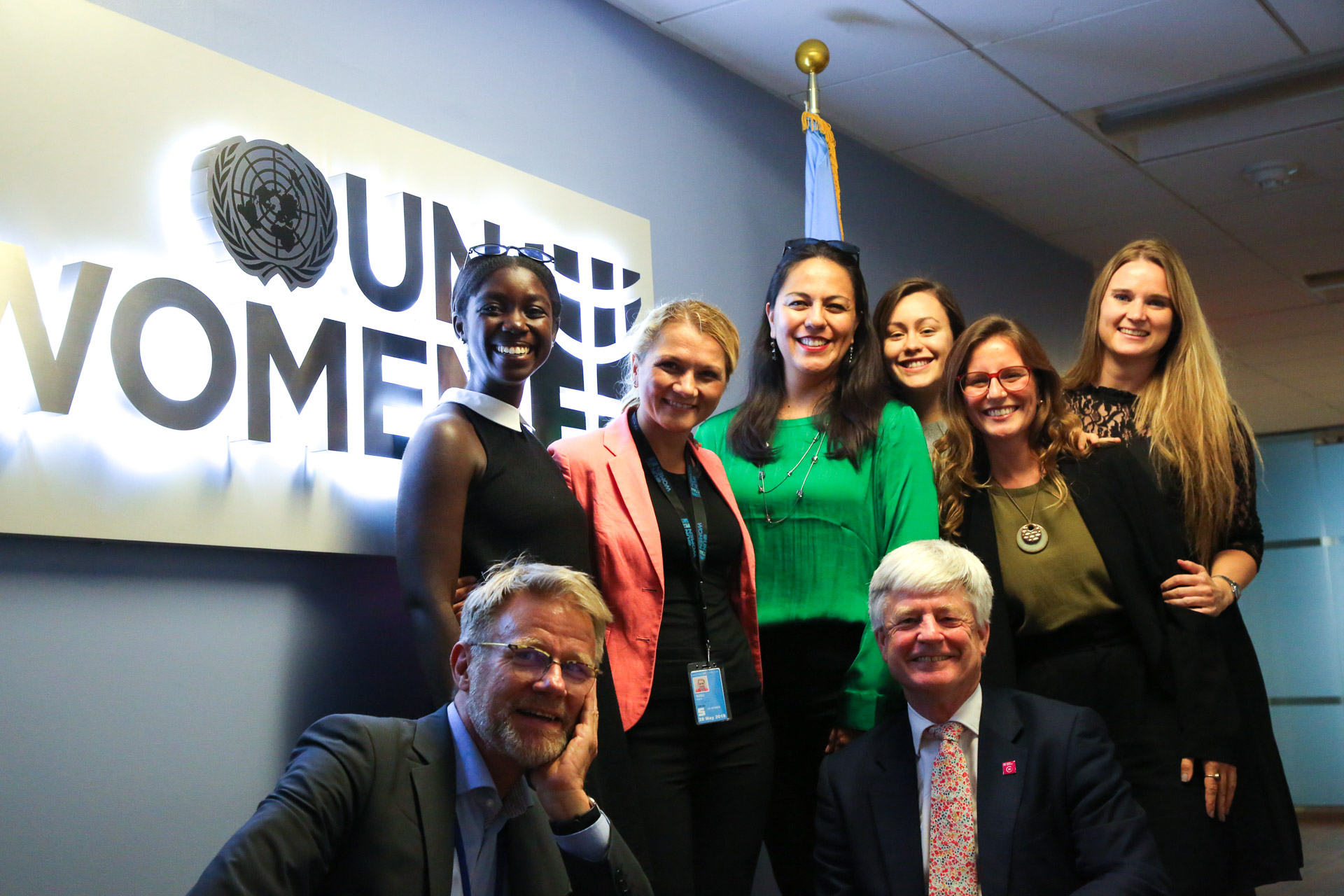
43941036125_cdf0d24a59_oWith so many EQUALS partners present in New York this was also an opportunity for members of the Skills Coalition and the Research Group to meet to review progress and plan for the future.  We were all very grateful to UN Women for hosting these meetings, and much progress was made in moving the initiative forward.  In particular, there was widespread support at the Skills Coalition meeting for the need to change men’s attitudes and behaviours, and the UNESCO Chair in ICT4D’s new TEQtogether initiative, soft-launched at this event, was strongly supported.  Indeed, the Skills Coalition has subsequently agreed that a group of its partners would have this theme as one of its deliverables for the next couple of years.
Royal Holloway, University of London’s formal commitments to EQUALS for 2018-19 are:

  • Research Group: membership of, and active contribution to, Research Group – e.g. one chapter in 2018 report, as well as two people undertaking editorial work.
  • Skills Coalition: support UNESCO in the development of the outputs through active participation in meetings, including continued participation in Mobile Learning Week.
  • Other Coalitions: support Access and Leadership Coalitions and their deliverables by sharing knowledge and resources.
  • Implementation and testing: application of tools developed by skills coalition with students and staff at Royal Holloway, University of London (c.9,500 students and 1,700 staff)
  • Additional Initiatives: Development of women in science database, and TEQtogether

We are all delighted to be able to contribute to this important initiative on behalf of Royal Holloway, University of London.

ITU and UNESCO Chair in ICT4D session at WSIS Forum 2018: International decision-making in ICT – where are the women?

The ITU is strongly committed to achieving gender equality across its organisational structures, and has been one of the driving forces for achieving gender equality in and through ICTs across the world, not least through its involvement in creating the EQUALS initiative.

One of the key international gatherings convened by the ITU has been the series of World Radiocommunication Conferences held periodically to reach international agreements on Radio Regulations, with new and revised Resolutions and Recommendations.  Traditionally, these have been very male dominated, and the ITU has therefore taken steps to encourage greater involvement of women at all levels in its decision-making processes.  One aspect of this has been the creation of the Network of Women for WRC-19 (NOW4WRC19), led by Dr. Hanane Naciri, which aims to encourage increased participation of women in the conference being held in 2019.  Its main objectives are to have a better gender balance among delegates, to prepare women for key roles in WRC-19, and to grow the women’s community capacity and contribution.

As part of this process, the ITU and the UNESCO Chair in ICT4D convened Session 113 at the WSIS Forum 2018.  This began with a lively panel discussion, opened by Dr Hanane Naciri (Radiocommunication and Software Engineer, Radiocommunication Bureau, ITU), with Sahiba Hasanova (Vice-Chairman, ITU-R Study Group 4 / Leading Adviser, Ministry of Transport, Communications and High Technologies, the Republic of Azerbaijan), Caitlin Kraft-Buchman (CEO/Founder Women@theTable, Geneva, Switzerland) and Brigitte Mantilleri (Director of the Equal opportunities office of the University of Geneva).  The speakers shared some of their experiences of leadership in the field of ICT, commented on the challenges facing women who wish to participate in such events, and suggesting what needs to be done to involve more women at all levels in such processes (summary).

workshop

Building on these inspirational introductions, participants then shared their experiences, insights and suggestions for what still needs to be done to ensure that women contribute fully and appropriately to international ICT decision making, and especially to WRC-19.  Twelve themes were identified, and these were captured in a mind map which is available on the ITU and UNESCO Chair in ICT4D sites:

  • Top leadership and champions: it is essential that top leadership supports the increased participation of women, and that champions are identified who can promote such participation;
  • Ensuring that women are in powerful positions: women need to be supported throughout their lives, and particularly encouraged to take leadership roles;
  • Building and promoting networks: it is essential that we work together in intergenerational networks that can support and advise women participating in such decision-making activities;
  • Involving men: we must have male feminists as well as female ones who are willing to help change attitudes and cultures of oppression;
  • Training: more effective training programmes are necessary, particularly ones that help men to understand the relevant issues;
  • Organisational structures: addressing elements of organizational culture is key, and it is important to equip women to survive and flourish in the environments where they work;
  • Awareness and communication: the need to provide much more information about how women can contribute to such decision-making gatherings, and to confront people who have negative behaviours;
  • Changing norms: the need to address and revisit many underlying assumptions;
  • Incentivisation: the need to provide incentives to organisations and individual women to participate in such events;
  • The role of recruitment: recruitment agents can play a key role in ensuring balanced interview panels and processes, and in supporting a charter code of practice on gender;
  • Remember that inclusion is not the same as diversity: diversity is not enough and we need to be inclusive to ensure that women feel comfortable in whatever environment they find themselves; and finally
  • Recognising it may not happen overnight: given how slow change has been so far, we need to recognize it may not happen swiftly, but we must develop the momentum so that it will happen as quickly as possible.

Participants were committed to supporting EQUALS and working with the ITU to ensure that there is much greater involvement of women at all levels in WRC-19.

The UNESCO Chair in ICT4D at EQUALS Research Group meeting in Macau

EQUALS is a global initiative committed to achieving gender equality in the digital age.  5Its founding partners are the ITU, UN Women, UNU Computing and Society (UNU-CS) institute, the International Trade Centre, and the GSMA, and Royal Holloway, University of London, is one of the first group of 25 partners for the initiative.  We were delighted that the Principal of Royal Holloway, Professor Paul Layzell, was able to attend the first Principal’s meeting in New York during the UNGA in September 2017 (image to the right).  There are three Coalitions within EQUALS, for Skills (led by GIZ and UNESCO), Access (led by the GSMA) and Leadership (led by the ITC), and these are supported by a Research Group, led by the UNU-CS.  The UNESCO Chair in ICT4D has been very active across all areas of EQUALS’ work since its original conception during the discussions held at the WSIS Forum in May 2016, and has been particularly involved in contributing to the work of the Skills Coalition.

The first face-to-face physical (rather than virtual) meeting of the Research Group was convened by the UNU-CS in Macau from 5th-6th December (official press release), and it was great that the UNESCO Chair in ICT4D could be represented by both Liz Quaglia and Tim Unwin at this meeting.  This week’s gathering brought together researchers and policymakers from 21 organizations around the world. It established the group’s research agenda, drafted its work plan for 2018, and finalized the content and schedule of its inaugural report due to be published in mid-2018.  In particular, it provided a good opportunity for researchers to help shape the Coalitions’ thinking around gender and equality in the three areas of skills, access and leadership, and also to identify ways through which they could contribute new research to enable the coalitions to be evidence-led in their activities.

This slideshow requires JavaScript.

Huge thanks are due to Araba Sey, who convened the meeting with amazing enthusiasm, insight and professionalism, and all of the other staff at UNU-CS who contributed so much to the meeting.  It was a great occasion when some of the world’s leading researchers in gender and ICTs could meet together, not only to discuss EQUALS, but also to explore other areas of related research, and to build the trust and openness necessary to increase gender equality both in the field of ICTs, and also through the ways that ICTs influence every aspect of people’s lives.