Above all, this Report begins with the education and not the technology
Read the full report here.
Listen to the executive summary here.

Members of the UNESCO Chair in ICT4D have worked hard with colleagues across the world over the last six months to craft an innovative and practical report for the UK’s FCDO and World Bank funded EdTech Hub on ways through which governments can learn from their experiences of COVID-19 to create resilent education systems that use digital technologies wisely, effectively and appropriately. We are all very excited to see this now published.
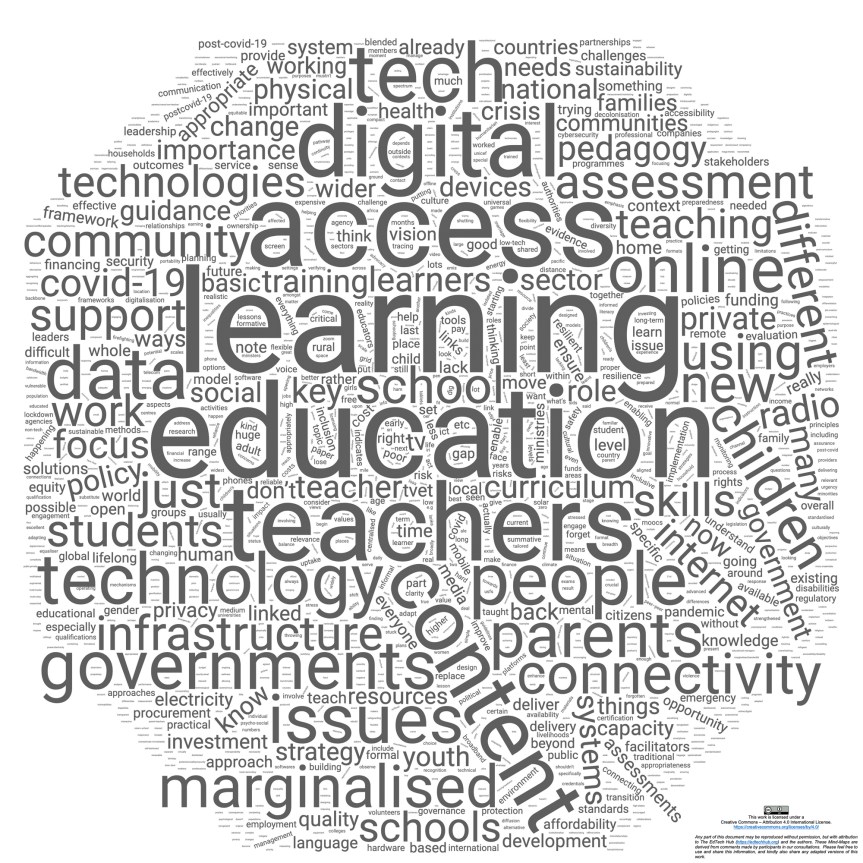
The report was based in part on extensive consultations with a group of 43 women and 44 men from 34 countries who contributed their insights and experiences, captured in this word-map designed by Paul Spiesberger,
The report is published in three Acts:
- Act One: Executive Summary (a 40 minute .mp3 audio file of the Executive Summary is also available; and a French version is currently in production)
- Act Two: The Complete Report
- Act Three: 14 Guidance Notes on specific themes of relevance, such as Resilient and Sustainable Energy Solutions, and Inclusion and Accessible Learning for People with Disabilities.
Additional details about the Report’s production, and all of the material in different formats is available here.
The report’s main recommendations focus on five main areas (shown in green in the diagram with which this post begins):
- A whole society approach: delivering equity in education
- Enabling access for all: building appropriate resilient infrastructures for education
- Being context specific: technologies and content
- Ensuring appropriate pedagogies: the practices of teaching and learning
- Making wise use of technology: security, privacy and data
Pilot projects using digital technologies for education should not be done where they are easiest to do and are most likely to succeed, but instead with and amongst the poorest and most marginalised, where the circumstances are most challenging, and where most innovation and creativity is required to make them succeed.
The report is published under a Creative Commons – Attribution 4.0 (CC BY) license, and was developed and written by a core team of seven people (Alicja Pawluczuk, Azra Naseem, Christopher Yoo, Mohamed Shareef, Paul Spiesberger, and Paul West – assisted by Juliette Unwin, Leon Gwaka and Müge Haseki) led by our Chairholder Tim Unwin. They were supported by a distinguished advisory board comprising: Alex Wong (ITU, Switzerland), Bitange Ndemo (ICT Champion and University of Nairobi, Kenya), Caroline Wright (DG BESA, UK), John Nasasira (Head of 4thIR Task Force, Uganda), Keith Krueger (CEO Consortium for School Networking, USA), Mike Trucano (World Bank, USA), Vanessa Dreier (GIZ, Germany), and Waleed Al Ali (Mohammed Bin Rashid Global Initiatives, UAE), and also worked closely with David Hollow and Jamie Proctor from the EdTech Hub.
Many other people contributed to the report, and we are particularly grateful to colleagues in the following UN agencies and other organisations, especially for their help in crafting the Guidance Notes.

Further details of the development and contents of the Report are available on our site here. Please use #Emmpostcovid19 (Education for the Most Marginalised post-COVID-19) to refer to and share our work on social media.

This work is licensed under a Creative Commons – Attribution 4.0 International License. https://creativecommons.org/licenses/by/4.0/
Any part of this document may be reproduced without permission, but with attribution to The EdTech Hub and the authors. Our work is based on existing good practices, and more details on these principles can be found at https://www.EdTechHub.org. Please feel free to use and share this information, but kindly respect the copyright of all included works and share any adapted versions of this work


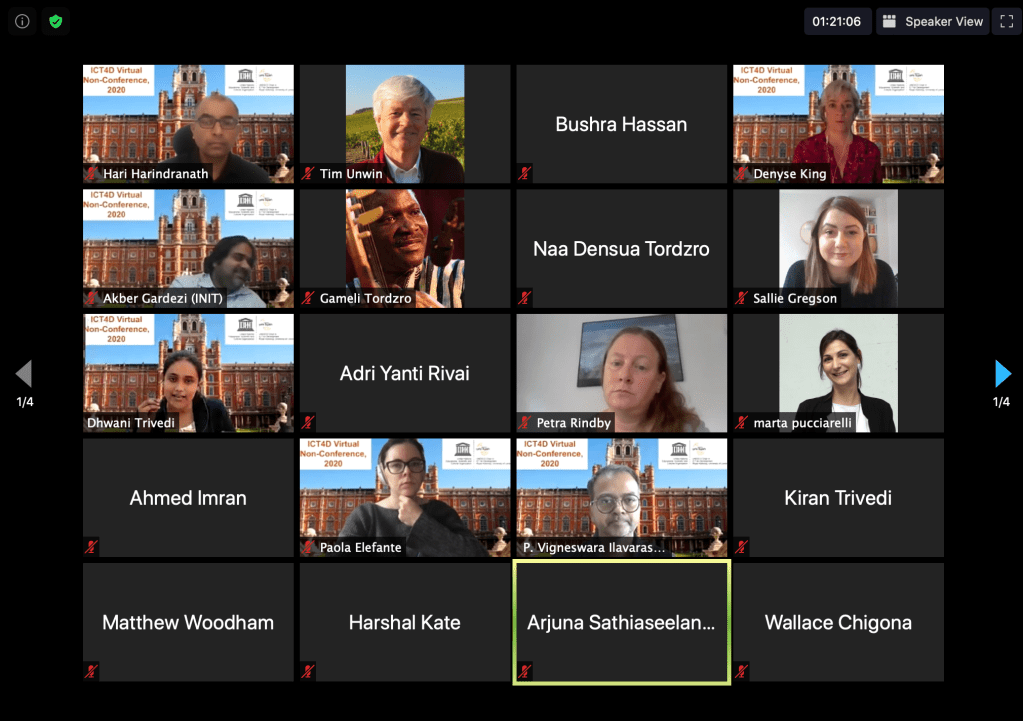





 The UNESCO Chair in ICT4D was delighted to contribute to the 3rd ICT4D workshop convened by the Inter Islamic Network on IT (INIT) and COMSATS University in Islamabad, also supported by the Ministry of IT and Telecom in Pakistan on the theme of Mainstreaming the Marginalised, which was held at the Ramada Hotel in Islamabad on 28th and 29th January 2020. This was a very valuable opportunity for academics, government officials, companies, civil society organisations and donors in Pakistan to come together to discuss practical ways through which digital technologies can be used to support economic, social and political changes that will benefit the poorest and most marginalised. The event was remarkable for its diveristy of participants, not only across sectors but also in terms of the diversity of abilities, age, and gender represented. It was a very real pleasure to participate in and support this workshop, which built on the previous ones that were held in Islamabd in 2016 and 2017.


 een a very active member of the Young Women Writers Forum, and had recently passed away battling Multiple Sclerosis. The Forum did not have any funding available and so they contacted Sightsavers with whom they had an existing MoU to help and support Blind Women Writers in Pakistan. The first “award” (but not in a physical sense) was a small gathering of like minded people who supported the cause of empowering women and overall inclusion more generally. As the years passed by this gathering which always took place around the 15th of October began a regular feature to honour visually impaired people who had done substantial work within the community. For the last 3-4 years they have also sought nominations from the wider community to include sighted people working for the service of visually impaired people.
 Akber writes “I am deeply humbled and thankful to my vision impaired friends who recommended my name for this award. This is very special for me as it links me to the memory of the late Saima Ammar. She was a symbol of activism and defiance; she is someone who fought the cause for access to education for people with disabilities in Pakistan. She is someone who did not let blindness be a burden on her life, but rather used it as a motivation. She did not lead a very comfortable and luxurious life herse
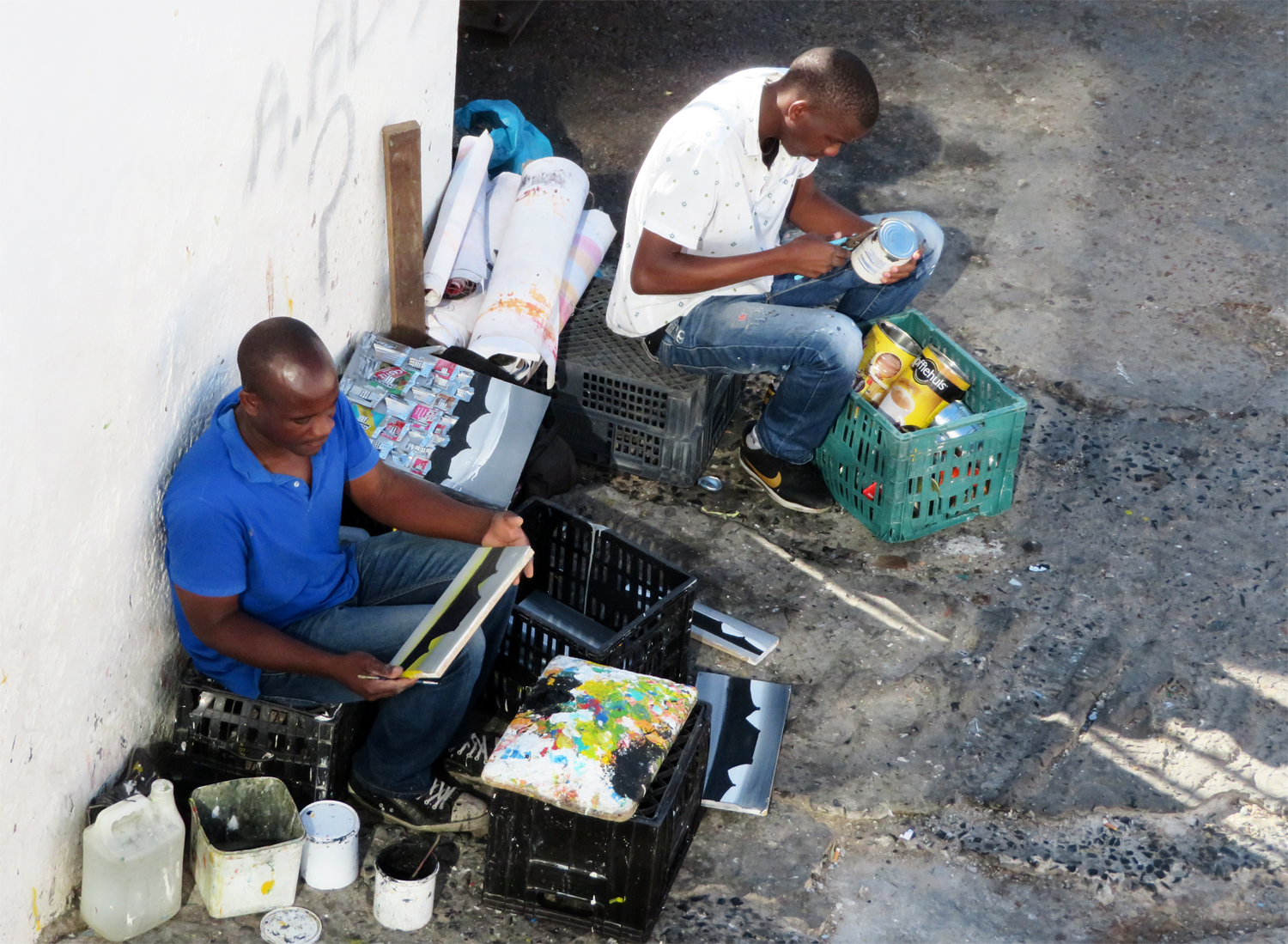 MIDEQ provides an opportunity to do things differently. It has the potential to change our understandings and influence policy, but only if we truly listen to the voices of migrants in the many different contexts where they live and work.