The ICT4D Collective at the WSIS Annual Forum 2026

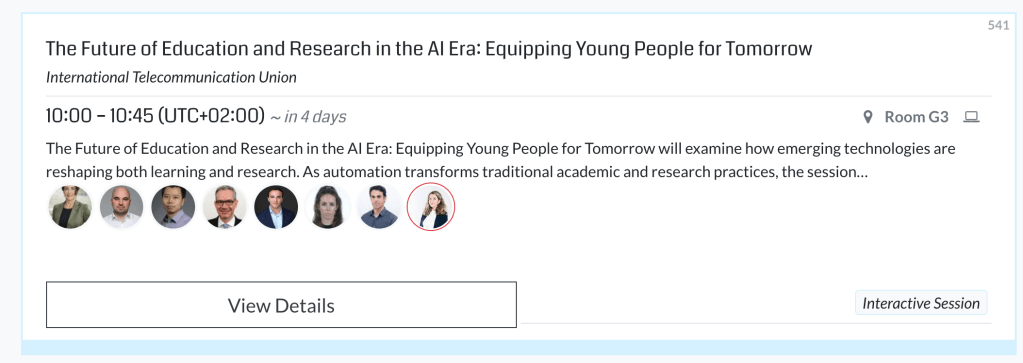
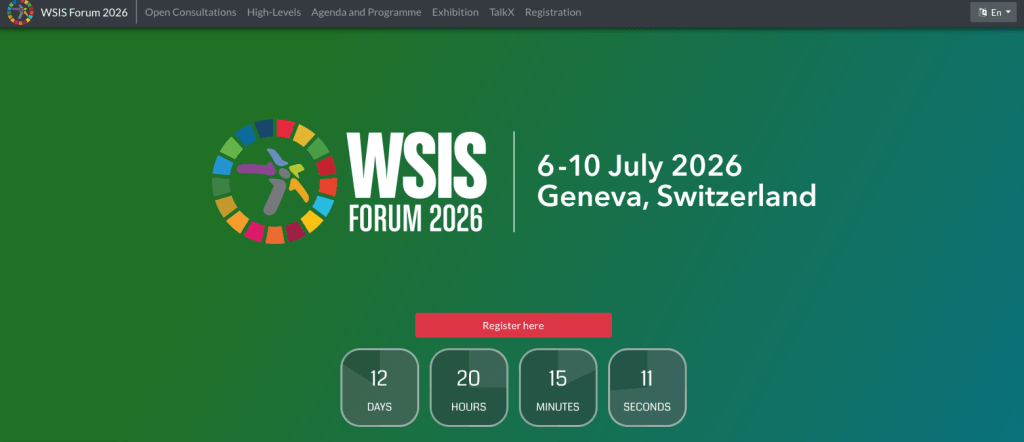
The ICT4D Collective and its members are taking an active role in this year’s WSIS Forum as we have done ever since the first WSIS summits in Geneva in 2003 and Tunis in 2005. If you are in Geneva then, do please join the sessions in which we will be involved, visit our stand in the Exhibition, or meet us for a drink in one of our favourite hostelries!


WSIS 2026 Exhibition, 8th-9th July

The ICT4D Collective has a stand in the small exhibition area on 8th and 9th July (although sadly our specially prepared banners have been banned!). This is only the second time that we have participated in the exhibition, and Prof G. ‘Hari’ Harindrath and Tim Unwin will be present at the stand for much of the time when they are not involved in sessions. Other members of the Collective will also be there at vsrious times during WSIS. Find out more about our research and practice at the stand, take away some of our resources (especially those prepared on safe wise and secure use of digital tech jointly developed with our colleagues in the LBT community in Rio de Janeiro), read some of our working papers (and take them away on the evening of 9th), buy a copy of Digital Inclusion in an Unequal World: An Emancipatory Manifesto at a 30% discount (first come first served) or get a 20% discount voucher.


Session: Digital Inclusion in an Unequal World, 6th July

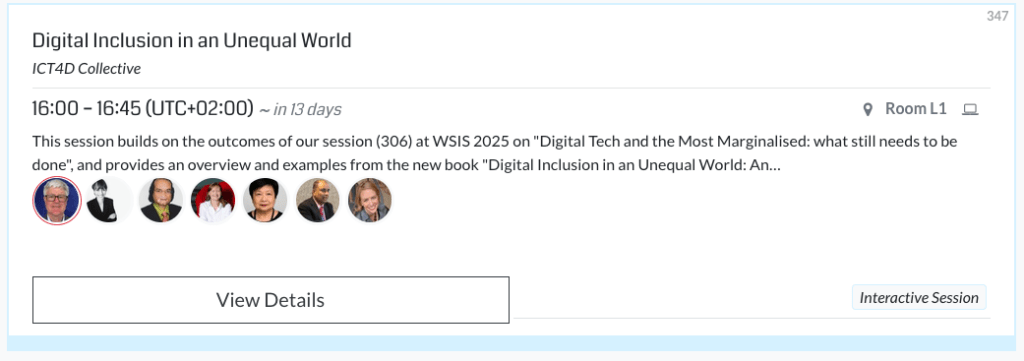
Join the ICT4D Collective’s session on Monday 6th July from 16.00-16.45 in Room L1 Montbrillant for a lively discussion about what we all need to do if the poorest and most marginalised are indeed to benefit from, rather than being enslaved through, the use of digital tech. See the great speakers lined up below!

Session: AI Empowerment for Older People from a Gender Mainstreaming Perspective, 7th July

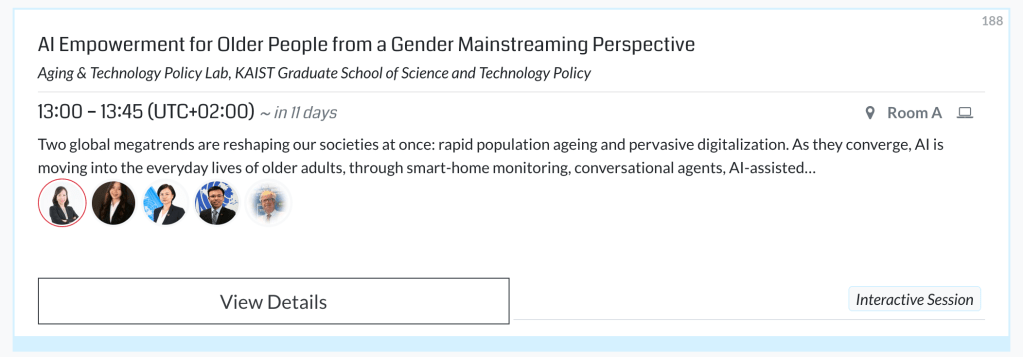
Tim Unwin is a panellist in Session 188 being convened by the Aging & Technology Policy Lab, KAIST Graduate School of Science and Technology Policy (South Korea), from 13.00-13.45 on Tuesday 7th July in Room A, ITU Tower Building.

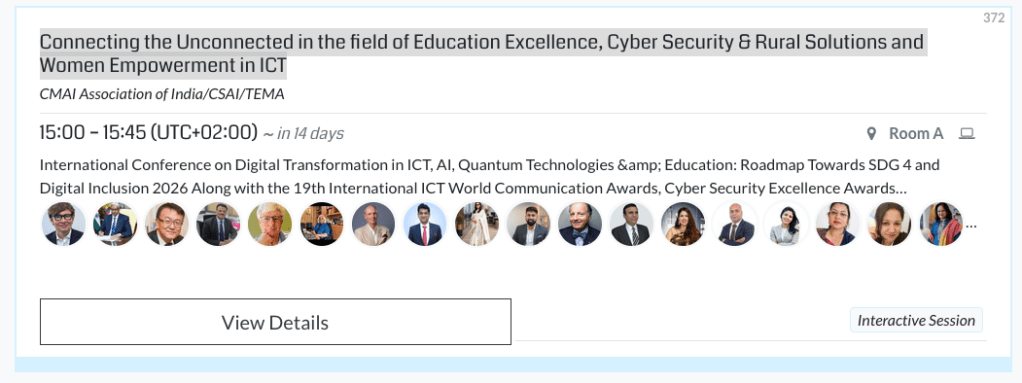
Session: Connecting the Unconnected in the field of Education Excellence, Cyber Security & Rural Solutions and Women Empowerment in ICT, 7th July

Members of the Collective will be participating in this session being convened by Prof. N.K. Goyal from the CMAI Association of India, along with CSAI and TEMA in Room A on Tuesday 7th Juk from 15.00-15.45. As in previous years, Tim Unwin will have the enjoyable but challenging task of moderating a very full session of Indian speakers.

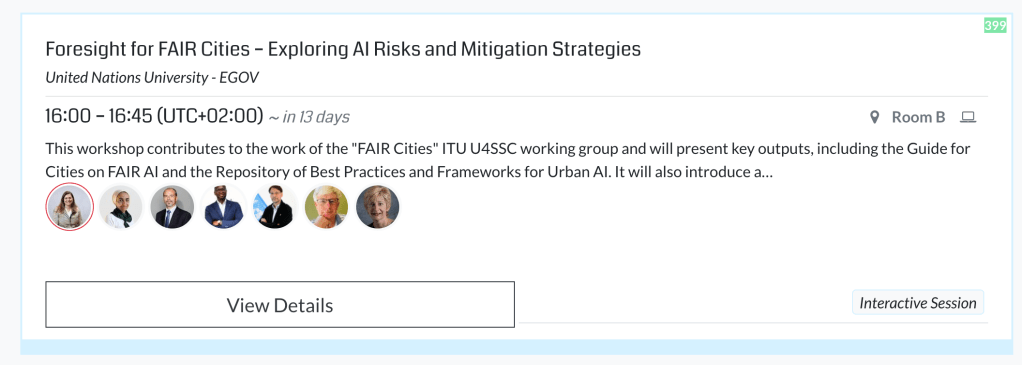
Session: Foresight for FAIR Cities – Exploring AI Risks and Mitigation Strategies, 9th July

This important session in Room B Palexpo from 16.00-16.45 on Thursday 9th July is being convened by UNU-EGOV to address some of the risks of AI and strategies that can be put in place to mitigate them in the context of their project on “FAIR Cities: Foster AI for Inclusive and Responsible Cities“. Tim Unwin has been invited to be a speaker.

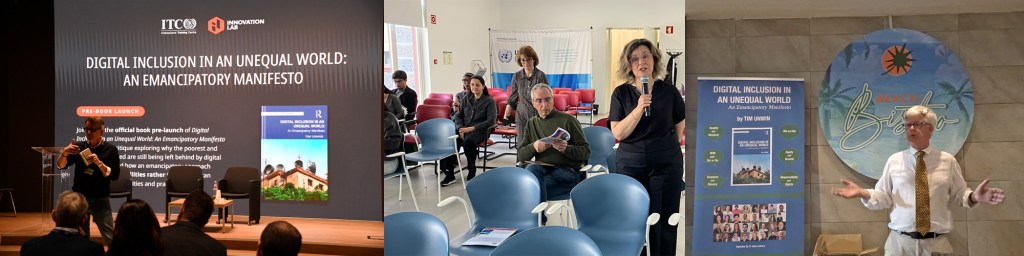
Celebrating the publication of Digital Inclusion in an Unequal World: An Emancipatory Manifesto

Following successful pre-launch and launch events for Tim Unwin’s latest book at the ITCILO in Turin (Italy), at UNU-GOV’s headquarters in Guimarães (Portugal), and during eLearning Africa in Accra (Ghana) several of the authors are going to be present during WSIS including Benita Rowe, G. ‘Hari’ Harindranath, Mei Lin Fung, Revi Sterling, and Yuliya Morenets and will be talking about during and after our session on 6th July. A small number of signed copies of the book will also be available at the >30% discounted price (of £25, CHF 28, €30, US$35) during the session and at our Exhibition stand. We may well also celebrate together at a local hostelry (probably Les Brasseurs) on the evening of 6th July.

Partner2Connect session at AI for Good

The ITU’s Partner2Connect initiative is convening a session on Building the future we want: scaling inclusive AI solutions through collaboration on 9th July from 14.00-15.00 during the AI for Good Summit and Tim Unwin has been asked to moderate the session on “Children, Youth, and Online Protection”. This should be an exciting and highly interactive “engagement”.
On the geopolitics of digital knowledge – by Domenico Fiormonte*

ChatGPT, the artificial intelligence launched by the consortium Open AI has captured the attention of the world’s media, triggering both apocalyptic reactions and palingenetic delusions. On the one hand we have the case of Geoffrey Hinton, the pioneering AI scientist who left Google to express more freely alarm about the risks of these technologies; on the other Bill Gates prophesies with satisfaction (Microsoft is part of the Open AI consortium) the end of education as we know it.   While some among the creators and funders of ChatGPT, such as Elon Musk, are even calling for a moratorium to curb further ‘disturbing’ developments, few have explained how the “machine” is made and how it works.  How would it suddenly bring into being the insights from science fiction, from Kubrik’s Hal 9000 rebel computer to the Wachowski sisters’ Matrix movie.

ChatGPT is basically a powerful syntactic system, so it does not really know what it is talking about, but it is convincing in simulating textual interactions. It therefore does not produce original knowledge, does not possess common sense and has no experience of the world. Its credibility rests on an essentially statistical nature, but to the ordinary user it “appears intelligent.”  This is mainly for four reasons:

  • the computational power (speed)
  • the quantity and quality of data with which the neural network is fed,
  • the ability to “reverse” the search pathway within the Large Language Model (LLM) into a generative pathway (i.e., response creation), and
  • finally the ability to correct and recalibrate answers through human input.

Within these four points it is crucial to understand the way in which the Large Language Model (i.e., the data repository), is constructed. Not surprisingly this is the most obscure part of the whole process. The Washington Post in 2023 sought to shed light on this in an article mapping the “sources” used by Google Bard, one of the main competitors of ChatGPT.  The Post, with the support of the Stanford Allen Institute, has analyzed some ten million websites drawn from the Google C4 dataset, which is used to train not only Google’s AI products but also the LLaMA (Facebook’s Large Language Model). The ten million sites analyzed by the newspaper were divided into eleven categories: Business and Industrial, Technology, News and Media, Arts and Entertainment, Science & Health, Hobbies & Leisure, Home & Garden, Community, Job & Education, Travel, Law and Government. To give some examples, in the News & Media category, the top five sources are: wikipedia.org, scribd.com (subscription-based book and text bulletin board), nytimes.org, latimes.org, and theguardian.com. There are few surprises among the top five in the Science & Health category: journal.plos.org, frontiersin.org, link.springer.com, ncbi.nlm.nih.gov, nature.com. And finally in the Law & Government category the five top sites are:  patents.google.com (in first place), patents.com, caselaw.findlaw.com, publication.parliament.uk, freepatentsonline.com. It can readily be seen that most of the content is generated in the USA, where the commercial and private sectors prevail (with the exclusion of Wikipedia).

In conclusion, three aspects of this need to be emphasised:

1) these AI chatbots could not exist without us: not in the sense of engineers and computer scientists, but of the Internet users who have populated it with content in for around two decades of existence;

2) the methods used to build the aforementioned LLM, with few exceptions, are totally opaque;

3) the sources used to construct the LLM reflect heavy bias in geographical distribution, linguistic and cultural.

In short, the “knowledge” of artificial intelligences is predominantly Western and English-speaking. Moreover, the Post’s reconstruction reveals some interesting points of contact methodologically with the Cambridge Analytica case: the choice of sources with which to feed the AI brings us back to the problem of “cultural units” and their bias. Ultimately, these tools are cultural weapons in the hands of very specific geopolitical actors, and media attention, even when these represents tensions or contradictions.  This only reinforces their mythological status.

Perhaps the main challenges that the media and our societies will face in the coming years, is not how to establish new rules (e.g., for “ethical” use of AI, etc.), but to understand if we will still have the right to know who is “governing” the processes of construction and representation of reality. It will be necessary to join all epistemic forces (journalism, research, education, academia, etc.) to identify and understand who is designing such technologies, who is disseminating them, for what purposes, and why. From this challenge to the entire intellectual world will depend not only the future of democracy, but probably of knowledge, of our cultures and our memories – at least those cultures and memories that we have started to process, transmit and communicate from the time of the first appearance of writing, more than five thousand years ago.


* This is an English translation of an excerpt from: Domenico Fiormonte’s “Geopolitica della conoscenza digitale”, in Frattolillo, Oliviero (ed.), La doppia sfida della transizione ambientale e digitale. Roma, Roma TrE-Press, pp. 57-84. The full paper is free to download at: https://romatrepress.uniroma3.it/libro/la-doppia-sfida-della-transizione-ambientale-e-digitale

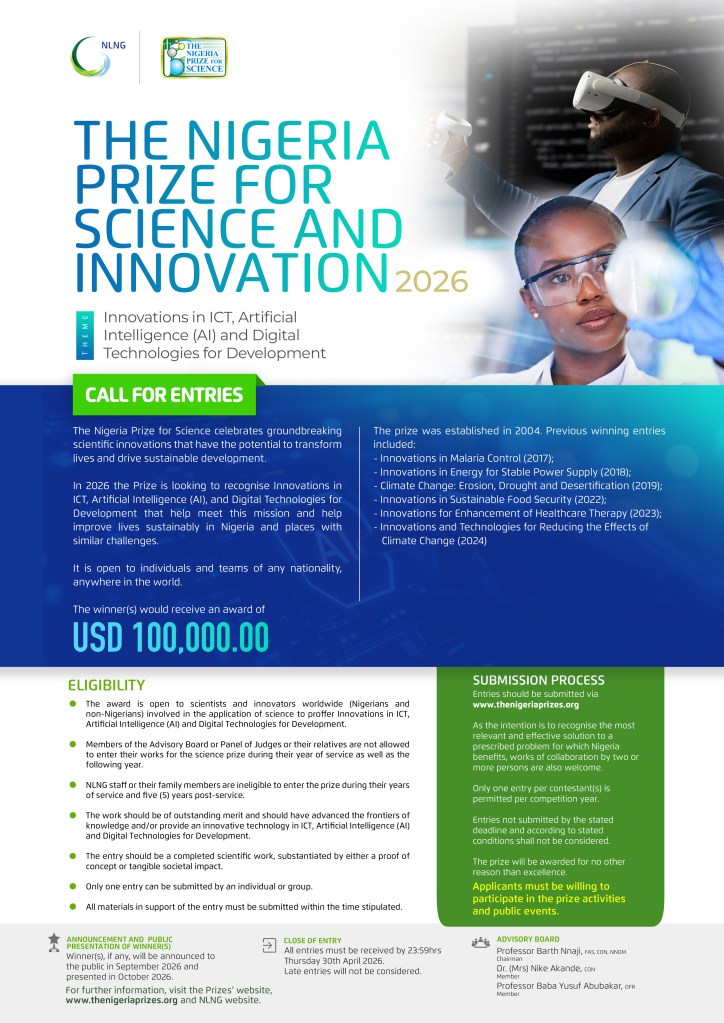
The Nigeria Prize for Science and Innovation, 2026

Do you know anyone involved in the application of science to support innovations in ICT, AI and digital tech for development. If so, do encourage them to submit an application by 30 April 2026 for THE NIGERIA PRIZE FOR SCIENCE AND INNOVATION. Details are in the image below, or find out more at https://www.thenigeriaprizes.org/the…/nps_call_for_entry/. The award is worth $100,000.

Chairholder on Teledifusão de Macau talk show discussing ICT4D

KelseyTim Unwin, our Chairholder of the UNESCO Chair in ICT4D,  was recently in Macau and Shenzhen, China, in his role as a member of the Advisory Board of the United Nations University Computing and Society Institute.  During this visit, colleagues at the Institute had arranged for him to participate in Teledifusão de Macau (TDM)’s prime time Talk Show with Kelsey Wilhelm.  This was a great opportunity to share some of his current thinking about the interface between digital technologies and humans!

The show is now available on YouTube, and begins with an overview of the current state of ICT for development, before going on to discuss

  • ways through which people with disabilities can be empowered through the use of technology,
  • the importance of new technologies being inclusive, because otherwise they lead to new inequalities,
  • working “with” the poorest and most marginalised rather than for them,
  • the role of new technologies such as AI and blockchain in serving the interests of the rich rather than the poor,
  • cyborgs and the creation of machine-humans and human-machines, and finally
  • some of the ethical issues that need to be discussed if we are to balance the benefits of new technologies whilst limiting their harm.

We need much wider public debate on these issues!