Our new identity as the ICT4D Collective

As of 1st August 2023, the UNESCO Chair in ICT4D at Royal Holloway, University of London has reverted to its original identity as the ICT4D Collective. We are a group of very diverse researchers and practitioners from across the world, bound together by our commitment to the highest possible quality of research-practice relating to the use of digital technologies in the interests of the world’s poorest and most marginalised people.

Meeting staff and students at the NIC's ICT and Electronics Innovation Lab in Pokhara,  Nepal, July 2023
Our last engagement as members of the UNESCO Chair in ICT4D: meeting staff and students at the NIC’s ICT and Electronics Innovation Lab in Pokhara, Nepal, July 2023

The Collective and the UNESCO Chair in ICT4D

The original ICT4D Collective was created in 2004, and evolved through an agreement in 2007 between UNESCO and Royal Holloway, University of London into the UNESCO Chair in ICT4D (Information and Communication Technologies for Development). UNESCO Chairs are groups of researchers in specific institutions undertaking work of direct relevance to UNESCO’s fields of competence, and they promote “international inter-university cooperation and networking to enhance institutional capacities through knowledge sharing and collaborative work”. Members of our UNESCO Chair have been very proud to have been associated with UNESCO for the last 16 years, and to have collaborated closely with many good friends in UNESCO’s Paris headquarters and field offices. We were also honoured that Houlin Zhao, the Secretary General of the International Telecommunications Union (ITU) between January 2015 and January 2023, and Jean Philbert Nsengimana, former Minister of Youth and Information and Communication Technology (MYICT) from Rwanda, were our Honorary Patrons.

The following are some of the things we have particularly enjoyed engaging in over the last 16 years:

  • Working together collegially in a truly multidisciplinary context, involving colleagues from Computer Science, Geography, Information Security, Law and Managament at Royal Holloway, University of London.
  • Creating one of the largest groups of postgraduates completing PhDs in the field of ICT4D during the late 2000s and early 2010s.
  • Crafting an extensive partnership network involving governments, the private sector and civil society, and sharing the lessons we have learnt about making partnerships successful.
  • Contributing our experiences in global discussions around the role of digital tech in international development, especially in the UN’s WSIS process (since its origins in 2003), and UNESCO’s many gatherings relating to education and technology.
  • Playing a leading role in the World Economic Forum and UNESCO’s Partnerships for Education initiative.
  • Working on the ground in support of diverse groups of marginalised people, especially those with disabilities, out of school youth, women in patriarchal societies, and migrants and refugees.
  • Being recognised as the 7th most influential global think tank in science and technology in the Go To Think Tanks Index Report for 2015 (we remained 15th in the 2020 index)

Quick links to aspects of our new identity

We are now re-energised as the ICT4D Collective, with 22 founding members drawn from 13 countries – we welcome new members who share our aims and principles. Quick links to our research and practice are available below:

An exciting future…

We all look forward to continuing the work started by the original ICT4D Collective almost 20 years ago, although we remain very sad that the new leadership team at Royal Holloway, University of London did not see value in the institution continuing to have a UNESCO Chair. Perhaps we represented voices from the past; perhaps we have been too critical and anarchic; perhaps we have just been honest and spoken truth to power. Whatever the reason, we will continue to have fun working together, we will continue to challenge the status quo, we will continue to point out the many harms caused by the use of digital tech, and we will continue to work with and support the world’s poorest and most marginalised peoples.

Launch of the Education for the Most Marginalised Report

The Report on Education for the Most Marginalised post-COVID-19: Guidance for governments on the use of digital technologies in education, led by the UNESCO Chair in ICT4D and funded by the FCDO and World Bank through the EdTech Hub was officially launched in a 2 hour online gathering on 18th December 2020. More than 350 people had registered for the launch, with some 150 participating at any one time throughout the event.

Speakers included:

  • Michael Trucano (Global Lead for Innovation in Education and Senior Education and Technology Policy Specialist, World Bank)
  • Tim Unwin (Chairholder, UNESCO Chair in ICT4D and Co-Founder of TEQtogether)
  • John Nasasira (Head of Expert National Task Force on Fourth Industrial Revolution, former Government Chief Whip 2011-2013, and Minister of Information and Communication Technology 2013-2016, Uganda)
  • Janet Longmore (Founder and CEO, Digital Opportunity Trust)
  • Caroline Wright (Director General, British Education Suppliers Association): “Technology and Education for the Most Marginalised Post-COVID-19 provides pragmatic, practical and insightful strategies, solutions and supportive practices to help and support Governments and educationalists working to empower learners in the most challenging of circumstances”.
  • Waleed Al Ali (General Co-ordinator Digital School Initiative, Mohammed Bin Rashid Global InitiativesUAE) 

Materials from the launch are available here, including videos of our speakers and more information. Full information about the report is available here.

In translation

We were delighted to announce the following translations of the report’s Executive Summary during the launch:

The full report has also been translated into French as Éduquer les personnes les plus défavorisées après la COVID-19: orientations destinées aux gouvernements sur l’utilisation des technologies numériques by Karen Ferreira-Meyers:

Thanks to all those who participated

Sadly, there were far too many people to capture on a single slide, but we hope this image captures something of the character of the launch:

Reclaiming Information and Communication Technologies for Development

Volume 2    Issue 6    June 2017

Information and Communication Technologies (ICTs) have immense potential.  However, they are created by people for specific purposes; they reflect the interests of individuals and the companies, or organisations, for which they work.  They can be used to do good, or to do evil.  They usually have unintended consequences.

In the context of debates over “development”, ICTs can thus be used for enhancing economic growth, or for reducing inequality.  However, can they be used to do both at the same time?  Much evidence exists to suggest that with the emphasis over the last 20 years on economic growth as the mantra of “development”, embedded in the MDGs and now the SDGs, ICTs have played an important role in enhancing development (Unwin, 2009).  At the same time, though, their design, implementation and use have led to significantly increased inequalities in the world: between the rich and the poor, between men and women, between those with fewer “disabilities” and those with more “disabilities”, between richer countries and poorer countries, between those living in rural and urban areas …  Despite their potential to be used anarchically and disruptively, ICTs therefore seem to have been used primarily to reinforce existing power differences and inequalities – both by design and by accident.  At its simplest, ICTs usually act primarily as accelerators, both of growth and of inequality.

What we mean by “ICT for Development” (ICT4D) depends fundamentally on what we consider “development” should be.  If reducing inequality does not matter, and economic growth is indeed the aim of “development”, then ICT4D has been successful.  However, for those who are concerned about the implications of an ever more unequal world, as reflected in part in the commitments made towards SDG 10 (Reducing inequality within and among countries), then ICT4D has largely failed.

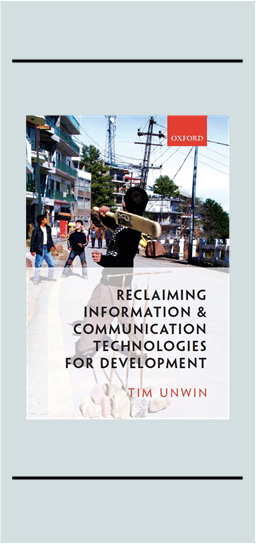
Based on my practice and research over the last 20 years, I have therefore crafted a different kind of book about ICT4D, intended to encourage everyone to reflect on their own roles in ICT4D, and to reclaim the moral agenda about using ICTs to enable poor and marginalised people to empower themselves.  It is called simply Reclaiming ICT4D (OUP, 2017).  In concept, it draws heavily on Jürgen Habermas’s Critical Theory focusing on interests, on empowerment and emancipation, on the complex intertwining of theory and practice, and on the power of self-reflection.

Reclaiming ICT4D calls for a radical rethinking of ICT4D and advocates the need for six transformations:

  • Designing and implementing technical solutions that prioritise the poorest and most marginalised people and communities
  • Reshaping the role of government and regulation
  • Crafting effective multi-stakeholder partnerships between governments, the private sector and civil society
  • Ensuring that digital systems are resilient in the face of security threats
  • Paying greater attention to effective learning and understanding at all levels and in all sectors
  • Placing the poor at the centre of all that we do – working with the poor, and not just for them.

For those attending the 2017 WSIS Forum in Geneva, the UNESCO Chair in ICT4D is convening a workshop on Reclaiming ICT4D at 11.00 on Friday 16th June (Room Popov 1).  Do join us to discuss these issues, and to develop an agenda that will enable the poorest and most marginalised to be empowered through the appropriate use of ICTs.  Outputs will be reported on the UNESCO Chair in ICT4D platform.

Above all, ICT4D is a moral agenda.  It is about what is right and what is wrong.  It is about what each of us does to make a difference.

UNESCO Chair in ICT4D at WSIS Forum 2017

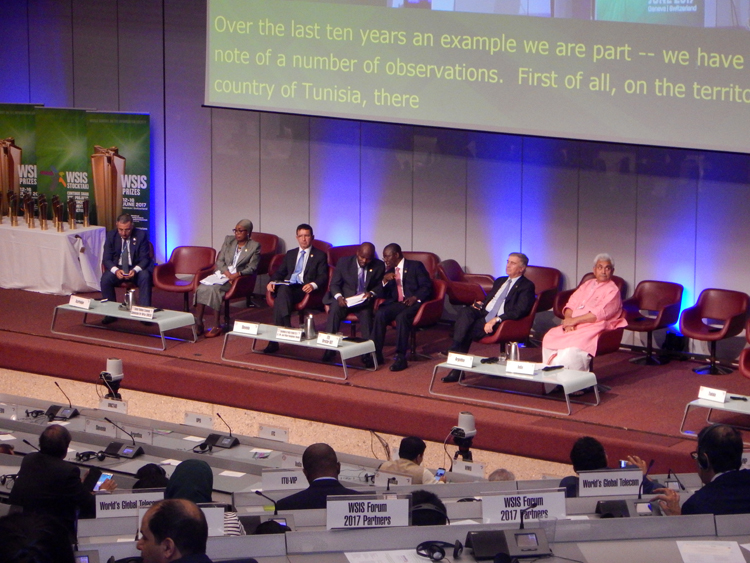
JPN ChairMembers of the UNESCO Chair in ICT4D are delighted to be participating in the 2017 WSIS Forum being held in Geneva from 12th-16th June.

We are very pleased to congratulate one of our Honorary Patrons, Hon. Jean Philbert Nsengimana (Minister of  Youth and Information and Communication Technology, Rwanda), who was elected Chair of the WSIS Forum 2017.

Sessions in which members of the Chair (including Jean Philbert Nsengimane, Marco Zennaro, Charlotte Smart, Bushra Hassan, and Tim Unwin) are playing an active role as moderators and speakers include:

  • Special SDG9 Session Co-hosted by International Telecommunication Union (ITU) and United Nations Industrial Development Organization (UNIDO) (Session 266): Digital Transformation for Sustainable Development (Room 1, CICG, 9.40-10.45 Thursday 15th June).

  • Action Line C4. Capacity Building: Building Capacity to Leverage eAgriculture Applications (Session 309) (11.00-13.00, Room G2, ITU Varembé)

  • Innovation in ICT Technologies, Broadband, Smart Cities and Manufacturing for Sustainable Development Goals (Session 310) (Room C1, 11.00-13.00, Thursday 15th June)

  • Global Partnership for Digital Gender Equality, first Research Group meeting being convened by UNU-CS.  The UNESCO Chair in ICT4D is delighted to be one of the founding members of this research group undertaking important research in support of this significant global initiative being led by the ITU and UN Women (Thursday 15th June)

  • Building ICT innovation capacity (ITU) (Session 324) (14.30-16.15, L2 ITU Montbrillant, Thursday 15th June)

  • Network for Digital Development – Advancing a Global Action Agenda (World Economic Forum, IEEE) (Session 335) (16.30-18.15, ICT Discovery, ITU Montbrillant, Thursday 15th June)

  • Reclaiming ICT4D (Session 345) hosted by the UNESCO Chair in ICT4D (11.00-12.45, Popov 1, ITU Tower, Friday 16th June)

We very much look forward to seeing friends and colleagues at these sessions.  Copies of Tim Unwin’s new book, Reclaiming Information and Communication Technologies for Development will also be available at a special WSIS rate during our session on Friday.