We are delighted to share the news that Profs G. ‘Hari’ Harindranath and Tim Unwin have received the award for “Best Collaborative and Innovation Research Project” from Royal Holloway, University of London for 2025 at their annual Festival of Research on 19th June for their ongoing research-practice with many other organisations across four continents on the safe, wise and secure use of digital tech in marginalised/peripheral communities, working especially with migrants and refugees. [The background to the image on the right is from one of their visits to the UNESCO offices in Nepal in 2023]
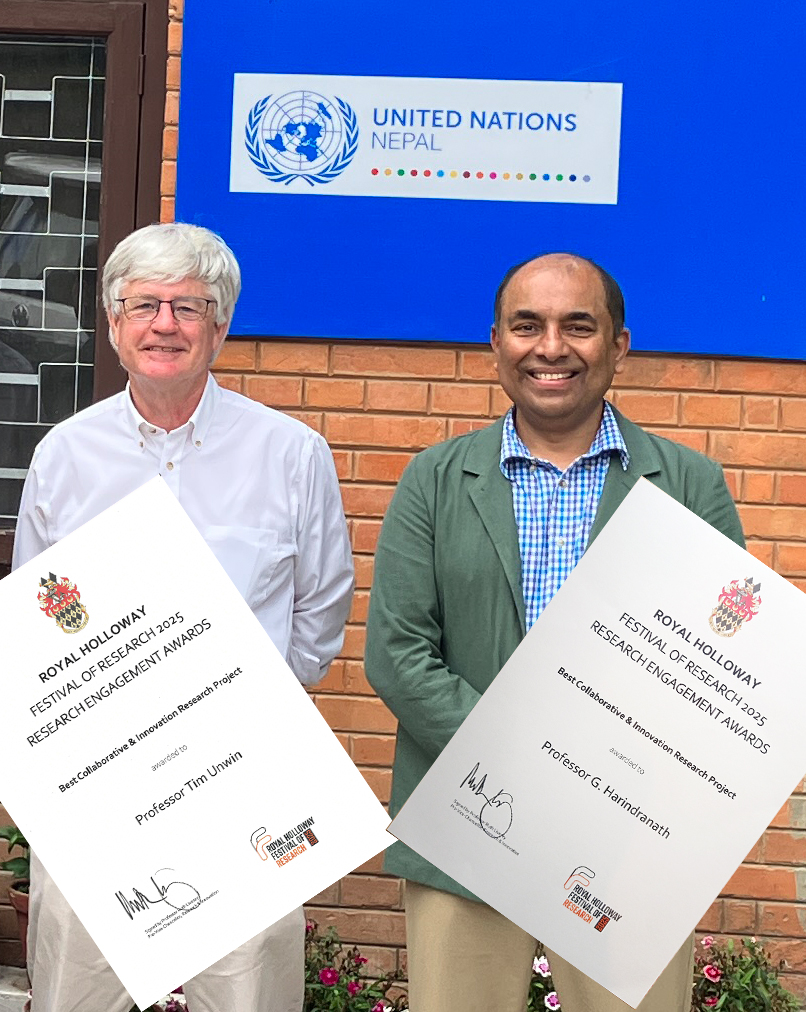
Their ‘project project was informed by social science research and resulted in the generation of interventions and training resources that were adopted by community groups and NGOs’ … To deliver outputs at scale, they have ‘engaged innovatively with international stakeholders, including third sector organisations (NGOs), international bodies (UNESCO, IOM, ILO) and key industry partners (community tech organisations). The sheer size, scale and duration of project activities are testament to the hard work’ they have invested. ‘Generating partnerships on such a global scale will not have come without its challenges, so [they] should be incredibly proud of [their] achievements in undertaking such a huge project’
Awards citation for research collaboration and innovation, Royal Holloway, University of London
More details of their work can be seen as follows:
- Their main contributions on migrant use of digital tech within the UKRI GCRF funded MIDEQ project (2019-2024) can be fiund through these links:
- Links to main work in Nepal (including freely available resources)
- Links to main work in South Africa (including freely available resources)
- Initial migrant videos from South Africa
- Advanced migrant videos from South Africa
- Initial migrant perspectives on video training in South Africa
- Migrants’ reflections on working with us in South Africa
- Documentary based on our work in South Africa: Through Their Eyes
- Outcomes eight months after the end of MIDEQ
- More recent work on safe, wise and secure use of digital tech with people living and working in the peripheries and favelas in Brazil
- An overview of our wider work on cybersecurity and the safe, wise and secure use of digital tech, ongoing in Nepal, Brazil, South Africa and Mozambique, including
- Guidance for small civil society organisations in English and Portuguese (for Mozambique)
Many organisations are contributing to this ongoing research, and full acknowledgement to them all is given in the links above.
A list of selected academic publications relating to this research:
- Lorini, M.R., Harindranath, G. and Unwin, T. (2025) Responsible Digital: Co-Creating Safe, Wise and Secure Digital Interventions with Vulnerable Groups, Information Systems Frontiers, https://link.springer.com/article/10.1007/s10796-025-10611-4
- Harindranath, G., Unwin, T., Lorini, M.R. (2024). The Design and Use of Digital Technologies in the Context of South–South Migration, in: Crawley, H. and Teye, J.K. (eds) The Palgrave Handbook of South–South Migration and Inequality, Cham: Palgrave Macmillan. https://doi.org/10.1007/978-3-031-39814-8_23
- Unwin, T., Casentini, G., Harindranath, G. and Lorini, M.R. (2023) What works for migrants: reflections on research practice in the interests of migrants, Egham: ICT4D Collective, Working Paper 1
- Harindranath, G. , Unwin, T. and Lorini, M.R. (2023) Rethinking digital tech policy for (and with) migrants, Chapter 8 in: UNRISD (United Nations Research Institute for Social Development) and MIDEQ (Migration for Development and Equality) Migration and Inequality in the Global South: Evidence from the MIDEQ Hub, Geneva: UNRISD, 36-40.
- Unwin, T., Harindranath, G.H., Lorini, M.R. (2023) Migrants and digital tech: policy recommendations, Egham: ICT4D Collective, Policy Brief 1.
- Harindranath, G. and Unwin, T. (2022) Digital technologies, migration and the SDG agenda, in: Piper, N. and Ditta, K. (eds) Elgar Companion to Migration and the SDGs, Cheltenham: Edward Elgar (in press)
- Unwin, T., Marcelin, L.H., de Souza e Silva, J., Otero, G., Lorini, M.R., Anyadi, C., Gonçalves, D.M., Sato, D.P. and Harindranath, G. (2022) Uses of digital technologies by migrants from Haiti and to Brazil, Egham: UNESCO Chair in ICT4D, Royal Holloway, University of London, Working Papers No.4.
- Unwin, T., Garba, F., Musaba, M.L., Lorini, M.R. and Harindranath, G. (2021) Uses of digital technologies by migrants in South Africa, Egham: UNESCO Chair in ICT4D, Royal Holloway, University of London, Working Papers No.3.
- Majidi, N., Kasavan, C. & Harindranath, G. (2021) In support of return and reintegration? A roadmap for a responsible use of technology, in: McAuliffe, M. (ed.) Research Handbook on International Migration and Digital Technology, Cheltenham: Edward Elgar, pp. 220-236.
- Unwin, T., Ghimire, A., Yeoh, S-G., Lorini, M.R. and Harindranath, G. (2021) Uses of digital technologies by Nepali migrants and their families, Egham: UNESCO Chair in ICT4D, Royal Holloway, University of London, Working Papers No.2.
- Unwin, T., Ghimire, A., Yeoh, S-G., New, S.S., Kishna, S.S., Gois, W., Lorini, M.R. and Harindranath, G. (2021) Uses of digital technologies by Nepali migrants in Malaysia, Egham: UNESCO Chair in ICT4D, Royal Holloway, University of London, Working Papers No.1.
- Harindranath, G. and Unwin, T (2019), Digital technologies and migration: Reducing inequalities or creating new ones?, TREO Talk, International Conference on Information Systems, 15th December, Munich, Germany.
- Harindranath, G. (2019) Digital technologies, migration and inequality, Presentation, Copenhagen Business School-Royal Holloway School of Management Joint Workshop, 16th September, Royal Holloway, UK.
To find out more about our work, do get in touch through our Contact Page.







 ICT4D Collective