Join the ICT4D Collective at our session on digital tech and the most marginalised at the WSIS+20 High-Level Event in Geneva on 8th July

We are delighted to be jointly convening a session (306) at the WSIS+20 High-Level Event in Geneva on 8th July at 09.00 in Room L, Palexpo, Geneva. The joint convenors are the ICT4D Collective and Microsoft (UN and International Organisations UNIO), supported by Bangladesh NGOs Network for Radio and Communication, ICT4D.at, and YouthIGF.

Session Outline

The multistakeholder digital tech communities associated with the UN system seem unlikely to deliver on the SDGs by 2030, despite the efforts of those involved in developing and implementing the Global Digital Compact (2024). In particular, SDG10 on reducing inequalities remains insufficiently addressed, with much emphasis instead continuing to be placed on maximising economic growth through innovation. All too often the most marginalised, especially those with disabilities, LGBTIQ communities, women in patriarchal societies, the elderly, ethnic minorities and refugees, are in practice made yet more marginal through the adoption of the latest digital tech by those more powerful and richer than they are.

UNDESA, ECOSOC/CSTD, many other UN agencies, and the IGF process are all conducting widespread consultations about the future of “digital and development” and the WSIS Process, but these have still not sufficiently addressed the tendency for digital tech to be used to increase inequalities, rather than to address issues of inequality and equity. Our interactive session is the culmination of a consultation process during the three months before the annual WSIS Forum through which people across our different networks have contributed their ideas to what the five highest priorities should be for governments, the private sector, civil society and the UN system in creating greater equity in the use of digital tech. The findings of this process will be presented during the session, and participants invited during the session to add to the recommendations through the interactive development of a mind map on marginalization that will provide a very specific output to feed into the wider ongoing debate within the UN system about digital tech and equity.

Please make your voice heard beforehand

Everyone is invited to contribute before the session through a short (max 10 minute) online survey available at:  https://app.onlinesurveys.jisc.ac.uk/s/rhul/digital-equity-wsis2025. This will form the basis of our conversations in Geneva, and so even if you cannot attend in person please do copmplete this survey about what needs to be done to ensure that the poorest and most marginalised can indeed benefit from the use of digital tech.
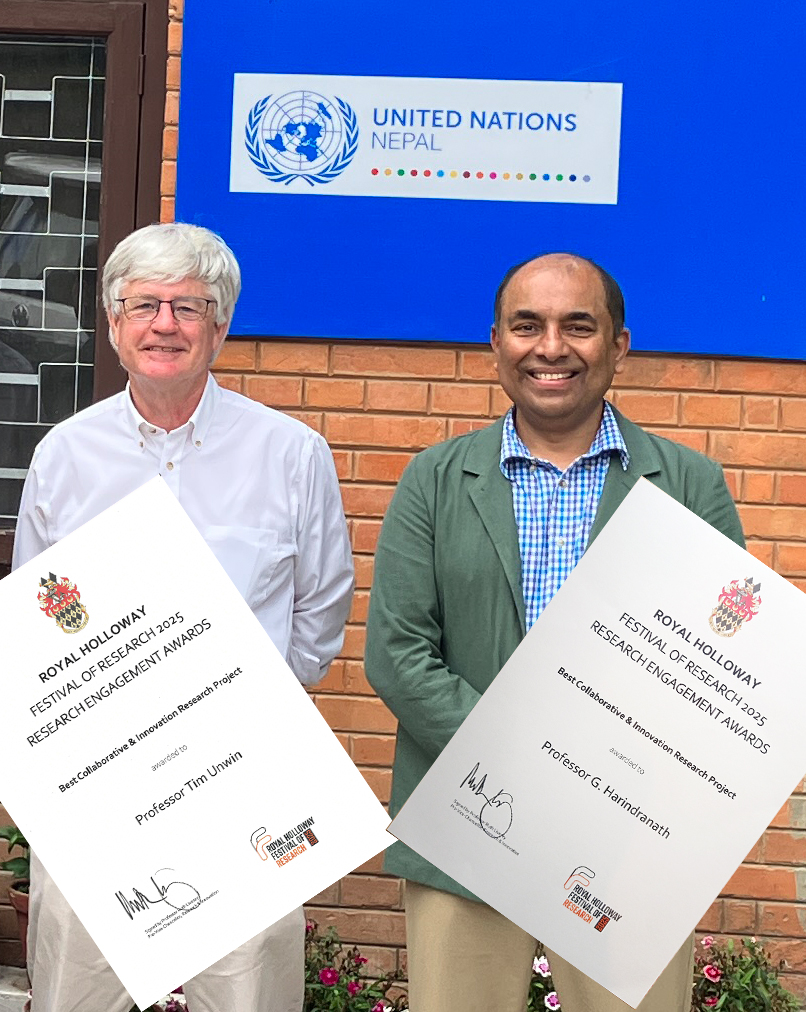
Hari Harindranath and Tim Unwin receive “Best Collaborative and Innovation Research Project” award

We are delighted to share the news that Profs G. ‘Hari’ Harindranath and Tim Unwin have received the award for “Best Collaborative and Innovation Research Project” from Royal Holloway, University of London for 2025 at their annual Festival of Research on 19th June for their ongoing research-practice with many other organisations across four continents on the safe, wise and secure use of digital tech in marginalised/peripheral communities, working especially with migrants and refugees. [The background to the image on the right is from one of their visits to the UNESCO offices in Nepal in 2023]

Their ‘project project was informed by social science research and resulted in the generation of interventions and training resources that were adopted by community groups and NGOs’ … To deliver outputs at scale, they have ‘engaged innovatively with international stakeholders, including third sector organisations (NGOs), international bodies (UNESCO, IOM, ILO) and key industry partners (community tech organisations). The sheer size, scale and duration of project activities are testament to the hard work’ they have invested. ‘Generating partnerships on such a global scale will not have come without its challenges, so [they] should be incredibly proud of [their] achievements in undertaking such a huge project’

Awards citation for research collaboration and innovation, Royal Holloway, University of London

More details of their work can be seen as follows:

Many organisations are contributing to this ongoing research, and full acknowledgement to them all is given in the links above.

A list of selected academic publications relating to this research:

  • Lorini, M.R., Harindranath, G. and Unwin, T. (2025) Responsible Digital: Co-Creating Safe, Wise and Secure Digital Interventions with Vulnerable Groups, Information Systems Frontiers, https://link.springer.com/article/10.1007/s10796-025-10611-4
  • Harindranath, G., Unwin, T., Lorini, M.R. (2024). The Design and Use of Digital Technologies in the Context of South–South Migration, in: Crawley, H. and Teye, J.K. (eds) The Palgrave Handbook of South–South Migration and Inequality, Cham: Palgrave Macmillan. https://doi.org/10.1007/978-3-031-39814-8_23
  • Unwin, T., Casentini, G., Harindranath, G. and Lorini, M.R. (2023) What works for migrants: reflections on research practice in the interests of migrants, Egham: ICT4D Collective, Working Paper 1
  • Harindranath, G. , Unwin, T. and Lorini, M.R. (2023) Rethinking digital tech policy for (and with) migrants, Chapter 8 in: UNRISD (United Nations Research Institute for Social Development) and MIDEQ (Migration for Development and Equality) Migration and Inequality in the Global South: Evidence from the MIDEQ Hub, Geneva: UNRISD, 36-40.
  • Unwin, T., Harindranath, G.H., Lorini, M.R. (2023) Migrants and digital tech: policy recommendations, Egham: ICT4D Collective, Policy Brief 1.
  • Harindranath, G. and Unwin, T. (2022) Digital technologies, migration and the SDG agenda, in: Piper, N. and Ditta, K. (eds) Elgar Companion to Migration and the SDGs, Cheltenham: Edward Elgar (in press)
  • Unwin, T., Marcelin, L.H., de Souza e Silva, J., Otero, G., Lorini, M.R., Anyadi, C., Gonçalves, D.M., Sato, D.P. and Harindranath, G. (2022) Uses of digital technologies by migrants from Haiti and to Brazil, Egham: UNESCO Chair in ICT4D, Royal Holloway, University of London, Working Papers No.4.
  • Unwin, T., Garba, F.,  Musaba, M.L., Lorini, M.R. and Harindranath, G. (2021) Uses of digital technologies by migrants in South Africa, Egham: UNESCO Chair in ICT4D, Royal Holloway, University of London, Working Papers No.3.
  • Majidi, N., Kasavan, C. & Harindranath, G. (2021) In support of return and reintegration? A roadmap for a responsible use of technology, in: McAuliffe, M. (ed.) Research Handbook on International Migration and Digital Technology, Cheltenham: Edward Elgar, pp. 220-236.
  • Unwin, T., Ghimire, A., Yeoh, S-G., Lorini, M.R. and Harindranath, G. (2021) Uses of digital technologies by Nepali migrants and their families, Egham: UNESCO Chair in ICT4D, Royal Holloway, University of London, Working Papers No.2.
  • Unwin, T., Ghimire, A., Yeoh, S-G., New, S.S., Kishna, S.S., Gois, W., Lorini, M.R. and Harindranath, G. (2021) Uses of digital technologies by Nepali migrants in Malaysia, Egham: UNESCO Chair in ICT4D, Royal Holloway, University of London, Working Papers No.1.
  • Harindranath, G. and Unwin, T (2019),  Digital technologies and migration: Reducing inequalities or creating new ones?, TREO Talk, International Conference on Information Systems, 15th December, Munich, Germany.
  • Harindranath, G. (2019) Digital technologies, migration and inequality, Presentation, Copenhagen Business School-Royal Holloway School of Management Joint Workshop, 16th September, Royal Holloway, UK.

To find out more about our work, do get in touch through our Contact Page.

Launch workshop in Maré for resources on safe, wise and secure use of digital tech for people living at the peripheries of Brazil, 12th September 2024

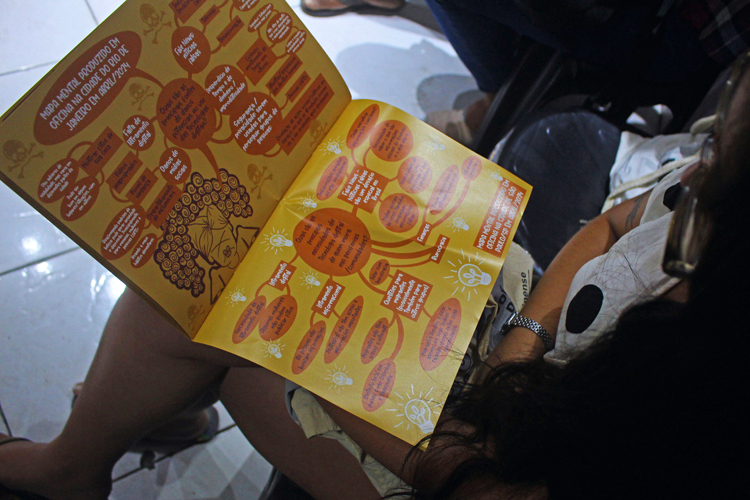
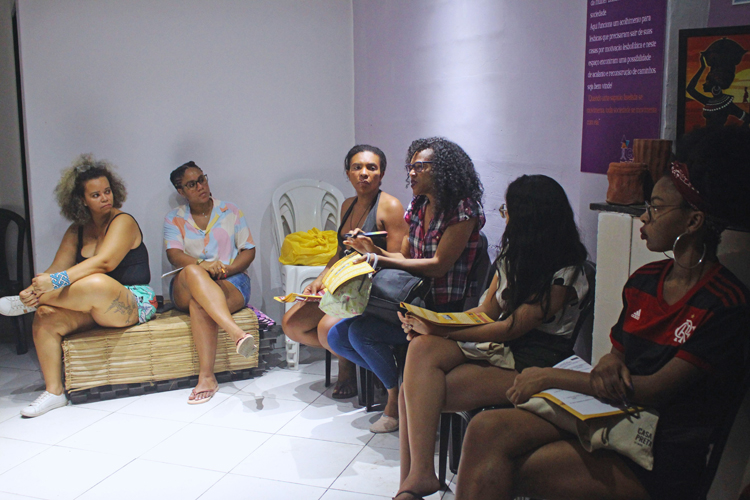
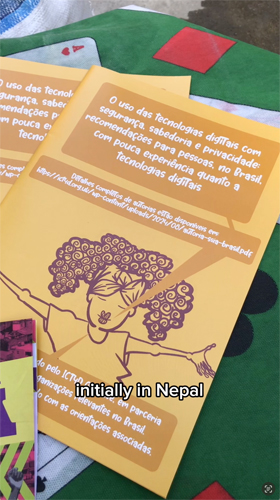
Building on our research-practice in the MIDEQ Hub, funded by the UKRI GCRF, between 2019 and 2024, we have been working with colleagues in Brazil during 2024 to reversion and develop resources on the safe, wise and secure use of digital technologies. These were originally created with migrants and migrant organisations in Nepal and South Africa, but discussions with Dr. Heloisa Melino in Rio de Janeiro in September 2023 suggested that they could also be useful for those living nas periferias of Brazil. Subsequent funding from the UK’s Economic and Social Research Council (ESRC) through its Social Science Impact Accelerator at Royal Holloway, University of London, enabled us to put this into action, and following design workshops in São Paulo and Rio de Janeiro in April 2024, a series of new resources were developed in formats that would be appealing, especially for the LBT community in Maré.

These resources were launched on 12th September at the Casa Resistências in Maré, Rio de Janeiro. This was a vibrant occasion and provided important validation both of the value of these resources, and of their significance especially for the LBT community. Huge thanks are due to our friend and colleague, Heloisa Melino, for all the work that she did in co-ordinating and delivering this inspirational event (see images below).

Two videos were also produced during the launch: one, a short video first posted on the Casa Resistências Instagram account, and the other a longer introduction to, and reflection about, the event with English sub-titles:

Participants in the launch workshop were eager to express their views about the value and importance of these materials, and created these inspiring videos (in Portuguese):

For more information about this research-practice do click in the links below:

Guidance for small civil society organisations on using digital tech safely, wisely and securely

During one of our research visits to South Africa in January 2024 it became abundantly clear that many small and poorly resourced civil society organisations have little experience of using digital tech safely, wisely and securely. Drawing on good practices across the world, as well as our subsequent experiences in and with colleagues from Brazil, Nepal and Mozambiaue, we have therefore produced a short (12 page) guide to help such organisations understand the risks they are at from the use of digital tech and how they can be mitigated. This contains useful tips, graphics that can be copied and reversioned into posters, as well as links to more detailed sourcers of information, and it is freely available in English under a Creative Commons CC BY SA license.

Please get in touch using our contact page should you have any comments on how this could be improved or to discuss developing versions in other languages or for other contexts, and do please share information about this resource through your own networks.

This forms part of the ICT4D Collective’s ongoing research-practice in the safe, wise and secure use of digital tech, further details of which are available here.