
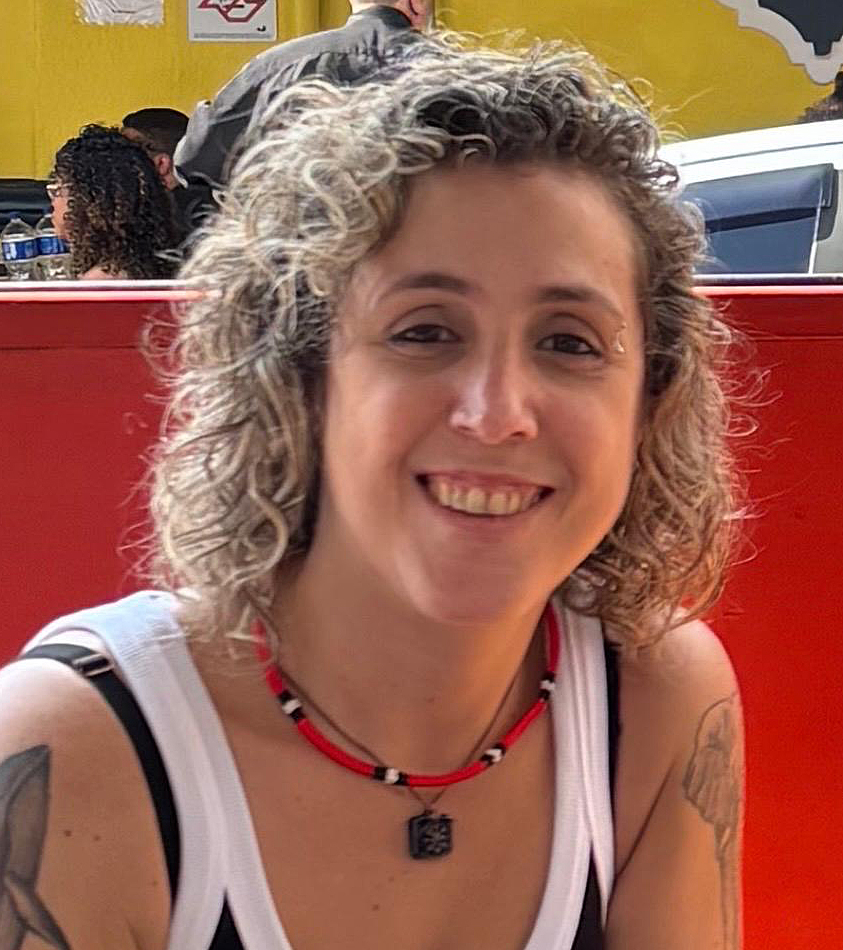
Dr. Heloisa Melino
Executive Director, Casa Resistências (Coletiva Resistência Lésbica da Maré), Rio de Janeiro, Brazil
Heloisa Melino is a Brazilian lawyer and legal scholar based in Rio de Janeiro. She is Executive Director of Casa Resistências, a lesbian-feminist organisation co-founded in 2022 and rooted in the Maré favela complex, where it works on human rights, digital security and community-based education with Lesbians, Bisexuals and Trans women (LBT) and Black women. She holds a PhD in Contemporary Legal Theories from the Federal University of Rio de Janeiro (UFRJ, 2020), supported by a FAPERJ scholarship, as well as a master’s degree in law, supported by CAPES, and an MRes in Public Policies of Urban Planning, all from UFRJ. She has more than 60 publications to her name, including peer-reviewed articles, book chapters, working papers and policy reports.
In 2025 she was a consultant to UNDP and Brazil’s Ministry of Human Rights and Citizenship, authoring a thirteen-volume national human rights training series for the National Human Rights Council. Each volume covers one of the Council’s permanent commissions, guiding readers to the Brazilian norms and guidelines on the rights within its remit and showing how they connect to the UN Sustainable Development Goals, including Brazil’s own SDG 18 on ethnic and racial equality, in support of Brazil’s implementation of the 2030 Agenda.
Her research starts from two arguments. The first, developed in her Master’s thesis, is that the agendas of the populations labelled “minorities”, who are in fact the majority in Brazil, must be a priority in confronting inequality. The second, from her Doctoral thesis, is that Brazilian popular culture, built by subaltern populations, spreads ideals against racism, misogyny and violence through joy rather than long texts with inaccessible language, and that academic knowledge and progressive movements have much to gain from recognising the potência of this way of transmitting and exchanging knowledge. Working through a Latin American decolonial lens and from knowledge that emerges from practice, she builds with vulnerable populations rather than about them. Her current interest is in investigating how democracy can be strengthened in the face of Big Tech, given how difficult these platforms are to regulate and oversee, and how digital sovereignty can be designed so that protections for the most vulnerable are part of the foundation of national digital infrastructure, rather than a repair that arrives later.
From 2022 to 2024 Heloisa was a researcher within the MIDEQ Hub (Migration for Development and Equality), working on the Haiti-Brazil corridor with a focus on access to justice and gender. Her work with the ICT4D Collective began in conversations in Rio de Janeiro in 2023 about adapting the Collective’s resources to the realities of Brazil’s peripheries. Between 2024 and 2025 she was the Collective’s local social impact partner in Brazil, working with Professors G. ‘Hari’ Harindranath and Tim Unwin to co-design the Brazilian version of their training materials on the safe, wise and secure use of digital technologies and bringing together 13 organisations in Rio de Janeiro across the two years. In 2024, the work centred on Casa Resistências and the Maré favela, where she delivered training workshops based on the material and coordinated a launch of the work in September. In 2025, through Heloisa’s networks, the Collective began working with Efeito Urbano, the first professional dance company in Morro da Providência, whose residency took the material as its starting point and led to a performance on 4 July 2025, followed by a workshop she co-led with Professor Harindranath. In March 2026 she was an SSIA Academic Visitor at Royal Holloway, where she gave a seminar on Latin American and Brazilian perspectives on the decoloniality of knowledge.
Her work had further effects. Casa Resistências developed a new line of work on digital safety, including training two cohorts of Fiocruz’s Prodígias (Prodigies) course for young women, in which a project by a young woman nominated by the Casa, on countering fake news in public health, was selected for investment. It also led to Cibernéticas, a digital rights training course for women run by Casa Resistências (first edition in 2025, second edition ongoing), and deepened Heloisa’s interest in researching ICT4D in intersection with gender from a decolonial perspective.
Heloisa is an Associate Researcher at the University of Dundee, where she has collaborated since 2019 and coordinates research and field activities in Brazil under the Turing Mobility Scheme. As part of this partnership she co-authored the book LGBTI+ in Deprivation of Liberty and the report Maré de Cuidados: Injustiças, Cuidado e Transições Justas, from the Waves of Care project (Just Transition Hub), the first diagnosis in Maré of what favelas already do that can spread as socio-environmental care technology.
Recent publications
- Droubi, S., Fernandes, F. L., Moser Torquato Luiz, J., Ferreira Montuori, B. and Melino, H. (2025) Maré de Cuidados: Injustiças, Cuidado e Transições Justas. Rio de Janeiro: Editora Periferias. ISBN 978-65-87799-37-7.
- Melino, H., Ministry of Human Rights and Citizenship (Brazil) and UNDP Brazil (2025) Coletânea: As Treze Comissões Permanentes do Conselho Nacional dos Direitos Humanos. ISBN 978-65-88137-61-1.
- Leon-Himmelstine, C., Dacilien, R., Guindani, N. and Melino, H. (2024) The role of gender norms in shaping the decision to migrate amongst Haitian migrants in Brazil. MIDEQ Working Paper.
- Fernandes, F. L., Melino, H. and Souza e Silva, J. de (2024) “In Defense of a Peripheral Epistemology: Exploring ‘Decolonial Cognitive Triggers’ for Epistemic Disobedience in Urban Peripheries”, Social Sciences, 13(5), 240. https://doi.org/10.3390/socsci13050240

