

2018 IFIP WG 9.4 European Regional Conference on the Social Implications of Computers in Developing Countries
Organised by IFIP WG 9.4, the UNESCO Chair in ICT4D at Royal Holloway University of London, The European University of Tirana and the University of Tirana.
22nd to 24th June 2018, Tirana, Albania

By clicking the REGISTER NOW button above you will be directed to https://www.tickettailor.com/events/ifipwg94euro2018/156030 where you can pay securely for your conference ticket.
Key Dates
Abstract Submission Deadline: 20 March 2018 extended until 26 March 2018
Acceptance Notification: before 10 April 2018
Early Bird Registration Deadline: 30 April 2018
Camera-ready Version (the revised extended abstract) Due: 20 May 2018
Venue: Hotel Tirana International, Tirana, Albania
Theme: Digital Innovation for Sustainable Development
Information technologies in general are great drivers of change that can create opportunities for new and improved models of sustainable international development. Digital innovation, when adapted to specific needs, could have the ability to solve social challenges, but concerns about amplifying inequality, access to benefits and diverting resources away from more pressing development priorities remain.
We are particularly interested in submissions related to innovation agility, indigenous innovation in developing countries and digital innovation for sustainable development. However, we are soliciting submissions across the full range of topics of interest to IFIP Working Group 9.4 in the broad areas of technology and sustainable international development, focusing but not limited to the following areas:
- Digital innovations for poverty and inequality reduction
- Education for Development – New Approaches Tools and Models
- Equality and human rights
- Digital technologies and forced international migration
- Technology, automation and decent work
- International business and economic growth
- Sustainable and innovative cities and communities
- Responsible consumption and production
- Digital governance, peace and justice
- ICT4D in South-East Europe
Extended abstract submissions for research papers (2 pages long excluding references) or work-in-progress abstract submissions (1 page long excluding references) should be submitted by the 20th of March 2018. They will be peer-reviewed and collated into an eBook which will be published online with an ISBN.
The aim of the Regional Conference is to provide an engaging space for researchers and practitioners to share their work and participate in a number of additional workshops around the following areas:
- Working in multidisciplinary research projects
- Getting published in leading international journals
- Impacting policy and practice
Confirmed Speakers

Robert Davison is a Professor of Information Systems at the City University of Hong Kong, currently researching on Knowledge Management and Collaboration in Chinese firms, and the Chair of the IFIP WG 9.4. He has published over 200 articles in a variety of journals and conferences, and his work has been cited in excess of 6500 times (H=41).
In a Guide to Publishing in International Journals and Paper Development Workshop Robert will open up the black box of publishing from the perspective of an Editor in Chief of two very different journals: the AIS Basket of 8 “Information Systems Journal” and the niche “Electronic Journal of Information Systems in Developing Countries”.
Call for Submissions
We seek proposals for panel or workshop sessions (1 page long excluding references) on topical issues bridging across multidisciplinary theory and practice, and professional development training workshop sessions on research impact, methods, fieldwork or publishing.
We are also seeking extended abstract submissions for research papers (2 pages long excluding references) for presentation at the conference.
Work-in-progress abstract submissions (1 page long excluding references) can be submitted for presentation as posters or demo installations. They will be displayed at the conference.
Submissions
Abstracts, panel and workshop proposals should be sent in PDF format, by email to ifip94euro2018@gmail.com
The decisions of acceptance will be made based on the extended abstracts that will be included in the final proceedings. The aim is to have a balanced programme and experience, welcoming paper presentations on research, theory and practice, but also creating a space for professional development and networking. Therefore we will not ask for full papers.
Submissions should follow the formatting guidelines for the IFIP Advances in Information and Communication Technology (IFIP AICT). Submissions should include: Title, Author names, Address, Email/URL, Keywords, the main body of the extended abstract and references, if required. It is not necessary to include an abstract section in the extended abstract. A submission template is available HERE, and detailed information is available from:
http://www.springer.com/gb/computer-science/lncs/conference-proceedings-guidelines
Registration fees
|
Early bird Before 30 Apr 2018 EUROS |
Full price From 1 May 2018 EUROS |
|
| Academics and professionals: Developed countries | 290 | 330 |
| Academics and professionals: Developing countries* | 200 | 230 |
| PhD students: Developed countries** | 150 | 170 |
| PhD students: Developing countries*,** | 100 | 120 |
| Distance participation: All*** | 50 | 60 |
| Gala dinner | 40 | 40 |
The full registration tickets include the conference participation fee, a reception on the 22nd of June 2018, coffee breaks and lunches on the 23rd and 24th of June 2018. These fees include a discount of at least 10% for participants from all IFIP member societies. The gala and networking dinner on the 23rd or June 2018 has to be paid separately.
*Developing countries are considered those in the OECD DAC List of ODA Recipients: http://www.oecd.org/dac/stats/daclist.htm Participants from developing countries can apply for a bursary by sending a cover letter along with their submission. Decision will be made based on merit and need.
** PhD Students willing to volunteer for facilitating the event can apply for a bursary by sending a cover letter along with their submission. Decision will be made based on merit and need. Priority will be given to local PhD students.
*** Online participation is for those who want to submit an extended abstract, but who cannot participate in person in the conference. They will have a chance to interact with the participants at the session when their presentation is scheduled and their contribution will be included in the proceedings.
Accommodation, Visa and Transfers
The conference will be hosted at Hotel Tirana International located in the Main Square of Tirana, combining a truly strategic location and breath-taking view of the capital city.
Any visitor who holds a valid, multiple entry and previously used visa issued by a Schengen area country, United States, or the United Kingdom, or a residence permit in these countries can enter Albania without a visa for 90 days. Detailed information about the visa policy of Albania for foreign nationals can be accessed here.
Tirana International Airport Mother Teresa is about 30 min drive from the hotel.
Call for Participation and Bursaries
We plan to offer a number of bursaries to attract Graduate Students from universities in developing countries in Europe or outside, researching on topics of interest for the conference that may have difficulty obtaining support from their host institution to attend the conference.
Bursaries will be allocated on a merit and need basis. If you wish to apply for a bursary, with your submission, please include a cover letter (1 page) demonstrating your need for financial support.
Conference Committee
Conference Chair: Endrit Kromidha, University of Birmingham
Programme Co-Chairs:
Kozeta Sevrani, University of Tirana
Tim Unwin, Royal Holloway University of London
Agim Kasaj, European University of Tirana
Programme Committee
| Jyoti Choudrie | University of Hertfordshire, UK |
| Betim Cico | South East European University, Macedonia |
| Jose-Rodrigo Cordoba-Pachon | Royal Holloway, University of London, UK |
| Robert Davison | City University of Hong Kong, Hong Kong |
| Gentian Elezi | Agenda Institute, Albania |
| Neki Frasheri | Polytechnic University of Tirana, Albania |
| G Hari Harindranath | Royal Holloway, University of London, UK |
| Richard Heeks | University of Manchester, UK |
| Ravishankar Mayasandra-Nagaraja | Loughborough University, UK |
| Irena Malolli | Ministry of Infrastructure and Energy, Albania |
| Silvia Masiero | Loughborough University, UK |
| Petter Neilsen | University of Oslo, Norway |
| Devinder Thapa | University of Agder, Norway |


 Its founding partners are the
 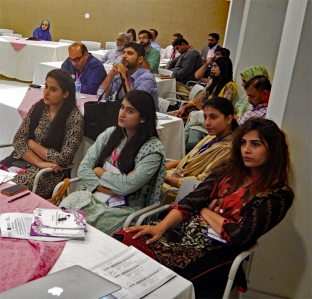 It was great to be back in Islamabad to participate in the second two-day workshop organised by the
  Understanding the ICT4D landscape, in which the main speaker was Dr. Ismail Shah, the Chairman of the
 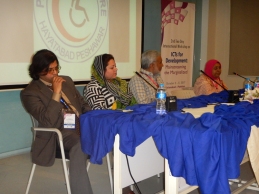 Serving the most marginalised: accessibility and disability, with a plenary by
  Full details of the event can be found on the


 In the run-up to this year’s UN General Assembly, the Office of the DG of the UN Office in Geneva has launched a novel initiative on big conversations driving the big goals of the SDGs as part of their Perception Change Project. The UNESCO Chair in ICT4D is delighted to have been invited to participate in
  Members of the UNESCO Chair in ICT4D are delighted to be participating in the
  Following an opening by Professor Gloria Agyemang (Head of the School of Management at Royal Holloway, University of London), keynotes were given by Hans Bressers (University if Twente), Diane Holt (University of Essex), Shaun McCarthy (Action Sustainability), Joseph Sarkis (Foisie Business School, Worcester Polytechnic Institute), Tim Unwin (UNESCO Chair in ICT4D), and Natalia Yakovleva (Newcastle University). Joseph Sarkis and Tim Unwin both focused specifically on ICTs, sustainability and the SDGS, highlighting both the positive and more problematic aspects of the relationships between technology and sustainable development.
 To coincide with the recent publication of Tim Unwin’s new book entitled
  Members of the UNESCO Chair in ICT4D participated in the
 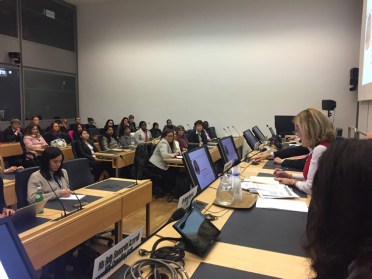 It also enabled us to engage in the kick-off meeting of the
 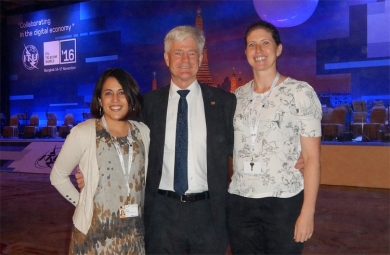 The UNESCO Chair in ICT4D featured prominently at the ITU’s