Prof. Harindranath participates in the ILO’s 10th anniversary celebrations of the Fair Recruitment Initiative

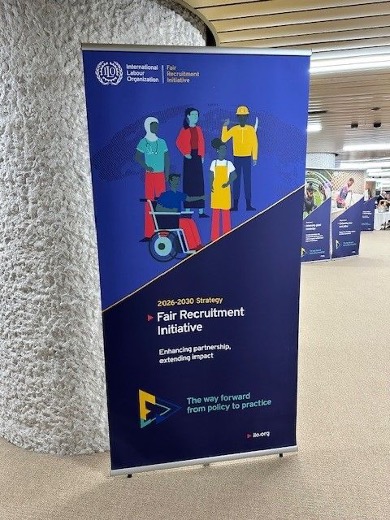
Prof G. ‘Hari’ Harindranath was honoured to be invited to contribute to the panel on ‘Leveraging digital innovations to enhance fair recruitment and combat abusive practices’ at the International Labour Organization‘s Global Conference on ‘Fair Recruitment Initiative: The Way Forward, from Policy to Practice’ held in Geneva between 19th and 20th May 2025. This event marked ten years of the ILO’s Fair Recruitment Initiative and brought together representatives from government, employers, trade unions and ILO’s UN partners including the IOM, WHO and UNHCR.
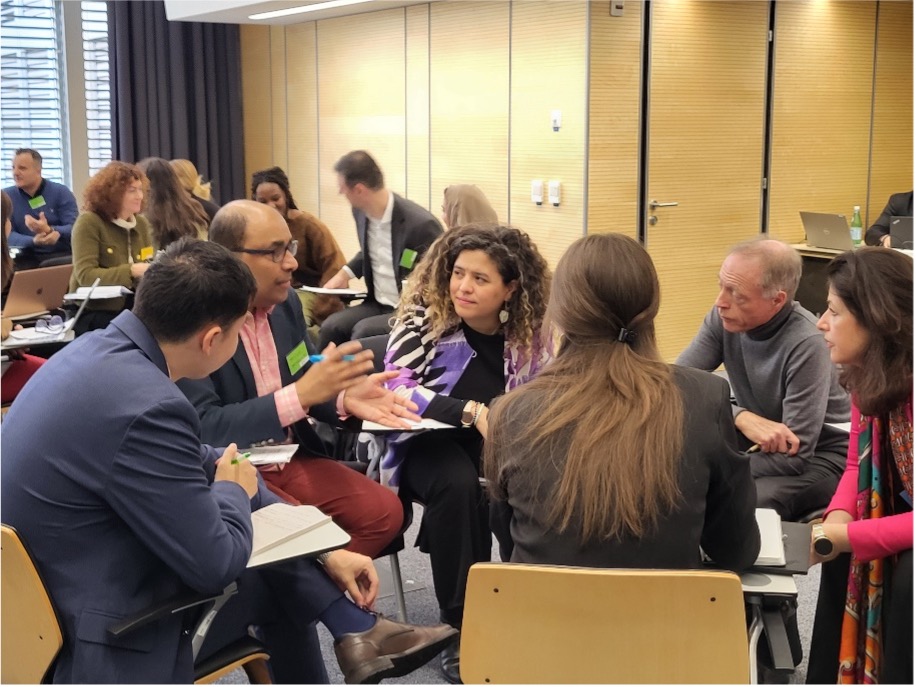
Digital technology is rapidly transforming the way migrant workers are recruited, bringing both new opportunities and serious risks. The interactive panel session examined emerging digital solutions that aim to promote fair recruitment – from tools used by workers to platforms leveraged by governments, inspectors and employers – and unpacked the associated risks and opportunities, and discussed actionable insights from participants on what works, what doesn’t, and how digital tech can be better harnessed to protect migrant workers.

Hari participated in a panel that also included representatives from the International Trade Union Confederation and The Adecco Group, one of the world’s largest human resources and temporary staffing firm.

Hari’s contribution questioned the uncritical application of digital tech in contexts of vulnerability that can cause harms, exacerbate existing inequalities and even create new ones. If digital technologies are to be used to advance fair recruitment of labour migrants, then it requires responsible digital practices that balance tech with supportive human interventions and a sustained focus on the safe, wise and secure use of digital tech by migrants.
Hari had previously been invited to contribute to the Global Forum on Migration and Development’s (GFMD) preparatory roundtables on ‘New Technologies and Digitalization: Improving Migration Management and Regular Migration Pathways’ in Geneva during February 2025 (and online in November 2024) in preparation for the 2025 GFMD Summit in Colombia.

Created in 2007, the Global Forum on Migration and Development (GFMD) is a state-led process connecting governments with civil society, the private sector, local and regional governments, youth, the UN system and other relevant stakeholders to helps shape the global debate on migration and development.

These significant policy engagement opportunities evidence the impact of our research-practice with vulnerable groups including migrants undertaken over the past six years, initially funded through a major UKRI GCRF grant and then through Royal Holloway’s Research England ODA and Social Purpose Research and Innovation Hub (SPRIH) grants (all in Nepal and South Africa) and through SSIA funding (in Brazil). Further details of this ongoing work can be found here (on the safe, wise and secure use of digital tech) and here (on our research-practice with migrants).

Prof. G. ‘Hari’ Harindranath, 29 May 2025
New Internet Society report on Internet Access and Education: Key considerations for policy makers

The Internet Society has just published a new report on Internet Access and Education.  This makes interesting reading.  In summary it argues that “The Internet has immense potential to improve the quality of education, which is one of the pillars of sustainable development. This … briefing outlines ways in which policymakers can unlock that potential through an enabling framework for access to the Internet. It sets out five priorities for policymakers: infrastructure and access, vision and policy, inclusion, capacity, and content and devices. Together these represent key considerations for unlocking access to the Internet in support of education”.

They will be holding an online seminar on 6th December to discuss these issues, which we be moderated by Ben Petrazzini, IDRC, and will include the following speakers:

  • Tomi Dolenc, Academic and Research Network (ARNES), Slovenia
  • Miguel Brechner, Ceibal Plan, Uruguay
  • Dirk Hastedt, IEA, Netherlands & Germany
  • Shireen Yacoub, Edraak.org, Jordan
  • Patrick Muinda, Ministry of Education and Sports, Uganda

This work follows the Internet Society’s report earlier this year entitled Internet for Education in Africa: Helping policy makers to meet the global education agenda Sustainable development Goal 4

Artificial Intelligence for Good

Volume 2    Issue 8    August 2017

In June, together with more than 500 experts in Artificial Intelligence (AI), I participated in the “AI for Good” Global Summit. Organised in Geneva by the ITU and the XPRIZE Foundation, the summit focused on a crucial and timely question: Can AI contribute to achieve the 17 Sustainable Development Goals that the UN has set to end poverty, protect the planet and ensure prosperity for all?

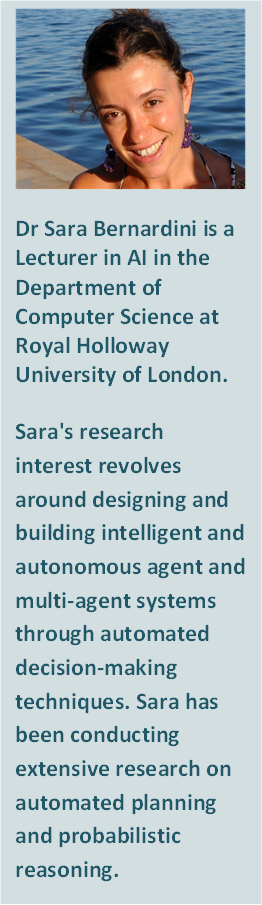
As an expert in automated decision-making, I know first-hand that AI is a uniquely powerful and transformative technology. AI can have a huge impact not only to further the progress of the wealthy countries, but also to foster the advancement of developing nations. For example, AI can teach people new skills and support lifelong learning. At the same time, the development of AI raises ethical and societal challenges for AI experts and policy-makers, who share the responsability to deploy an AI technology that is safe, reliable and fair.

Why is AI so special? As observed by Stephen Cave during the Summit, AI is a tool different from any other because of three crucial aspects: (i) AI is a universal tool, which will be soon incorporated in all other technologies (e.g. self-driving cars, smart homes, robotics, personalised medicine); (ii) AI can accelerate its own development, besides the development of other tools (e.g. machine learning is an AI tool that can improve itself as well as other AI algorithms); and (iii) AI is autonomous (AI agents make and implement decisions without constant human intervention). In addition, AI is based on data, which are often collected from people and contain sensitive information about them. Considering all these factors together, it becomes clear why AI generates excitement but also concern.

In the last few years, I have focused on the development of UAVs (unmanned aerial vehicles) for surveillance and disaster response applications. I have formulated techniques based on task planning and probabilistic reasoning to make UAVs smart enough to fly autonomously and strategically to achieve sophisticated goals specified by domain experts over a large geographical area and a long temporal horizon. The potential of intelligent vehicles in emergency scenarios is enormous as resources are limited and time is critical. However, these are challenging situations in which decisions can have a life-changing impact and human operators need to trust the machines and understand their behaviour.

At the Summit, Professor Virginia Dignum formulated three principles on which AI development should be based, which I find particularly relevant:

  • Accountability: an AI system needs to to be able to justify its own decisions based on the algorithms and the data used by it. We have to equip AI systems with the moral values and societal norms that are used in the context in which these systems operate;
  • Responsibility: although AI systems are autonomous, their decisions should be linked to all the stakeholders who contributed in developing them: manufacturers, developers, users and owners. All of them will be responsible for the system’s behaviou;
  • Transparency: users need to be able to inspect and verify the algorithms and data used by the system to make and implement decisions.

I would like to conclude with a provocative remark that Professor Gary Marcus brought to the table during the Summit and that I share: are we really so close to Strong AI  as many people seem to think, where “Strong AI” means a system that exhibits integration between all aspects of intelligence: common sense, planning, reasoning, analogy, language and perception? I believe that, although AI can truly change the world, we still need fundamental advances first. Key to achieve them are interdisciplinarity and global collaboration. In particular, I would welcome multi-disciplinary collaborations to make UAVs and drones truly effective in disaster response scenarios.