
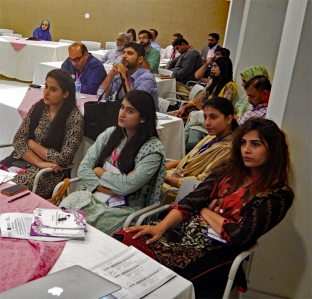
 It was great to be back in Islamabad to participate in the second two-day workshop organised by the Inter-Islamic Network on Information Technology and COMSATS Institute of Information Technology with the assistance of the UNESCO Chair in ICT4D, and held on 5th and 6th October. It was fascinating to see the progress that has been made in Pakistan since the first such workshop that we convened in January 2016, particularly in terms of policy making, awareness, and entrepreneurial activity. It was also very good to see such a diverse group of participants, including academics, entrepreneurs, civil society activities, government officials, and representatives of bilateral donors engaging in lively discussions throughout both days about how best we can turn rhetoric into reality.
Following the official opening ceremony, there were seven main sessions spread over two days:
 Understanding the ICT4D landscape, in which the main speaker was Dr. Ismail Shah, the Chairman of the Pakistan Telecommunication Authority
- The road to facilitation: financial technologies for the marginalised, with a plenary given by Qasif Shahid (FINJA) about making payments frictionless, free and real time.
- Addressing the digital gender gap, at which the UNESCO Chair in ICT4D spoke about why this is a pressing concern, and it gave a chance for him to tdiscusst the new UN-led EQUALS initiative for gender equality in a digital age, as well as some of the challenges that face women in using ICTs (slide deck).
- No tech to low tech to high tech: an entrepreneur’s tale, with a plenary by Muhammad Nasrulla (CEO INTEGRY).
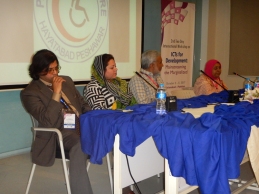 Serving the most marginalised: accessibility and disability, with a plenary by David Banes on access and inclusion using ICTs, which included a very useful framework for considering digital accessibility issues.
- Developing technologies for the rural/urban slum needs, during which Muhammad Mustafa spoke about his vision of enabling all 700 million illiterate adults in the world to go online through his Mauqa Online initiative.
- Educating the marginalised, where the UNESCO Chair in ICT4D spoke about educating marginalised children (slide deck) and Shaista Kazmi from Vision 21 described their Speed Literacy Program.
Each session combined enthusiastic discussion around the themes addressed by the plenary speakers, and it was excellent to learn from all those involved about using ICTs in very practical ways to deliver on the needs of poor and marginalised people and communities in Pakistan.
 Full details of the event can be found on the INIT site, where copies of the slide decks from each main presentation will also be available. Very many thanks go to all of the organisers, especially Tahir Naeem, Akber Gardezi and Muhammad Atiq from COMSATS IIT and INIT for all of the hard work that they put into making the event a success. We look forward to convening the next such workshop in about a year’s time, once again bringing together people from all backgrounds intent on using ICTs to support Pakistan’s most marginalised communities.


 In the run-up to this year’s UN General Assembly, the Office of the DG of the UN Office in Geneva has launched a novel initiative on big conversations driving the big goals of the SDGs as part of their Perception Change Project. The UNESCO Chair in ICT4D is delighted to have been invited to participate in
  Members of the UNESCO Chair in ICT4D are delighted to be participating in the
  Following an opening by Professor Gloria Agyemang (Head of the School of Management at Royal Holloway, University of London), keynotes were given by Hans Bressers (University if Twente), Diane Holt (University of Essex), Shaun McCarthy (Action Sustainability), Joseph Sarkis (Foisie Business School, Worcester Polytechnic Institute), Tim Unwin (UNESCO Chair in ICT4D), and Natalia Yakovleva (Newcastle University). Joseph Sarkis and Tim Unwin both focused specifically on ICTs, sustainability and the SDGS, highlighting both the positive and more problematic aspects of the relationships between technology and sustainable development.
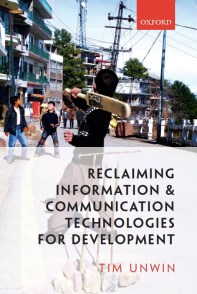 To coincide with the recent publication of Tim Unwin’s new book entitled
  Members of the UNESCO Chair in ICT4D participated in the
 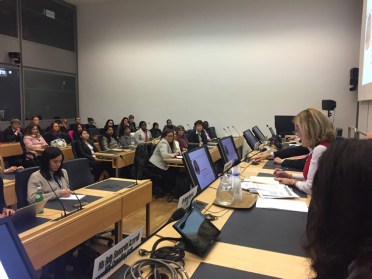 It also enabled us to engage in the kick-off meeting of the
 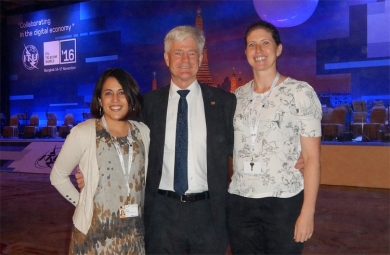 The UNESCO Chair in ICT4D featured prominently at the ITU’s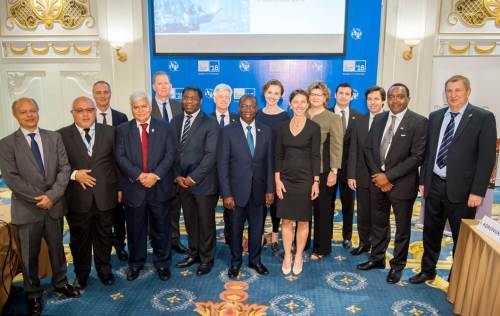
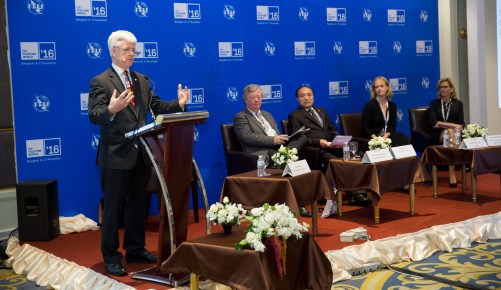
 This was an opportunity for me to explore the relevance to the European context of some of my ideas about ICTs and inequality gleaned from research and practice in Africa and Asia. In essence, my argument was that we need to balance the economic growth agenda with much greater focus on using ICTs to reduce inequalities if we are truly to use ICTs to support greater European integration. To do this, I concluded by suggesting that we need to concentrate on seven key actions:
 ICT4D Collective