
By Paul Spiesberger (Chair ict4d.at)
Overall the conference is worth a visit to see yet another aspect of the ICT4D movement. The ICT4D conference is more an event from the private sector for the private sector and governments. Although some researchers were present, many of the exhibition booths and sessions were held by for-profit organisations. Everyone working in the ICT field as an engineer understands that ICTs need constant funding for software development and maintenance and there is nothing wrong with earning money while doing some good with ICTs. It is estimated that 70% of ICT4D projects fail and having a business model behind any ICT4D initiative can only be a plus if it successfully balances profits and benefits for its users. Unfortunately some sectors such as education or health can never be profitable if you do not discriminate the most marginalized. One challenge we saw was that this is yet another ICT4D event where only a subsection of the movement is represented. Others such as researchers, UN organisations, target groups (marginalized people) or engineers were mostly absent. This also applies to other conferences where for instance the private sector is absent and we do not know of any event or conference where all stakeholders are involved equally – please let us know if you do.
Ghana’s Minister of Communications and Digitalisation, Hon. Ursula Owusu-Ekuful, opened the 12th ICT4D Conference. She emphasized Ghana’s leadership in digitalization while acknowledging the global connectivity gap and the need for digital inclusion for older generations. This timely conference coincided with a critical situation in Africa at the time, with multiple submarine cable cuts disrupting internet access across Sub-Saharan Africa. These challenges underline the importance of building sustainable, local digital infrastructure for long-term progress in Africa’s digital transformation.
What was rather troubling was the involvement of Microsoft and their keynote speech where they wrapped their business case into a shiny development aid gift wrapping paper. The Microsoft speaker started to explain that we are living in an overall changing world and the new big factor is artificial intelligence (AI). He stated that some countries are left behind and Microsoft wants to solve this problem. 10 million for Microsoft’s OpenAI to close the “digital divide” and “democratizing” AI by providing access to the people – where the problem starts. Once more the “digital divide” is misused and a 2 billion offline population is connected to a system where they will become customers rather than free citizens. Furthermore, why would you call connecting people to a product “democratizing” it? Microsoft will call all the shots and is owning the technology. Just as ever and today, they will not open their technologies for anyone but themselves and call acquiring more customers “democratizing”. Do not let you get fooled by the “Open” in their product’s name. OpenAI is not controlled, owned nor adaptable by the people. Only open source LLMs and open source software can live up to these high standards of a democratized technology and Microsoft/OpenAI defiantly do not.
In the second part he presented the true reason why they sponsored the event, their Digital Development Program (DDP):
“During UNGA78, we also unveiled Microsoft’s Digital Development Program (DDP). Our DDP program is a comprehensive platform that supports low- and middle-income countries who receive international development assistance. These countries, with 1.8 billion citizens, represent 23% of the world’s population. Participating countries will benefit from pro bono digital advisory, affordable cloud solutions, skilling, and capacity building tools to help governments modernize their infrastructure and provide critical services. Cape Verde, Angola, and Ethiopia are among the first countries leading the way in harnessing the potential of this program and to have a real impact towards a more equitable and inclusive digital economy.”
https://techcommunity.microsoft.com/t5/nonprofit-community-blog/unlocking-the-power-of-ai-and-digital-innovation-reflections/ba-p/3963203
In short, they will grant governments of low- and middle-income countries 35% discount on Microsoft products until 2030. Full price from 2030 onwards of course. Not only is this just plain business and has not much to do with development, it also has the following consequences:
- Governments of low- and middle-income countries will be completely depended on a foreign software company and lose their sovereignty
- In the future all software related expenditures of governments will go outside their economies to the pockets of an US based company
- No local software industries will evolve as it will be impossible to compete with the 35% discount – Microsoft plans here on the long run to destroy all local competitors
- The US government will further expand its soft power and will control foreign national infrastructure to surveil internal communication of other governments
- Digital colonialism continues and this is just another prime example
Promoted Material and updated Documents
During the conference two documents were promoted:
Principles for Digital Development
The Principles for Digital Development got updated and republished:
“The Principles for Digital Development serve as a compass for those working to promote sustainable and inclusive development in today’s complex digital landscape. Using these Principles as a starting point, policymakers, practitioners, and technologists will be better equipped to ensure that all people can benefit from digital initiatives and from the broader digital society.”
Digital Development Guidebook
The Digital Development Guidebook was presented and discussed. Overall a good guidebook and definitely worth reading and discussing. The checklists seem to be thought through and helpful for future projects. Listing expert organization, underline the importance of open source software and a focus on digital literacy is something we very much appropriate. A bit confusing is the fact that the guidebook advocates for Digital Public Goods, ownership, free and open source software while probably nobody at the conference was using Linux nor other free software while Microsoft was promoting exactly the opposite in their keynote and they mark “ChatGPT” as the main achievement in 2022?
Projects, Talks & Discussions
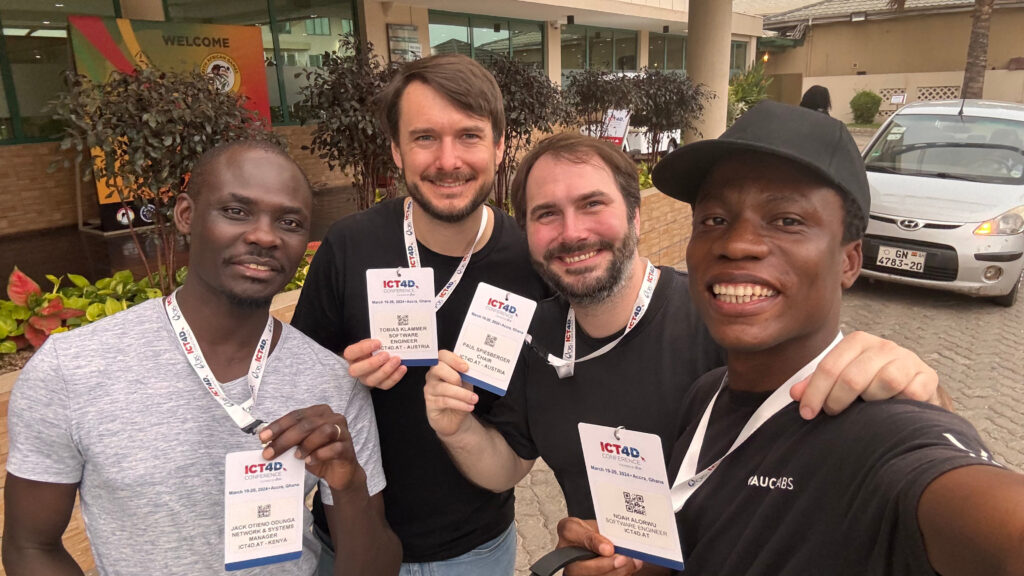
This blog post is a collaboration between Tobias, Jack and Paul who report from sessions they visited and overall impressions.
Reimagining Digital Transformation through Digital Public Goods (DPGs)
Speakers: Abisola Fatokun, Sabeen Dhanani, Ms. Nita Tyagi, Dileep Bapat, Seth Akumani, Lauren Kahn, and Moritz Fromageot
Decision-makers and development professionals across the globe have increasingly understood the importance of Digital Public Goods (DPGs). DPGs promise significant changes in communication between citizens and authorities and in the way services are provided. A key example of the introduction of DPGs was the introduction of an eHealth system in India based on the Aadhaar ID. Due to the size of the Indian population it was not possible to reuse respectively import an existing system from another country. Another key point was that the solution was not pushed from the top down, but rather according to the approaches of “Empowerment comes when people build solutions” and “it is people who bring in the transformation”. DHIS 2 was mentioned several times as a prime example for a successful Digital Public Good. The discussion concluded in the statement that people design solutions that meet their needs – It’s not digital transformation, it is people transformation.
Author: Tobias
Food Security and Climate Tech
Speakers “Enabling Tech access for local market Systems strengthening”: James Haithcoat, Sildio Mbonyumuhire, Meshack Mbinda, Dorien Asampana, Karen Hampson, Gidraf Wachira, Andrew Karlyn, and Worlali Senyo
Speakers “Harnessing Technology for a Climate-Smart Future”: Karen Hampson , Gidraf Wachira, Andrew Karlyn, Dorien Asampana, and James Haithcoat
The Big Discussion on Food Security and Climate Tech stressed the power of technology to bolster local markets, optimizing supply chains and connecting producers directly to consumers. It also highlighted the need to leverage technology for a climate-smart future, promoting precision farming, weather forecasting tools, and resilient crops. The conversation acknowledged the digital divide in rural areas, emphasizing the importance of last-mile solutions like solar-powered equipment to bridge the gap and ensure farmer access to information and markets. Farm Radio was recognized as a vital tool for understanding farmers’ needs, underlining the importance of listening to the listeners to tailor effective solutions. Federated data was seen as crucial for documenting farmers and informing policy decisions, emphasizing the need for collaboration and data sharing to achieve food security and sustainability. Ultimately, the discussion resonated with the message of collective action: “Those of us who can do more should do more, but together we can do a lot.” In his contribution, Worlali Senyo, a member of ICT4D.at and the Country Manager of Farmerline Limited, highlighted a significant financial gap that must be addressed to empower farmers to fulfil their responsibilities. He emphasized the importance of ensuring poverty alleviation among farmers and advocated for a comprehensive approach that incorporates introducing them to the carbon market. Farmerline Limited is already walking the walk. They are equipping farmers with cutting-edge tools for monitoring, traceability, and data analysis. This not only helps farmers, but also paves the way for a future where they can benefit from carbon credits.
The crux of the food security challenge hinges on our resource allocation. The quandary lies in our allocation of efforts: are we truly prioritizing effective food distribution, whereby regions facing scarcity are systematically pinpointed and supplied with surplus from areas of abundance within national, continental, or global contexts? Or are we inadvertently tilting the balance towards a singular focus on production efficiency, channelling our energies solely into boosting yields without adequately addressing the pressing issue of equitable food access and distribution? This dilemma presents a compelling research opportunity. By delving deeper into the effectiveness of both distribution and production efforts, we can illuminate the path towards a more comprehensive and sustainable solution for global food security.
Author: Jack
Greening ICT4D: Tackling our impact on the environment and climate
Speakers: Mariela Machado, Morten Risgaard, Ms. Onica N. Makwakwa and Joel Urbanowicz (Moderator)
The Plenary discussion on “Greening ICT4D: Tackling our Impact on the Environment and Climate” highlighted innovative initiatives like Japan’s Smart Farming, showcasing the potential of technology to reduce the agricultural sectors carbon footprint. However, a critical challenge emerged – the inadequate management of electronic waste (e-waste), particularly in Sub-Saharan Africa. This exposes a significant gap in the region’s approach to sustainable waste management.
A Call to Action: Addressing the E-Waste Challenge
The discussion emphasized the need for a multi-pronged approach:
- Policy and Strategy Formulation: There’s is a pressing need for robust policies and strategies that encourage responsible e-waste management by producers, consumers, and waste handlers. Research efforts should explore effective policy frameworks that incentivize environmentally sound practices throughout the e-waste life cycle.
- End-of-Life Management Solutions: Organisations more so in Sub-Saharan Africa lacks proper infrastructure and cost-effective solutions for handling e-waste at the end of its lifespan. Research is crucial to develop sustainable e-waste collection, recycling, and disposal systems tailored to the region’s context.
- E-waste Reuse and Refurbishment: Exploring the potential for e-waste reuse and refurbishment can significantly extend the lifespan of existing equipment and reduce the need for new electronics. Research could investigate ways to create local markets and incentives for refurbishing and reusing e-waste.
Infrastructure Sharing and Global Collaboration
The discussion recognized the importance of infrastructure sharing as a means to minimize the carbon footprint of ICT4D initiatives. Additionally, it highlighted the need for substantial global efforts, particularly in the Global South, where a lack of adequate e-waste management policies and infrastructure presents a critical gap in sustainable development. Collaboration across different stakeholders – governments, NGOs, technology companies, and research institutions – is crucial to bridge this gap.
Bridging the Gap: A Sustainable Future for ICT4D
By addressing these challenges and gaps, ICT4D initiatives can contribute to a more sustainable future for Sub-Saharan Africa. This will allow the region to bridge the digital divide in an environmentally responsible manner, ensuring inclusive growth and a greener future.
Author: Jack
Digital and Data for Education
Speakers: Nyagaki Gichia, Lindsay Kincaid, Daniel Ganyoame, Maryam Lawan, Vincent Wang (Moderator)
It was a vivid discussion about education and hubs/spaces where learning can happen. Most parents think these spaces are only for children, so how could a hub become inclusive for all ages to access education? Bringing in parents as participants into their children’s education raises its importance and also targets adult’s education. One presented solution was to offer services for adults such as searching online for jobs so they get in touch with the hubs or schools.
The following challenges for education were mentioned:
- Safe space for women to find comfort, make it social and look at the social context. Usually women come with their kids and you need child care taking to facilitate time for education.
- Localize content, use local dialect to make material accessible
- Context of family – the husband often needs to approve so his wife can participate
- Always take the cultural context in consideration. One speaker mentioned that in one of their projects, instead of free t-shirts for women’s graduation they handed out free scarf as most women came fully covered due to their Muslim background
- Young girls needed to be at home to do choirs and the program needs to consider this. Parents need to be on board
Author: Paul
Connecting the Unreached; Accelerating Dignified Development to Amplify Shared Prosperity
Speaker: Ms. Peace Delali
I was not expecting much from BLUETOWN Ltd.’s presentation at this panel discussion. It felt like another company pitch. But then Ms. Peace took the stage, and everything changed. She was not there to sell; she was there to share the incredible work BLUETOWN is doing to bridge the digital divide. Their approach is ingenious. They use a network of strategically placed, solar-powered base stations to deliver local cloud content to students and underserved communities. They even empower locals to monitor the network, troubleshoot basic issues, and escalate problems when needed. This creates a sustainable model that keeps content local and avoids the high cost of undersea cables.
BLUETOWN’s projects are a shining example of how to make ICT truly accessible in Sub-Saharan Africa and the greater global south. Their focus on local content ensures its relevance and accessibility, while their community involvement creates a sense of ownership and long-term impact. This is the kind of innovative thinking we need to bridge the digital divide and empower people everywhere.
Author: Jack
GIS Mapping Innovation & Community Engagement
Presenter: Pano Skrivanos
I was tuning into a session from Cadasta about mapping land for vulnerable communities via GIS technologies. Their “tools empower vulnerable communities to affordably and easily document, map, and secure inclusive land and resource rights at scale for a more sustainable and equitable planet” as vast land has not yet officially claimed by the people who actually live there since generations. They mentioned the following projects they worked on:
- Protecting Indigenous Land through self recognition and registration in Cambodia Indigenous peoples Organization
- Colandef in Ghana to document lands
- VSG Association of Saamaka Authorities – Empowering Saamaka Communities: Strengthening Territory Governance and Resources Management
- JKPP Indonesian Community Mapping Network
They focus a lot on training people and illustrated how they categorize “mappers” from beginners to experts and what kind of services in terms of trainings & technologies they then offer.
In the end participants raised the question if they are also working with governments as just mapping without officially acknowledging would not be enough. They do work with governments but this adds further complexity to a project and often officials are not welcoming to these kind of empowerment. Unfortunately, what I completely missed in the discussion and presentation was the fact that land often is claimed by more than just one person or group. It is still unclear to me how they decide who actually has the right to map a certain area and then state that they own it? Someone who can afford their services and is in control of the technology can raise claims to properties of others which showcases the power such a technology encapsulated.
Author: Paul




 ICT4D Collective