

Hari Harindranath and Tim Unwin with migrants, migrant organisations and tech organisations in Kathmandu, January 2023
The UNESCO Chair in ICT4D leads Work Package 9 within the MIDEQ Hub (funded by UKRI GCRF) on technology, inequality and migration. This is explicitly an intervention package, designed to draw on research across the Hub to bring migrants, migrant organisations and tech developers together to craft practical interventions that can benefit their lives and reduce inequalities associated with migration. We have been working with NISER, our lead partner in Nepal, since 2019 undertaking research on how migrants already use digital tech (see our working papers), and building on this work Prof “Hari” Harindranath and Dr. Maria Rosa Lorini visited Nepal in September 2020 to initiate our intervention activities. Migrants identified two main areas where they felt that interventions could make a significant difference: appropriate training in the uses of safe, wise and secure digital tech, and creating a platform or portal as a digital one-stop-shop that would bring together the most important sources of information for Nepali migrants and ther families.
Hari returned to Nepal with Tim Unwin in January-February 2023 to convene workshops (on 28 and 29 January, and 3rd February) and meetings to take forward the implementation of these two interventions. Good progress was made in the following areas (further details here):
- Designing the content structure for the platform, and setting in motion the work of the content team and the tech team who are going to take forward the digital one-stop-shop with a Beta version planned for May 2023.
- Running a pilot workshop in Kathmandu for migrants based on the slide deck developed with migrant organisations over the previous couple of months. This was well received, with helpful comments having been suggested for improvement.
- Running another workshop in Pokhara for students and staff from a Migrant Resouce Centre, which recommended that we need to develop a more basic introduction to the wise, safe and secure use of digital tech for those who have negligible prior knowledge of digital tech.
This visit to Nepal also provided the valuable opportunity to have a very productive visit to colleagues in the UNESCO Office in Kathmandu (30 January), to sign a partnership agreement and discuss collaborative research-practice with Gandaki University in Pokhara (1-2 February), to meet with tech companies including Hamro Patro and Ncell (3 February), to explore collaboration with government initiatives through the Foreign Employment Board (31 January), to engage with colleagues at the National Innovation Centre (31 January), and to meet with fellow researchers working in the field of digital tech and migration (see images below).

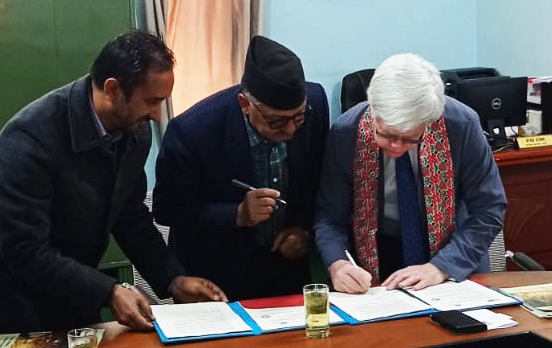


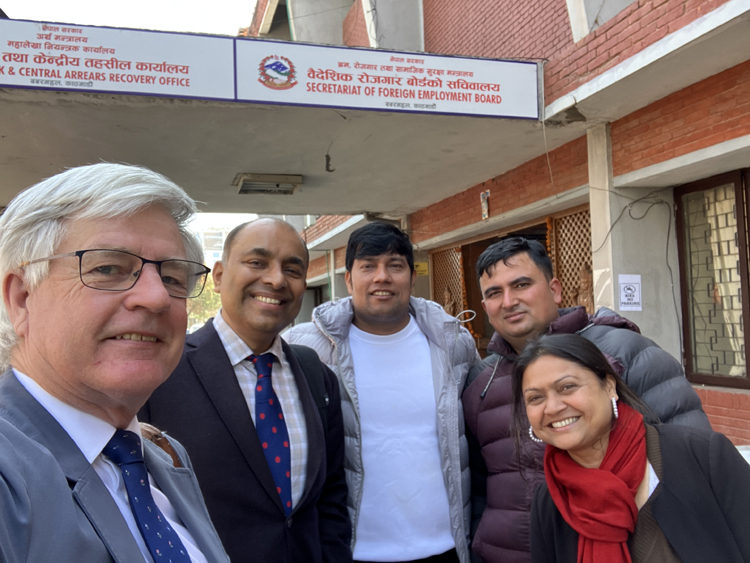

We would like to take this opportunity to thank all those who attended our workshops, and who contributed to this work. We are also grateful to the staff at the Hotel Himalaya, Lalitpur and the Landmark Hotel in Pokhara for facilitating our stay and meetings – and would recommend both for anyone visiting Kathmandu and Pokhara respectively.
 ICT4D Collective
This is good work Hari and Tim.
I often hear people from the OECD nations would volunteer and leave Napal children worse off. However, this research leaves digital wisdom for a common recurring problem. Local government can learn that things can be more efficient and easier to help migrants in other similar developing nations.
Technology is far too often a commercial commodity and not a vehicle to advance social justice.
LikeLike
Thanks so much for these kind words – we are at least trying to be “servants of the poor and marginalised”. Would be good to talk about sharing this work within other contexts
LikeLike
Our colleague Maria Rosa Lorini is leading our work in South Arfica, and will actually be at UCT later this month
LikeLike
Hi Prof Tim
Compliments to the new year and recent publications.
Could you please consult on my Ph.D. proposal for a South African university press media technology.
I am still in the draft stage and need guidance from the I. S. department at UCT. I had a lovely experience with my Faculty but wish to add an international flare to my studies.
I may need ethical clearance and engagement with different campuses in South Africa and would rely on UCT regardless of where one is registered ultimately. I cannot register for this year as the PhD candidates for the year have already started.
I do need a supervisor to show funders in Cape Town. I just need registration guidance from the department. If the attached proposal is eventually cleared I can show funders to agree on a contract as soon as possible.
If this isn’t appropriate to your scope and the , that’s fine. Early stages of research tend to be bumpy.
Regards Mr Nkululeko Makhubu ________________________________
LikeLike
Ciuld you send me a bit more detail about what youmean by “consult on [your] PhD proposal”? Best to send e-mail to address at https://pure.royalholloway.ac.uk/en/persons/tim-unwin – I will be in Cape Town later in the year, and happy to meet up then.
LikeLike