
 Volume 2 Issue 8 August 2017
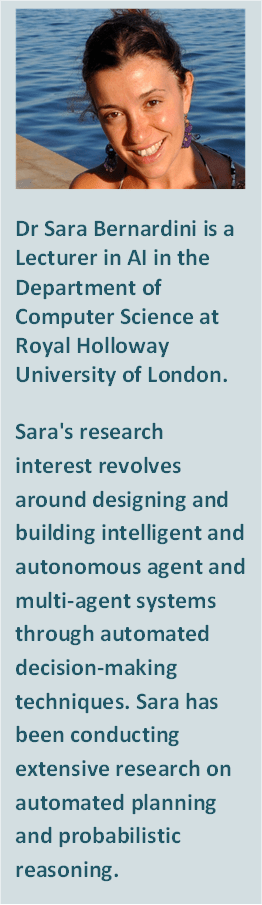
In June, together with more than 500 experts in Artificial Intelligence (AI), I participated in the “AI for Good” Global Summit. Organised in Geneva by the ITU and the XPRIZE Foundation, the summit focused on a crucial and timely question: Can AI contribute to achieve the 17 Sustainable Development Goals that the UN has set to end poverty, protect the planet and ensure prosperity for all?
As an expert in automated decision-making, I know first-hand that AI is a uniquely powerful and transformative technology. AI can have a huge impact not only to further the progress of the wealthy countries, but also to foster the advancement of developing nations. For example, AI can teach people new skills and support lifelong learning. At the same time, the development of AI raises ethical and societal challenges for AI experts and policy-makers, who share the responsability to deploy an AI technology that is safe, reliable and fair.
Why is AI so special? As observed by Stephen Cave during the Summit, AI is a tool different from any other because of three crucial aspects: (i) AI is a universal tool, which will be soon incorporated in all other technologies (e.g. self-driving cars, smart homes, robotics, personalised medicine); (ii) AI can accelerate its own development, besides the development of other tools (e.g. machine learning is an AI tool that can improve itself as well as other AI algorithms); and (iii) AI is autonomous (AI agents make and implement decisions without constant human intervention). In addition, AI is based on data, which are often collected from people and contain sensitive information about them. Considering all these factors together, it becomes clear why AI generates excitement but also concern.
In the last few years, I have focused on the development of UAVs (unmanned aerial vehicles) for surveillance and disaster response applications. I have formulated techniques based on task planning and probabilistic reasoning to make UAVs smart enough to fly autonomously and strategically to achieve sophisticated goals specified by domain experts over a large geographical area and a long temporal horizon. The potential of intelligent vehicles in emergency scenarios is enormous as resources are limited and time is critical. However, these are challenging situations in which decisions can have a life-changing impact and human operators need to trust the machines and understand their behaviour.
 At the Summit, Professor Virginia Dignum formulated three principles on which AI development should be based, which I find particularly relevant:
- Accountability: an AI system needs to to be able to justify its own decisions based on the algorithms and the data used by it. We have to equip AI systems with the moral values and societal norms that are used in the context in which these systems operate;
- Responsibility: although AI systems are autonomous, their decisions should be linked to all the stakeholders who contributed in developing them: manufacturers, developers, users and owners. All of them will be responsible for the system’s behaviou;
- Transparency: users need to be able to inspect and verify the algorithms and data used by the system to make and implement decisions.
I would like to conclude with a provocative remark that Professor Gary Marcus brought to the table during the Summit and that I share: are we really so close to Strong AI as many people seem to think, where “Strong AI” means a system that exhibits integration between all aspects of intelligence: common sense, planning, reasoning, analogy, language and perception? I believe that, although AI can truly change the world, we still need fundamental advances first. Key to achieve them are interdisciplinarity and global collaboration. In particular, I would welcome multi-disciplinary collaborations to make UAVs and drones truly effective in disaster response scenarios.
 Volume 2 Issue 7 July 2017
 We heard many concerns around all the above.
 Volume 2 Issue 6 June 2017
 Volume 2 Issue 5 May 2017
 Volume 2 Issue 4 April 2017
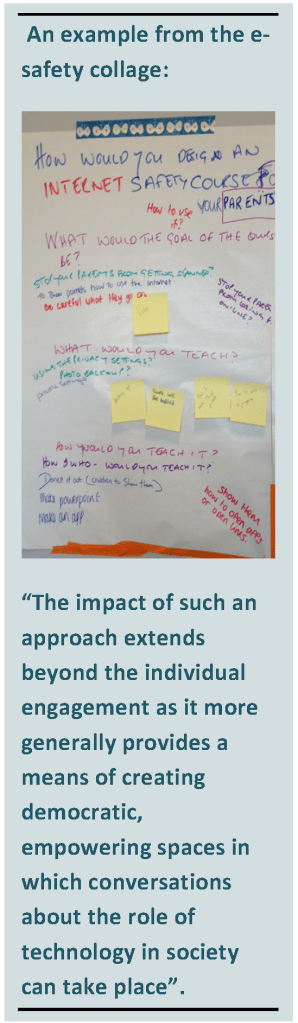 people. The youth workers at the centre decided to focus on e-safety in the context of parental advice and the role they would like parents to play. It was agreed that creative methods would be used to enable this discussion. The researcher worked as a facilitator to help the youth workers and young people to develop the conversation through the co-creation of a wall collage.
 March 2017
 Developers recognise a need to establish a consistent style regardless of the local version of a product. Later localisation is facilitated if a clear style guide for design is developed which includes the use of universal graphics and icons wherever possible.
 In 2016, the Colombian Government had already envisaged a clear direction for the role of information and communication technologies (ICTs) to support post-conflict. According to
 India’s Aadhaar project is the biggest biometric project worldwide, and a good example of ICTs and datafication for development. Aadhaar provides a unique 12-digit number to those who enrol, capturing their fingerprints and iris scan. Its purpose is that of semplifying delivery of social services, enabling rapid identification of those entitled. Biometric details are linked to citizens’ data, hence a fingerprint is enough to access subsidised foodgrains or other benefits. My research on Aadhaar reveals two important points about the datafication of anti-poverty programmes. First is their technical rationale, and second are the political consequences that the new data architecture produces.
 The UNESCO Chair in ICT4D was delighted to represent
 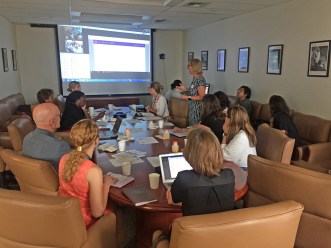 This first Focal Point meeting brought together the founders and partners to explore ways through which the work of EQUALS can best be delivered through three coalitions of partners:
 he efforts made over the last two decades. We suggest that there are four key areas where further action is necessary.
 Interestingly, preliminary results from our online survey suggest that although social media are used for harassment, most often it occurs through calls and text messages. The implications of posting images on social media have recently been highlighted by the apparent
 nergies using existing ICT infrastructures, embracing differences between developed and developing countries without necessarily trying to change them, promoting open and inclusive innovation and redefining financial inclusiveness beyond money could all really bridge gaps in the global digital economy.
 ICT4D Collective