
Enhancing research impact and the launch of our multi-lingual, multimedia resources on the safe, wise and secure use of digital tech by migrants in Nepal, January 2026

Prof G. ‘Hari’ Harindranath visited Nepal in January 2026 funded by an ODA grant from Royal Holloway, University of London to work with partners there to develop new collaborations and help sustain digital interventions undertaken through the UKRI GCRF MIDEQ (2019-2024) project and over the past two years through other funding streams.

Launch of our new collaborative resources

A key highlight was an event to launch our multi-lingual, multimedia resources on the safe, wise, and secure use of digital technology by migrants and other vulnerable groups, developed in partnership with the Association of Community Radio Broadcasters (ACORAB), a network of 300+ community radio stations reaching every corner of Nepal
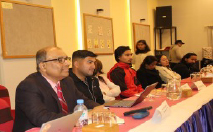
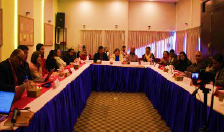
The event included a multi-stakeholder dialogue on digital safety among vulnerable groups in Nepal which brought together nearly 60 participants representing migrant and civil society organisations (female migrants, undocumented labour migrants, LGBTQ+ communities and migrant families from marginalised backgrounds), media and tech organisations including BBC Nepali and international NGOs as well as other international organisations.

New partnership opportunities with Pourakhi

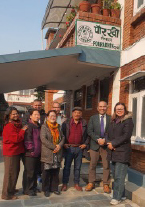
The visit led to new opportunities for partnership with organisations in Nepal that can help further the impact of our ongoing work in support of labour migrants’ use of digital technologies. Pourakhi Nepal, a migrant advocacy group that supports female migrants and returnee migrants, and a key partner for our MIDEQ work, has committed to taking guardianship of the migrant information portal, Pardesi.org.np, which was the result of our collaboration with several migrant organisations and a local tech NGO undertaken during our UKRI GCRF MIDEQ project. The portal will now become part of Pourakhi’s core activity ensuring that it remains updated and relevant to Nepali migrants and their family members.
Meetings with government officials and international organisations

Hari was also able to meet with Nepal’s Minister for Education as well as senior officials at the Ministry of Labour, Employment and Social Security, migrant organisations, local tech and media organisations, and international organisations including UNESCO, IOM, ILO and Helvetas, all with a view to embed our digital interventions within the activities undertaken by our partners, thereby ensuring their sustained impact.
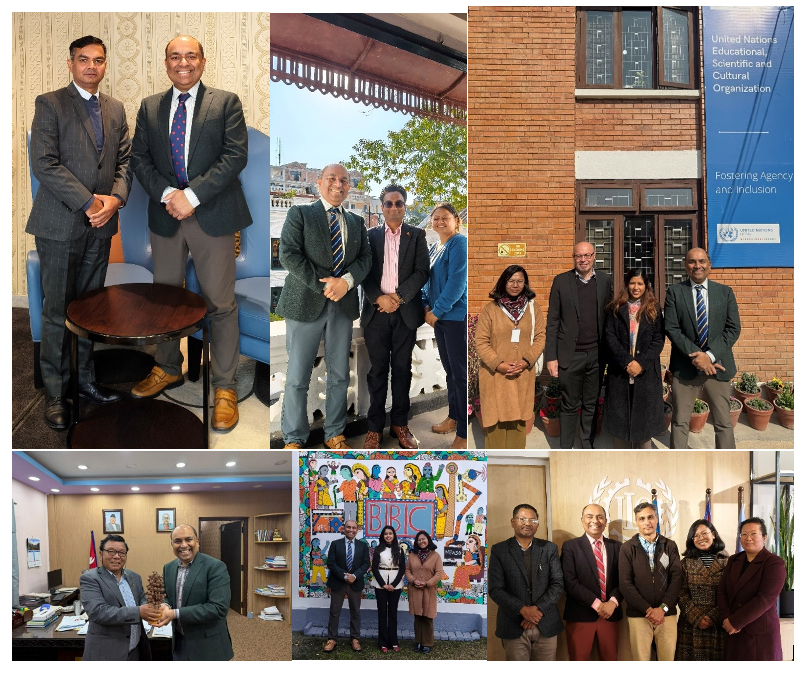
Photos, from the top: two with Gov. of Nepal officials; with UNESCO Nepal; with the Minister for Education; with BBC Nepali Sewa; and with ILO Nepal

Hari Harindranath

23 January 2025

Our new identity as the ICT4D Collective

As of 1st August 2023, the UNESCO Chair in ICT4D at Royal Holloway, University of London has reverted to its original identity as the ICT4D Collective. We are a group of very diverse researchers and practitioners from across the world, bound together by our commitment to the highest possible quality of research-practice relating to the use of digital technologies in the interests of the world’s poorest and most marginalised people.

Meeting staff and students at the NIC's ICT and Electronics Innovation Lab in Pokhara,  Nepal, July 2023
Our last engagement as members of the UNESCO Chair in ICT4D: meeting staff and students at the NIC’s ICT and Electronics Innovation Lab in Pokhara, Nepal, July 2023

The Collective and the UNESCO Chair in ICT4D

The original ICT4D Collective was created in 2004, and evolved through an agreement in 2007 between UNESCO and Royal Holloway, University of London into the UNESCO Chair in ICT4D (Information and Communication Technologies for Development). UNESCO Chairs are groups of researchers in specific institutions undertaking work of direct relevance to UNESCO’s fields of competence, and they promote “international inter-university cooperation and networking to enhance institutional capacities through knowledge sharing and collaborative work”. Members of our UNESCO Chair have been very proud to have been associated with UNESCO for the last 16 years, and to have collaborated closely with many good friends in UNESCO’s Paris headquarters and field offices. We were also honoured that Houlin Zhao, the Secretary General of the International Telecommunications Union (ITU) between January 2015 and January 2023, and Jean Philbert Nsengimana, former Minister of Youth and Information and Communication Technology (MYICT) from Rwanda, were our Honorary Patrons.

The following are some of the things we have particularly enjoyed engaging in over the last 16 years:

  • Working together collegially in a truly multidisciplinary context, involving colleagues from Computer Science, Geography, Information Security, Law and Managament at Royal Holloway, University of London.
  • Creating one of the largest groups of postgraduates completing PhDs in the field of ICT4D during the late 2000s and early 2010s.
  • Crafting an extensive partnership network involving governments, the private sector and civil society, and sharing the lessons we have learnt about making partnerships successful.
  • Contributing our experiences in global discussions around the role of digital tech in international development, especially in the UN’s WSIS process (since its origins in 2003), and UNESCO’s many gatherings relating to education and technology.
  • Playing a leading role in the World Economic Forum and UNESCO’s Partnerships for Education initiative.
  • Working on the ground in support of diverse groups of marginalised people, especially those with disabilities, out of school youth, women in patriarchal societies, and migrants and refugees.
  • Being recognised as the 7th most influential global think tank in science and technology in the Go To Think Tanks Index Report for 2015 (we remained 15th in the 2020 index)

Quick links to aspects of our new identity

We are now re-energised as the ICT4D Collective, with 22 founding members drawn from 13 countries – we welcome new members who share our aims and principles. Quick links to our research and practice are available below:

An exciting future…

We all look forward to continuing the work started by the original ICT4D Collective almost 20 years ago, although we remain very sad that the new leadership team at Royal Holloway, University of London did not see value in the institution continuing to have a UNESCO Chair. Perhaps we represented voices from the past; perhaps we have been too critical and anarchic; perhaps we have just been honest and spoken truth to power. Whatever the reason, we will continue to have fun working together, we will continue to challenge the status quo, we will continue to point out the many harms caused by the use of digital tech, and we will continue to work with and support the world’s poorest and most marginalised peoples.