Digital tech and the most marginalised: what still needs to be done?

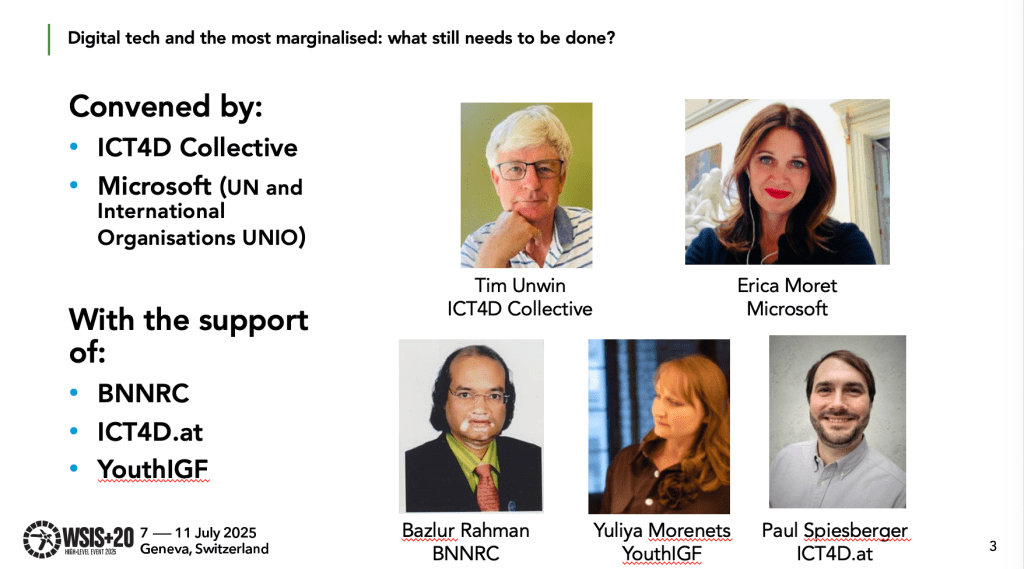
The ICT4D Collective and Microsoft (UN and International Organisations UNIO) (supported by Bangladesh NGOs Network for Radio and Communication, ICT4D.at, and YouthIGF) convened a very lively and interactive Session 360 this morning at the WSIS+20 gathering at Palexpo in Geneva. This began by recognising that digital tech will not be used successfully to deliver the SDGs (especially SDG10) by 2030, but then focused in a very positive way on what governments, the private sector and civil society can indeed do to try to ensure that the poorest and most marginalised can use digital tech to improve their lives.
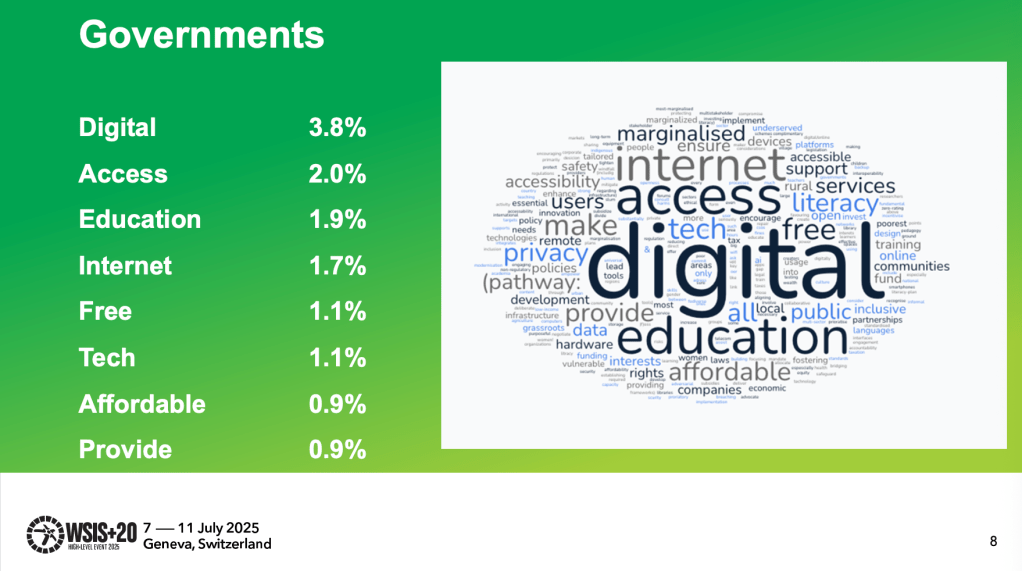
The session built on an online survey conducted in advance of the gathering to explore what people in our networks consider are the most important actions that can be done by governments, the private sector and civil society (as well as international organisations and academia). This is summarised in the slide deck used to guide the sessions (the whole deck is also available by clicking the image below).
Lively introductory thought-provocations were given by Erica Moret (Microsoft), Bazlur Rahman (BNNRC), Paul Spiesberger (ict4d.at) and Yuliya Morenets (Youth.IGF), and the main focus of the session was then to create together a mind map from brainstorming by participants both in the room and also online (as well as using post-its). This generated a wide range of positive and constructive ideas for what we all need to do if we really care about helping the most marginalised use digital technologies to improve their lives. This discussion is summarised below (click on image for full sized .pdf file):
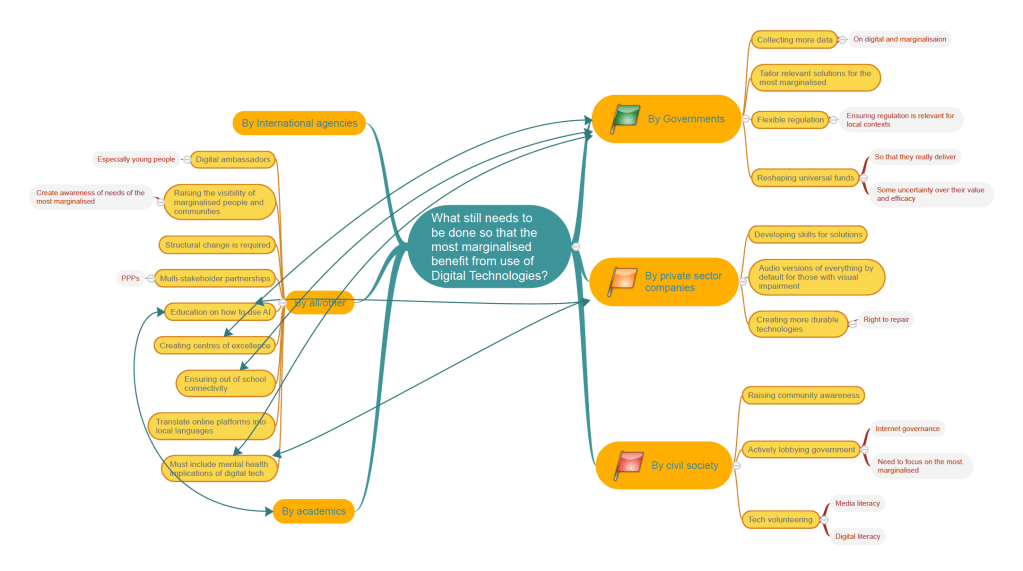
The session ended by participants re-committing themselves to doing something different in the interests of the poorest and most marginalised.
Join the ICT4D Collective at our session on digital tech and the most marginalised at the WSIS+20 High-Level Event in Geneva on 8th July

We are delighted to be jointly convening a session (306) at the WSIS+20 High-Level Event in Geneva on 8th July at 09.00 in Room L, Palexpo, Geneva. The joint convenors are the ICT4D Collective and Microsoft (UN and International Organisations UNIO), supported by Bangladesh NGOs Network for Radio and Communication, ICT4D.at, and YouthIGF.

Session Outline

The multistakeholder digital tech communities associated with the UN system seem unlikely to deliver on the SDGs by 2030, despite the efforts of those involved in developing and implementing the Global Digital Compact (2024). In particular, SDG10 on reducing inequalities remains insufficiently addressed, with much emphasis instead continuing to be placed on maximising economic growth through innovation. All too often the most marginalised, especially those with disabilities, LGBTIQ communities, women in patriarchal societies, the elderly, ethnic minorities and refugees, are in practice made yet more marginal through the adoption of the latest digital tech by those more powerful and richer than they are.

UNDESA, ECOSOC/CSTD, many other UN agencies, and the IGF process are all conducting widespread consultations about the future of “digital and development” and the WSIS Process, but these have still not sufficiently addressed the tendency for digital tech to be used to increase inequalities, rather than to address issues of inequality and equity. Our interactive session is the culmination of a consultation process during the three months before the annual WSIS Forum through which people across our different networks have contributed their ideas to what the five highest priorities should be for governments, the private sector, civil society and the UN system in creating greater equity in the use of digital tech. The findings of this process will be presented during the session, and participants invited during the session to add to the recommendations through the interactive development of a mind map on marginalization that will provide a very specific output to feed into the wider ongoing debate within the UN system about digital tech and equity.

Please make your voice heard beforehand

Everyone is invited to contribute before the session through a short (max 10 minute) online survey available at:  https://app.onlinesurveys.jisc.ac.uk/s/rhul/digital-equity-wsis2025. This will form the basis of our conversations in Geneva, and so even if you cannot attend in person please do copmplete this survey about what needs to be done to ensure that the poorest and most marginalised can indeed benefit from the use of digital tech.

Reflections on research practice in the interests of migrants

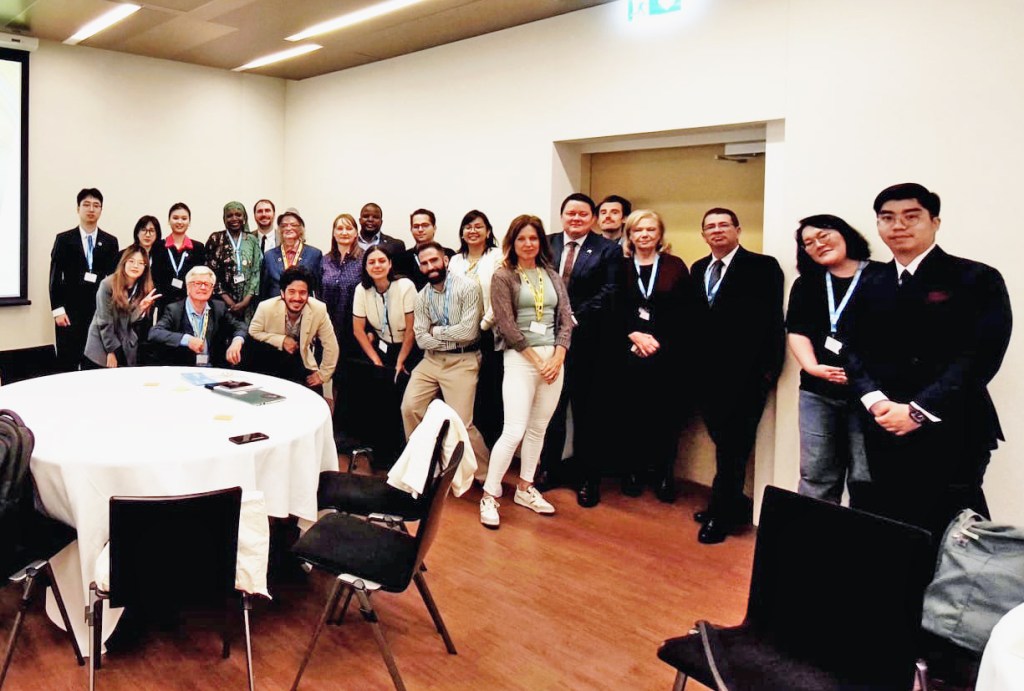
Participants in the workshop (without the convenors!)

Members of the ICT4D Collective have been actively involved as Work Package 9 in the MIDEQ Hub since 2019, focusing especially on ways through which migrants can use digital tech to improve their lives, and thereby reduce the inequalities associated with migration. The Hub held its final major symposium in Rio de Janeiro in September 2023, and Tim Unwin, Hari Harindranath and Maria Rosa Lorini from the Collective, together with Guilia Casentini from SOAS took this opportunity to convene a highly interactive workshop/roundtable for members of MIDEQ on the theme of “What works for migrants: reflections on research practice in the interests of migrants”. The fundamental purpose of this was to explore how migrants may have benefited from our work, and how we might know what impact we may actually have had on them.

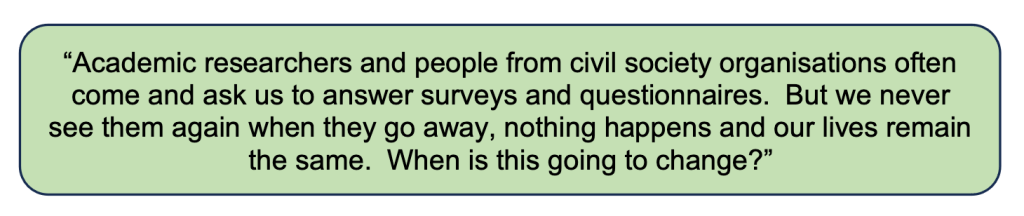
Heard in passing during our research… When will such often heard comments be consigned to the past?

The workshop addressed four main themes:

  • How do we really know what migrants think about our work?
  • What have we found to be effective ways of gathering empirical evidence about
    outcomes experienced by migrants?
  • What have we found to be effective ways of disseminating our outputs so that
    migrants benefit from them?
  • What are good forms of “output”/intervention to improve migrant lives?

The discussion was highly interactive, and generated a mind map of our collective thoughts, based on which we have now crafted a working paper which combines a summary of what was said with some of our own ideas around these issues. This is freely available as Unwin, T., Casentini, G., Harindranath, G. and Lorini, M.R. (2023) What works for migrants: reflections on research practice in the interests of migrants, Egham: ICT4D Collective, Working Paper 1.

We very much hope that this will promote discussion and further interaction on the crucial subject of the extent to which academic research can positively impact the lives of poor and marigalised communites and how we can know what migrants actually think of what we do. Do share your views by adding a comment to this post, or please get in touch with us directly to carry the conversation forward,

Members of UNESCO Chair in ICT4D to play leading roles in DFID’s multi-country directorate for research and innovation hub on technology for education

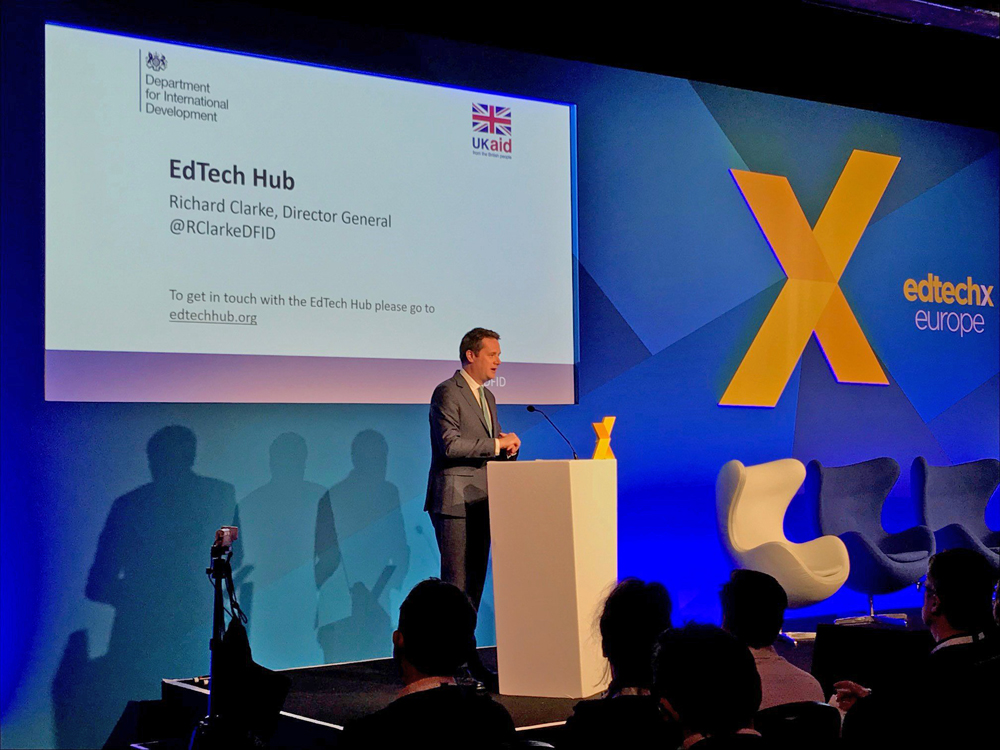
DFID AnnouncementRichard Clarke, Director General for Policy, Research and Humanitarian at the UK’s Department for International Aid (DFID) announced today that a consortium involving Dr. David Hollow and Tim Unwin, both from our UNESCO Chair in ICT4D, has been awarded the contract to lead its new £20 m research and innovation hub on technology for education.  This will explore how the world’s most marginalised children and young people can learn best through the use of new and innovative technologies.  The members of the consortium are the Overseas Development Institute, the Research for Equitable Access and Learning (REAL) Centre at the University of Cambridge, Brink, Jigsaw Consult, Results for Development, Open Development and Education, AfriLabs, BRAC and eLearning Africa.  David will serve as Research Co-Director and Tim as Chair of the Intellectual Leadership Group.

The new Hub aims to undertake and promote the highest quality of comparative and longitudinal research at the interface between technology and education, and then share the findings widely so that everyone is better aware about how technology can best serve the learning interests of the poorest and most marginalised.  This builds in part on the UNESCO Chair in ICT4D’s long established experience on technology and learning, dating back to Tim’s leadership of the UK Prime Minister’s Imfundo initiative (2001-2004) creating partnerships for IT in education in Africa, our DelPHE and EDULINK funded collaboration with African universities, the wider work of the World Economic Forum and UNESCO Partnership for Education initiative between 2007 and 2011, and the cohort of PhD students doing research at the UNESCO Chair in ICT4D on technology and learning in Africa in the latter 2000s , including David Hollow and Marije Geldof.

We are all very excited to be a part of this new initiative, which will be the largest ever education and technology research and innovation programme designed specifically to improve teaching and learning, especially in poorer countries.  It is a clear example of the ways through which research undertaken within the UNESCO Chair in ICT4D is having real global impact, and is the second £20 m grant to have been awarded to consortia that include members of the Chair in the last six months, the other being the UKRI GCRF South-South Migration, Inequality and Development Hub.

Christmas Greetings 2017 from the UNESCO Chair in ICT4D

crib

Members and Affiliated Members of the UNESCO Chair in ICT4D would like to take this opportunity to share these images from a nativity scene in Macau earlier this month and wish all of their friends and colleagues a happy, peaceful and relaxed Christmas.  According to the Gospels,  Christ was born in a stable (homeless), to an unmarried mother, and then became a refugee as his parents fled from Palestine to Egypt.  For those of us working in the field of ICT4D, it is a timely reminder of our commitment to using ICTs to serve the interests of the poorest and most marginalised, wherever they are to be found, and especially children, the homeless, minorities, and refugees.

crib 2

For learn more about our work, do explore these links:

UNESCO Chair in ICT4D session at WSIS Forum 2017

coverTo coincide with the recent publication of Tim Unwin’s new book entitled Reclaiming Information and Communication Technologies for Development (Oxford University Press, 2017), the UNESCO Chair in ICT4D is convening a workshop on Friday 16th June (11.00-12.45 in Room Popov 1) at the 2017 WSIS Forum being held in Geneva.  The key premise of the workshop is that the global spread of ICTs has increased inequality, and that the poorest and most marginalised have therefore failed sufficiently to benefit.  The workshop will explore whether the continued focus on the ways through which ICTs can contribute to economic growth will inevitably lead to ever increasing, and dangerous, inequality, and will make recommendations as to how different stakeholders can best ensure that the poorest and most marginalised can indeed benefit from their use.

It will begin with short (5 minute) perspectives from some amazing people (listed in alphabetical order of first names):

  • Alex Wong (Head, Global Challenge Partnerships & Member of the Executive Committee; Head of the Future of the Internet Global Challenge Initiative, World Economic Forum) on The power of partnership
  • Dr. Bushra Hassan (School of Psychology, University of Sussex) on The wisdom of marginalised women
  • Charlotte Smart (Digital Policy and Programme Manager, Department for International Development, UK) on The delivery of donors
  • Michael Kende (Senior Advisor, Analysis Mason, and former Chief Economist of the Internet Society) on The trust in technology
  • Nigel Hickson (VP IGO Engagement, ICANN) on The design of the domain name system
  • Torbjörn Fredriksson (Head of ICT Analysis Section of the Division on Technology and Logistics, UNCTAD) on The energy of entrepreneurship

Following these short, and undoubtedly provocative, presentations there will be an open discussion focusing on participants’ thoughts as to what are the most important priorities for action that different stakeholders must take so that the poorest and most marginalised people and communities can indeed be empowered through the use of ICTs.

The workshop is open to everyone with interests in ways through which ICTs can indeed benefit poor people, and there will also be an opportunity after the workshop for participants to purchase copies of Reclaiming Information and Communication Technologies for Development at a 40% reduction from list price.

We very much look forward to seeing you in Geneva at the 2017 WSIS Forum.

Silvia Masiero’s seminar on big data and poverty in India

Silvia Masiero (Loughborough University, and Affiliated Member of the UNESCO Chair in ICT4D) has just finished a fascinating seminar at the UNESCO Chair in ICT4D on The Affordances of Big Data for Poverty Reduction: Evidence from India, which raised many interesting questions about the relative benefits and challenges of biometric data, especially in the context of demonetisation in India.  Slides of the presentation are available here, and her recent ICT4D briefing on the same subject is here.

This slideshow requires JavaScript.