ITCILO Labour Migration Academy Webinar: Digitalisation and Fair Recruitment – Sharing Experiences

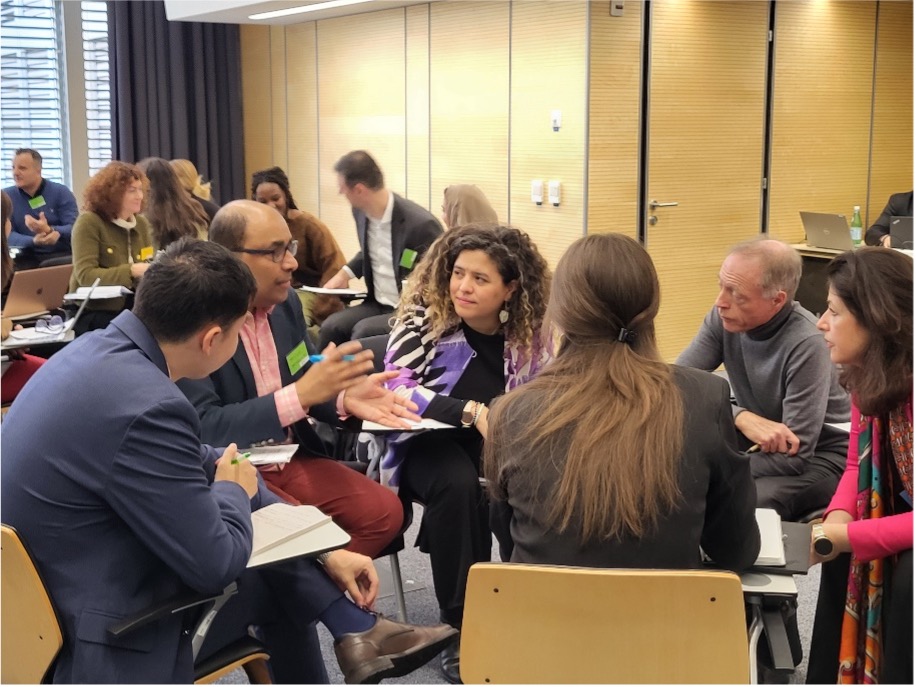
Prof. G. ‘Hari’ Harindranath was delighted to to moderate the ITCILO Labour Migration Academy webinar on Digitalisation and Fair Recruitment – Sharing Experiences held on 23 October 2025. This was attended by over 50 practitioners from around the world representing governments, employers, trade unions, and civil society groups. They were joined by three experts who shared national experiences of digitalising fair recruitment processes in Bangladesh, India, and Nepal:

  • Neha Choudhary discussed Nepal’s Foreign Employment Information Management System (FEIMS), designed to reduce information asymmetries in the labour migration supply chain by connecting migrant workers, recruiters, employers, and other relevant actors.
  • Rahnuma Salam Khan introduced Bangladesh’s Recruitment Agents’ Information Management System (RAIMS), which enhances oversight of recruitment agencies and intermediaries, promoting transparency and accountability.
  • Dr. K.V. Swamy (former GM, Overseas Manpower Company of Andhra Pradesh, India) shared his experiences with India’s eMigrate system, which connects and monitors all stakeholders involved in labour migration.

Key insights from the discussion

Key insights from the discussions were:

  • Digitalisation can be transformational for fair recruitment. It enables more integrated engagement across stakeholders in the labour migration cycle, improving data collection and analysis, increasing transparency and accountability, reducing migration costs, and offering quicker access to grievance resolution mechanisms.
  • However, these benefits cannot be taken for granted. Labour migration recruitment is complex and risk laden. Digital tools alone cannot eliminate exploitation or structural inequities. Successful digitalisation of fair recruitment requires significant groundwork, including:
    • A migrant-first approach, aligned with the principle of “nothing about us without us”
    • A whole-of-government approach to ensure policy coherence and a data governance approach to match
    • Organisational cultural change across stakeholders to enable new ways of working
    • Commitment to digital skills development and ensuring accessibility for all migrant workers
    • Complementary on-the-ground interventions to ensure inclusion of the most vulnerable, who are often least likely to benefit from digital systems
    • Ethical and privacy safeguards that underpin digital systems, ensuring compliance with data protection regulations and safeguarding migrant workers’ rights.

Hari would like to thank the ITCILO for convening this panel, all the participants and staff for their engagement, and particularly Elton Di Tommazi Maciel and Michela Albertazzi for inviting him to moderate the session.
Prof. Harindranath’s reflections on an inspiring session at ITCILO’s Academy on Labour Migration

Today, I had the privilege of delivering a session titled “Digitalisation of Labour Migration Governance: Inclusive Solutions or Digital Solutionism?” at the ITCILO Academy on Labour Migration. The session brought together an incredible group of nearly 40 participants from diverse regions – Asia, Africa, the Caribbean, Pacific Islands, and Europe. This global audience included policy planners, government officials, workers’ and employers’ organisations, civil society representatives, activists, researchers, and journalists – all deeply engaged in the critical issues surrounding labour migration.

What stood out for me was the richness of the perspectives shared by participants on the role of digital technologies in this sensitive and complex domain characterised by huge power imbalances and varied digital capacities. Digitalisation of labour migration governance cannot be truly fair if it serves governments, employers and intermediaries and then disempowers vulnerable labour migrants, the very group it is meant to support. We must ensure that migrant voices are at the forefront of these efforts. Their experiences and needs are integral to shaping solutions that are equitable, inclusive, and just.

Let us keep working together to amplify and centre the voices of migrants in this important conversation.

Prof G. ‘Hari’ Harindranath

15/7/2025

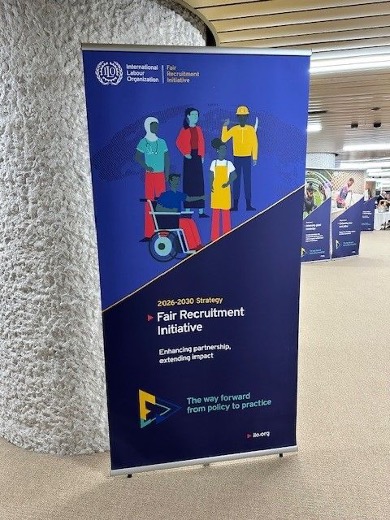
Prof. Harindranath participates in the ILO’s 10th anniversary celebrations of the Fair Recruitment Initiative

Prof G. ‘Hari’ Harindranath was honoured to be invited to contribute to the panel on ‘Leveraging digital innovations to enhance fair recruitment and combat abusive practices’ at the International Labour Organization‘s Global Conference on ‘Fair Recruitment Initiative: The Way Forward, from Policy to Practice’ held in Geneva between 19th and 20th May 2025. This event marked ten years of the ILO’s Fair Recruitment Initiative and brought together representatives from government, employers, trade unions and ILO’s UN partners including the IOM, WHO and UNHCR.

Digital technology is rapidly transforming the way migrant workers are recruited, bringing both new opportunities and serious risks. The interactive panel session examined emerging digital solutions that aim to promote fair recruitment – from tools used by workers to platforms leveraged by governments, inspectors and employers – and unpacked the associated risks and opportunities, and discussed actionable insights from participants on what works, what doesn’t, and how digital tech can be better harnessed to protect migrant workers.

Hari participated in a panel that also included representatives from the International Trade Union Confederation and The Adecco Group, one of the world’s largest human resources and temporary staffing firm.

Hari’s contribution questioned the uncritical application of digital tech in contexts of vulnerability that can cause harms, exacerbate existing inequalities and even create new ones. If digital technologies are to be used to advance fair recruitment of labour migrants, then it requires responsible digital practices that balance tech with supportive human interventions and a sustained focus on the safe, wise and secure use of digital tech by migrants.

Hari had previously been invited to contribute to the Global Forum on Migration and Development’s (GFMD) preparatory roundtables on ‘New Technologies and Digitalization: Improving Migration Management and Regular Migration Pathways’ in Geneva during February 2025 (and online in November 2024) in preparation for the 2025 GFMD Summit in Colombia.

Created in 2007, the Global Forum on Migration and Development (GFMD) is a state-led process connecting governments with civil society, the private sector, local and regional governments, youth, the UN system and other relevant stakeholders to helps shape the global debate on migration and development.

These significant policy engagement opportunities evidence the impact of our research-practice with vulnerable groups including migrants undertaken over the past six years, initially funded through a major UKRI GCRF grant and then through Royal Holloway’s Research England ODA and Social Purpose Research and Innovation Hub (SPRIH) grants (all in Nepal and South Africa) and through SSIA funding (in Brazil). Further details of this ongoing work can be found here (on the safe, wise and secure use of digital tech) and here (on our research-practice with migrants).

Prof. G. ‘Hari’ Harindranath, 29 May 2025