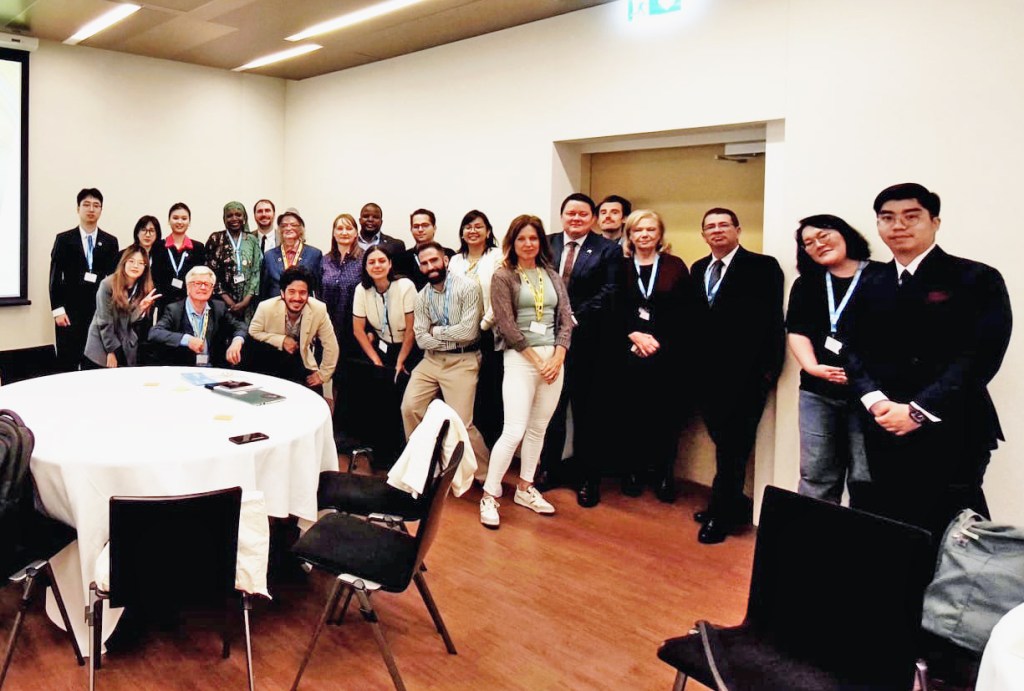
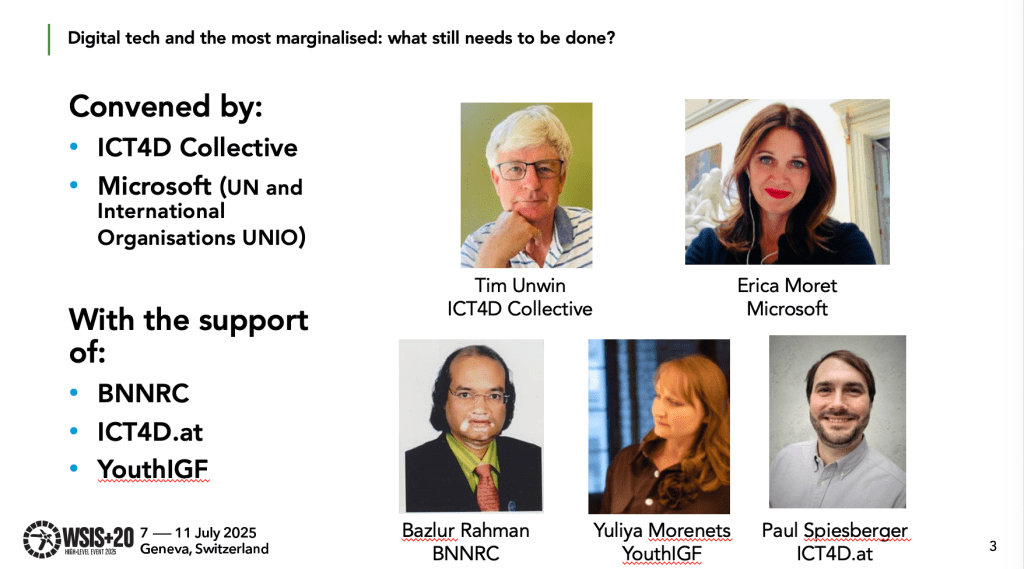
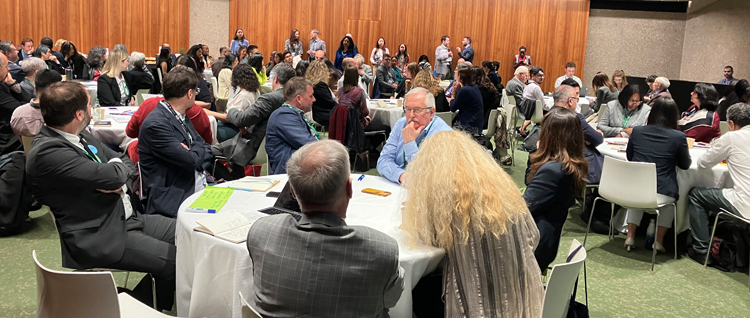
The ICT4D Collective and Microsoft (UN and International Organisations UNIO) (supported by Bangladesh NGOs Network for Radio and Communication, ICT4D.at, and YouthIGF) convened a very lively and interactive Session 360 this morning at the WSIS+20 gathering at Palexpo in Geneva. This began by recognising that digital tech will not be used successfully to deliver the SDGs (especially SDG10) by 2030, but then focused in a very positive way on what governments, the private sector and civil society can indeed do to try to ensure that the poorest and most marginalised can use digital tech to improve their lives.
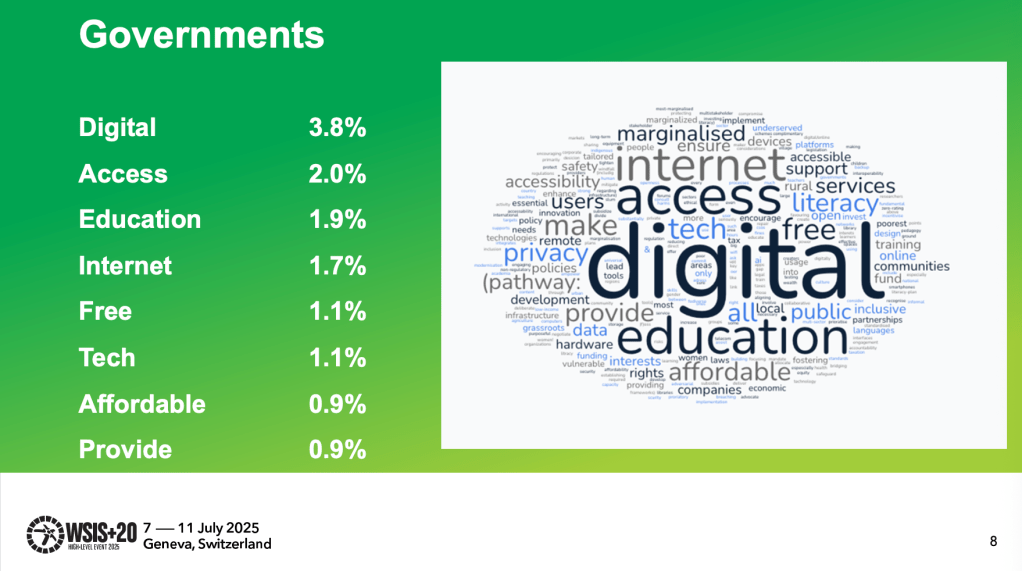
The session built on an online survey conducted in advance of the gathering to explore what people in our networks consider are the most important actions that can be done by governments, the private sector and civil society (as well as international organisations and academia). This is summarised in the slide deck used to guide the sessions (the whole deck is also available by clicking the image below).
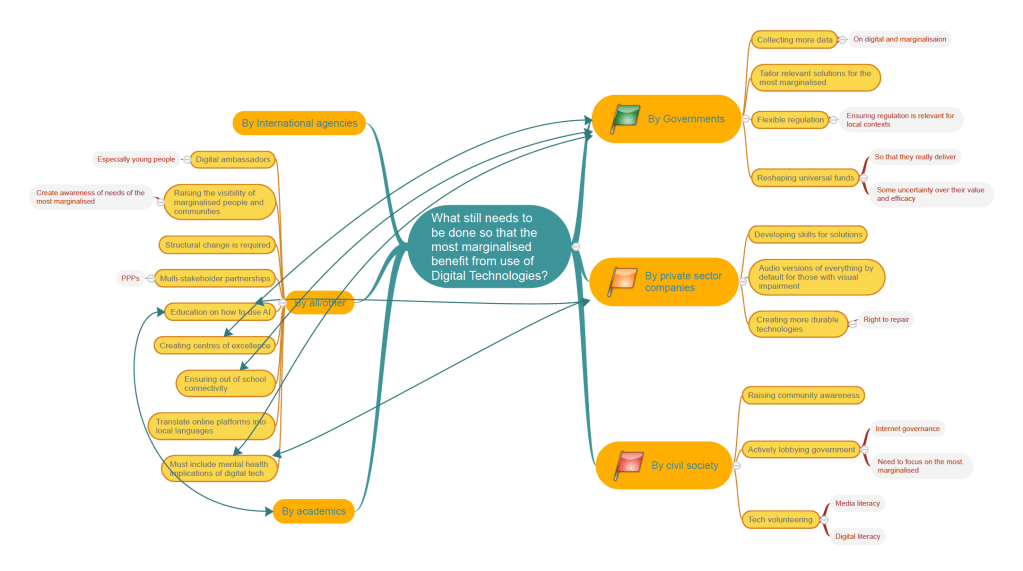
Lively introductory thought-provocations were given by Erica Moret (Microsoft), Bazlur Rahman (BNNRC), Paul Spiesberger (ict4d.at) and Yuliya Morenets (Youth.IGF), and the main focus of the session was then to create together a mind map from brainstorming by participants both in the room and also online (as well as using post-its). This generated a wide range of positive and constructive ideas for what we all need to do if we really care about helping the most marginalised use digital technologies to improve their lives. This discussion is summarised below (click on image for full sized .pdf file):
The session ended by participants re-committing themselves to doing something different in the interests of the poorest and most marginalised.
The multistakeholder digital tech communities associated with the UN system seem unlikely to deliver on the SDGs by 2030, despite the efforts of those involved in developing and implementing the Global Digital Compact (2024). In particular, SDG10 on reducing inequalities remains insufficiently addressed, with much emphasis instead continuing to be placed on maximising economic growth through innovation. All too often the most marginalised, especially those with disabilities, LGBTIQ communities, women in patriarchal societies, the elderly, ethnic minorities and refugees, are in practice made yet more marginal through the adoption of the latest digital tech by those more powerful and richer than they are.
UNDESA, ECOSOC/CSTD, many other UN agencies, and the IGF process are all conducting widespread consultations about the future of “digital and development” and the WSIS Process, but these have still not sufficiently addressed the tendency for digital tech to be used to increase inequalities, rather than to address issues of inequality and equity. Our interactive session is the culmination of a consultation process during the three months before the annual WSIS Forum through which people across our different networks have contributed their ideas to what the five highest priorities should be for governments, the private sector, civil society and the UN system in creating greater equity in the use of digital tech. The findings of this process will be presented during the session, and participants invited during the session to add to the recommendations through the interactive development of a mind map on marginalization that will provide a very specific output to feed into the wider ongoing debate within the UN system about digital tech and equity.
Please make your voice heard beforehand
Everyone is invited to contribute before the session through a short (max 10 minute) online survey available at: https://app.onlinesurveys.jisc.ac.uk/s/rhul/digital-equity-wsis2025. This will form the basis of our conversations in Geneva, and so even if you cannot attend in person please do copmplete this survey about what needs to be done to ensure that the poorest and most marginalised can indeed benefit from the use of digital tech.
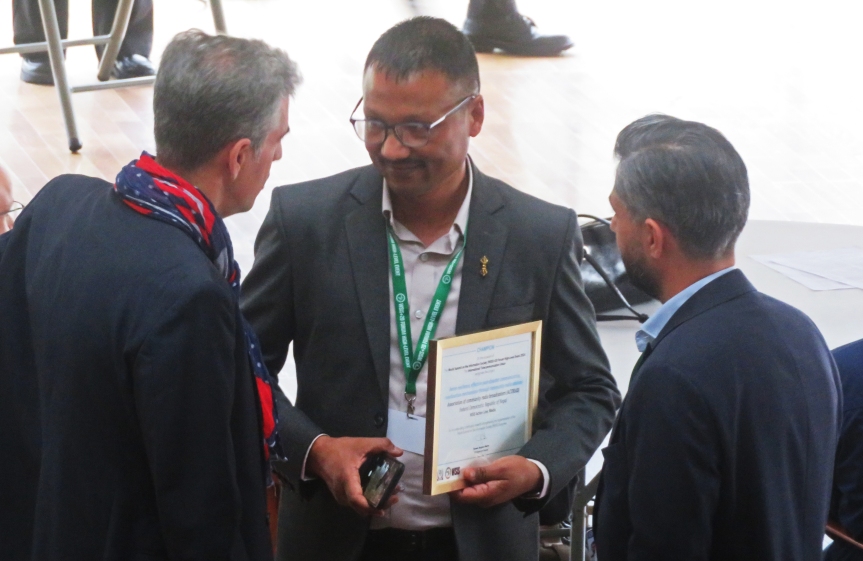
Digital technology is rapidly transforming the way migrant workers are recruited, bringing both new opportunities and serious risks. The interactive panel session examined emerging digital solutions that aim to promote fair recruitment – from tools used by workers to platforms leveraged by governments, inspectors and employers – and unpacked the associated risks and opportunities, and discussed actionable insights from participants on what works, what doesn’t, and how digital tech can be better harnessed to protect migrant workers.
Hari participated in a panel that also included representatives from the International Trade Union Confederation and The Adecco Group, one of the world’s largest human resources and temporary staffing firm.
Hari’s contribution questioned the uncritical application of digital tech in contexts of vulnerability that can cause harms, exacerbate existing inequalities and even create new ones. If digital technologies are to be used to advance fair recruitment of labour migrants, then it requires responsible digital practices that balance tech with supportive human interventions and a sustained focus on the safe, wise and secure use of digital tech by migrants.
Hari had previously been invited to contribute to the Global Forum on Migration and Development’s (GFMD) preparatory roundtables on ‘New Technologies and Digitalization: Improving Migration Management and Regular Migration Pathways’ in Geneva during February 2025 (and online in November 2024) in preparation for the 2025 GFMD Summit in Colombia.
Created in 2007, the Global Forum on Migration and Development (GFMD) is a state-led process connecting governments with civil society, the private sector, local and regional governments, youth, the UN system and other relevant stakeholders to helps shape the global debate on migration and development.
These significant policy engagement opportunities evidence the impact of our research-practice with vulnerable groups including migrants undertaken over the past six years, initially funded through a major UKRI GCRF grant and then through Royal Holloway’s Research England ODA and Social Purpose Research and Innovation Hub (SPRIH) grants (all in Nepal and South Africa) and through SSIA funding (in Brazil). Further details of this ongoing work can be found here (on the safe, wise and secure use of digital tech) and here (on our research-practice with migrants).
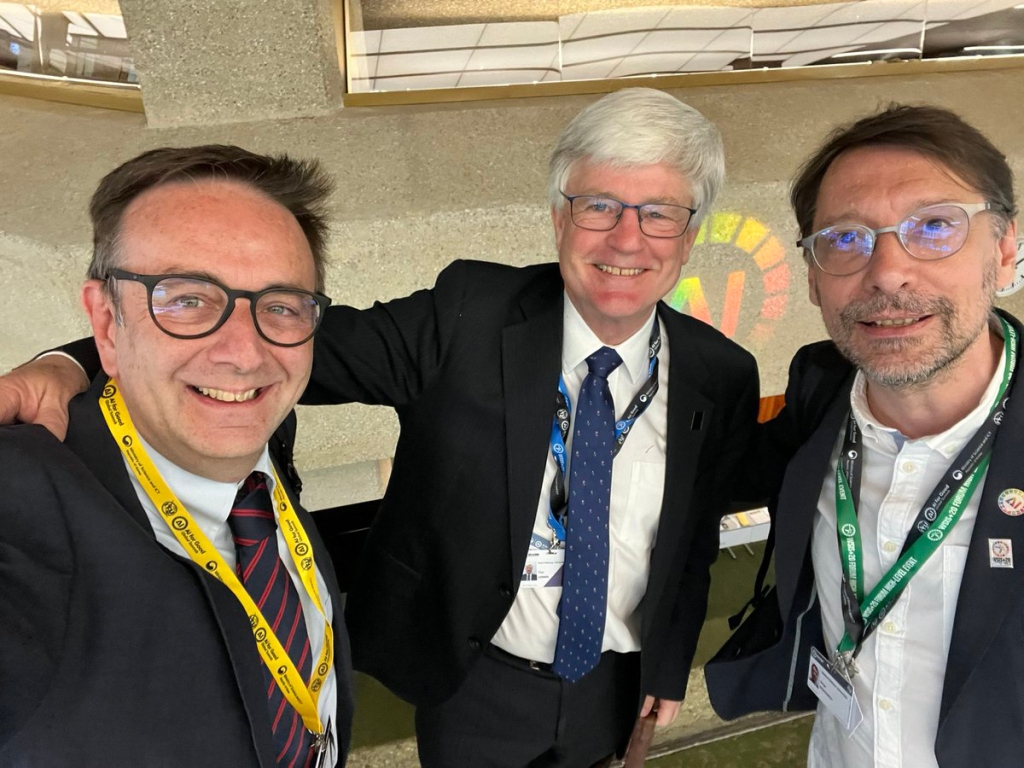
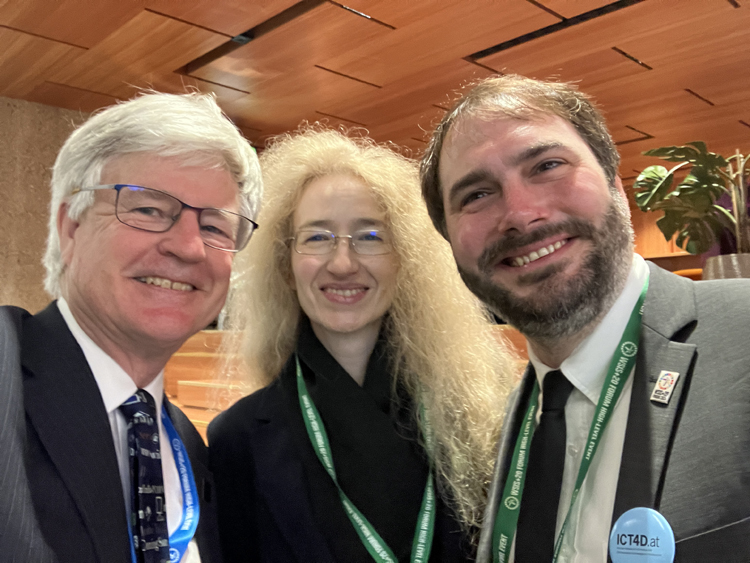
Members of the ICT4D Collective and friends had an exciting and very busy time in Geneva during the 20th anniversary meeting of the World Summit on the Information Society between 26th and 31st May, 2024. Our full agenda is available here, but we summarise below details of the two main sessions that we convened.
Community Media Networks: envisioning the future (Session 331)
We convened this session on 29th May with ACORAB/CIN , BNNRC, TaC-Together, Youth IGF, Cape Town TV, CEMCA, and ICT4D.at, highlighting the importance of community media in reaching some of the world’s most isolated and marginalised people. Our very distinguished line-up of speakers and moderators included (in order of speaking): Pramod Tandukar (Executive Director, ACORAB, Nepal), AHM Bazlur Rahman (CEO, Bangladesh NGOs Network for Radio and Communication), Dr. R Sreedher (Tele Learning and Community Radio Practitioner), and Philomena Gnanapragasam (CEO Asia-Pacific Institute for Broadcasting Development), with Tim Unwin (ICT4D Collective) and Paul Spiesberger (ICT4D.at) also being moderators.
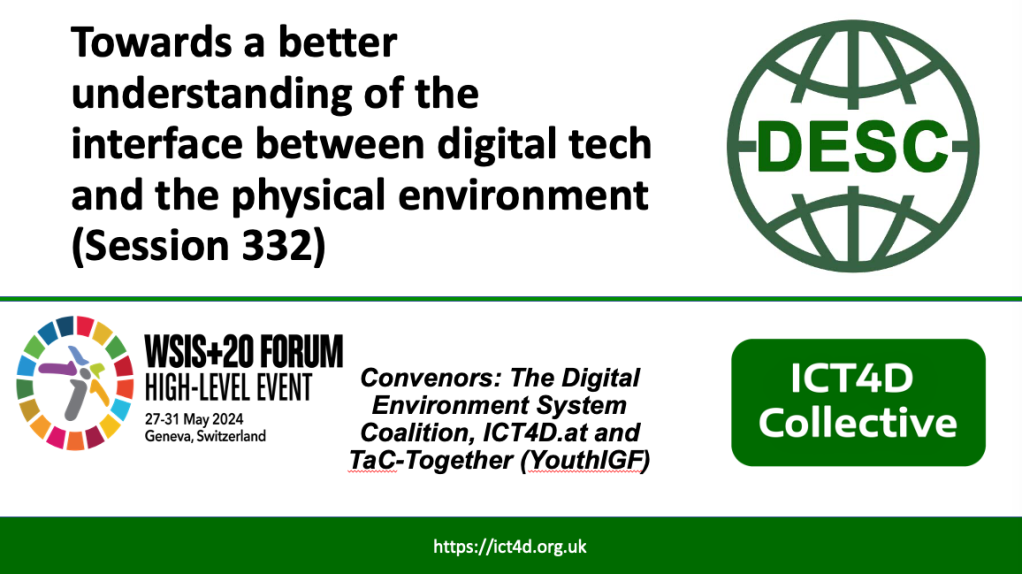
Towards a better understanding of the interface between digital tech and the physical environment (Session 332)
This session (convened by The Digital Environment System Coalition, ICT4D.at and TaC-Together with YouthIGF) provided an overview of the agenda being developed by the Digital-Environment System Coalition (DESC), and an outline of our proposed contribution to the ITU’s Partner2Connect initiative. It emphasised the need for a completely new was of understanding the interactions between digital tech and the environment, that is much more holistic than the existing emphasis of the “global community” mainly on climate change, carbon emissions, and e-waste.
The ICT4D Collective is delighted to be participating actively in the upcoming WSIS+20 week of activities in Geneva, especially since 2024 is also the 20th anniversary of the foundation of the Collective, which was created in 2004 to conduct the highest possible quality of research in the field of ICT4D primarily in the interests of poor people and marginalised communities, and making the results of this available freely to the global community.
Geneva from the ITU
Members of the Collective are actively engaged mainly in the following sessions at WSIS+20:
All of these events have been convened jointly with our partners and friends or we have been invited to participate in their sessions as speakers and moderators, and we are most grateful to them for such collaboration. Please do join us at WSIS+20 – we promise to try to make our involvement exciting, interactive and challenging. Should you wish to contact us and arrange meetings during WSIS, do please use our contacts page.
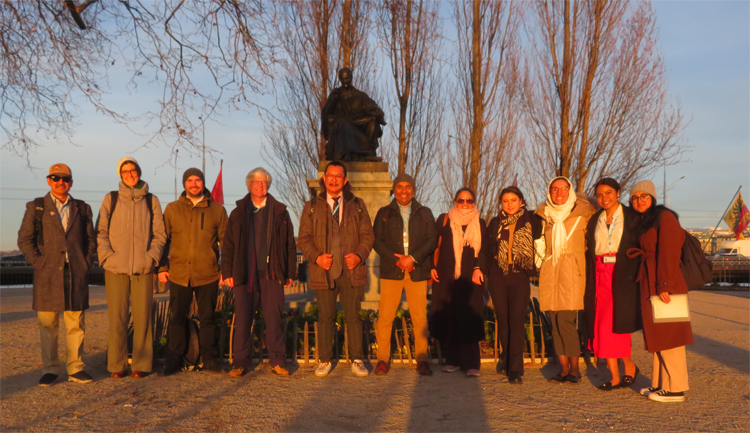
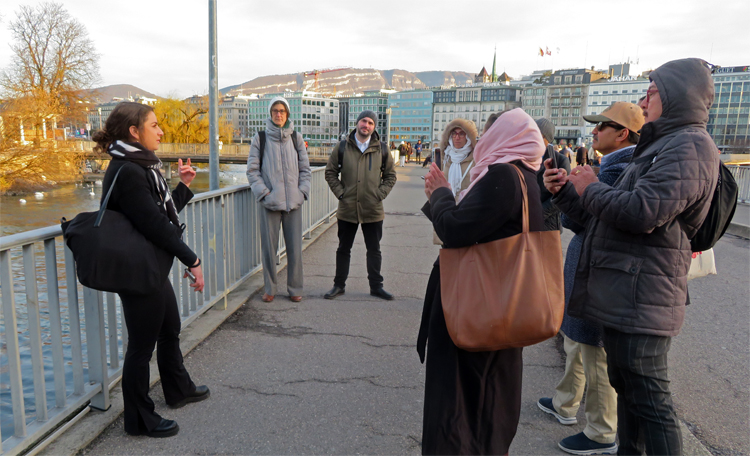
Particiants on the DESC walk photographes beneath the statue of Rousseau as the sun sets
The Digital Environment System Coalition (DESC) convened two sessions (403 and 204) on 16th and 18th March at this year’s WSIS Annual Forum held in Geneva. The first was a walk which we believe to be the first ever such event held during a WSIS annual forum, and the second was a more traditional session within the cavernous CIGG. Both sessions were convened by the UNESCO Chair in ICT4D at Royal Hollloway, University of London which provides the Secretariat to DESC, in association with INIT (the Inter-Islamic Network on IT), the WWRF (Wireless World Research Forum), ICT4D.AT, and RC-DISC (the Research Cluster for Digital Inequality and Social Change at the University of Canberra).
Experiencing digital environment interactions in the “place” of Geneva (Session 403): the DESC Walk
We experience things differently when we walk, when we talk together, and when we interact with the real physical environment. We feel the fresh air on our faces, smell the vegetation, hear the noise of running water, and touch the rough rocks on the slopes. We interact differently with each other. We pause and contemplate where we are. Our minds engage in ways that are so, so different from when we sit in large conference halls.
This DESC walk provided an opportunity for participants (i) to share their own research and practice relating to the interactions between digital tech and the environment, (ii) to discuss the positive and negative impacts of digital tech specifically on the biosphere, hydrosphere, atmosphere and lithosphere, and (iii) to make recommendations concerning the further development of YouthDESC. In essence, individual participants brought the group to a halt at locations that they felt were most appropriate for them along the walk and shared information about themselves and their research/practice, and we also stopped at five pre-planned locations to discuss each of the main themes as a group. Moderators of each main stop sought to encourage the participants to highlight three positive and three native interactions between digital tech and the environment.
Parc Mon Repos – the biosphere (led by Paul Spiesberger). Issues discussed included the positives of being able to share nature through digital images, use of remote sensed imagery to monitor the biosphere, and the use of digital tech to enhance agricultural production. Negatives included digital pollution of plants and green spaces, potentially adverse effects on human health (including mental health), and increased urban exploitation of rural environments through digital tech.
Poste Filial – YouthDESC (led by Tasfia Rahman). This began with a visit inside the building to discover the ways through which it is now necessary to use virtual/digital systems to post a physical/real card. We also recognized the important links between postal communication in the past and digital communication at present. The Instagram account of @YouthDESC was discussed, alongside the pros and cons of different social media platforms for engaging youth
Pont des Bergues – the hydrosphere (led by Ahmed Imran). It was recognised that unlike the biosphere and lithosphere, the impact of digital tech on the hydrosphere is less immediately visible. However, negatives include the impact of deep sea mining for rare earth minerals, and the heating of water in cooling systems. The use of water warmed by the heat produced by servers was, though, also seen as a benefit.
Ile Rousseau – the atmosphere (led by Zumana Imran). Beneath the feet of the philosopher Rousseau, our thoughts turned to the atmosphere above us, and focused on the positives of the use of satellites for monitoring environmental change and enabling communication in isolated places, whilst also recognizing the harms of treating outer space as we used to treat the oceans (global commons), the impact on dark space, and space junk. It was also recognised that different cultures have differing views about the environment, and we must engage with indigenous communities.
Auditoire de Calvin – the lithosphere (led by Tim Unwin). As dusk came upon us, few people remained to walk up the steps to the Cathedral and Auditoire de Calvin, but we nevertheless discussed the impact of mining for minerals used in digital tech, the impact of waste especially in landfill, and also the potential benefits in land management.
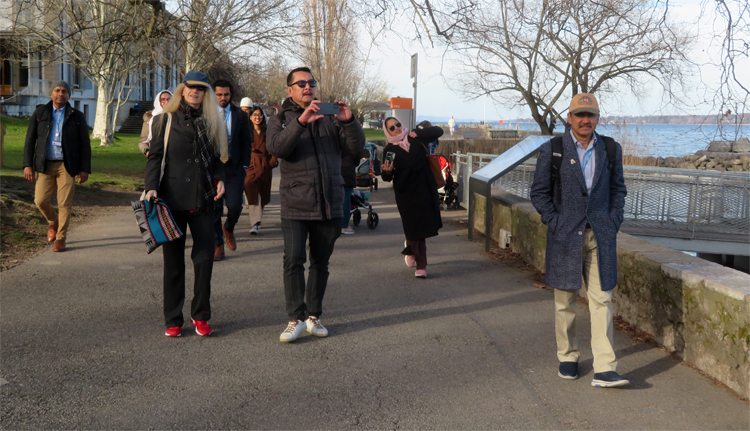
Scenes from the DESC walk in Geneva, 16 March 2023
Reimagining the Interface between Digital Tech and the Physical Environment (Session 204)
This formal workshop session had three main aims:
to share an updated overview of DESC’s emerging model that challenges much existing work being undertaken on digital tech and climate change;
to provide an update on its ongoing activities since WSIS 2022; and
to do this in a lively and interactive way.
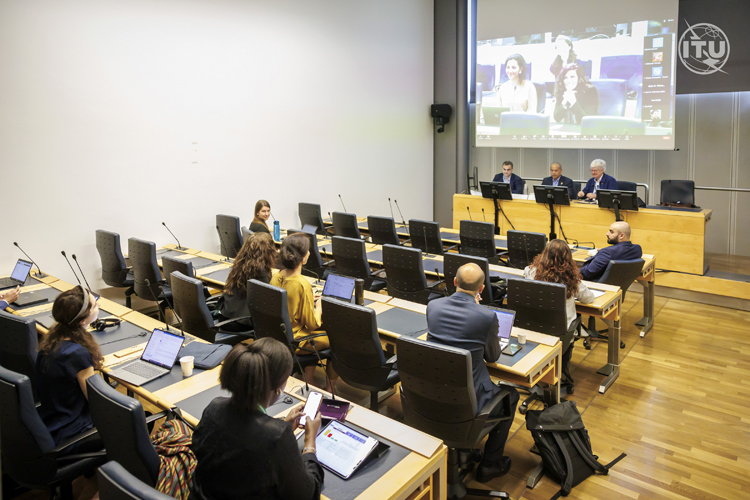
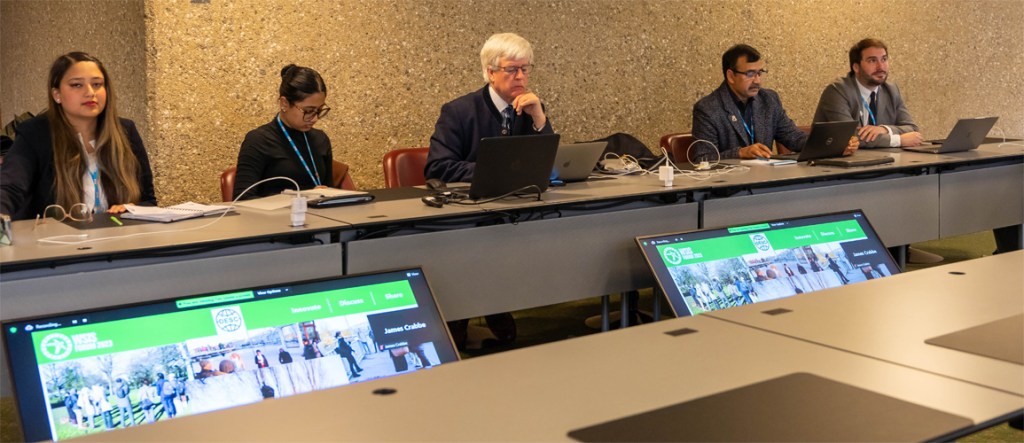
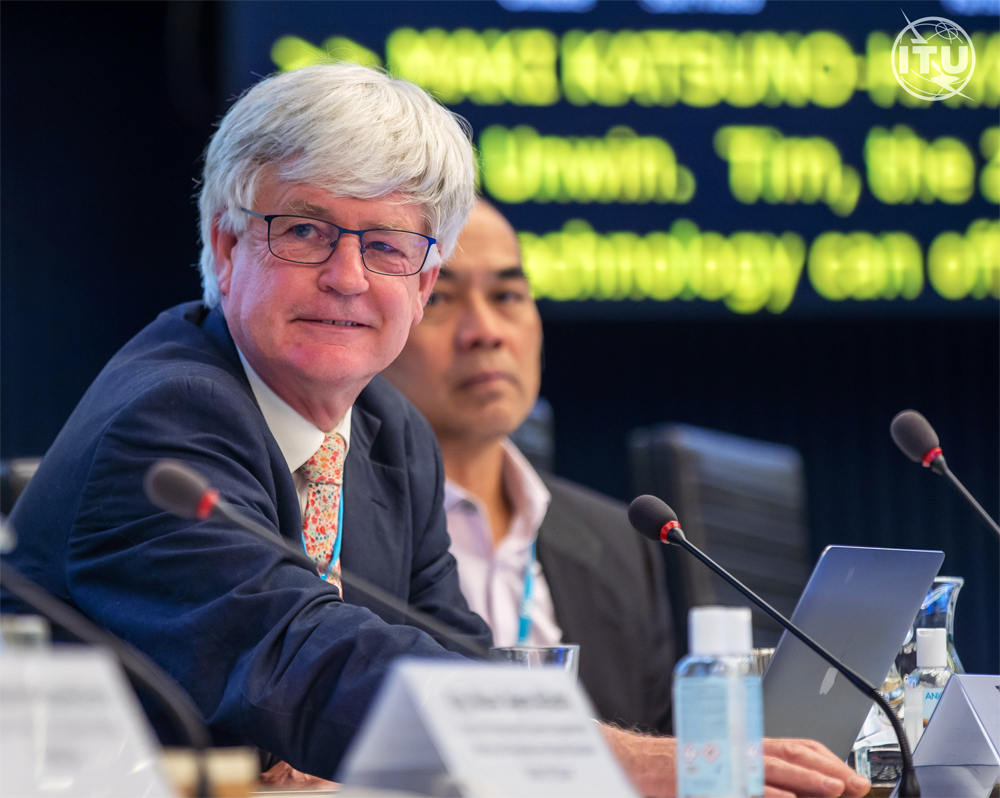
Official ITU photograph from WSIS Session 204
The session was structured as follows:
Introduction to DESC, highlighting the need to adopt a holistic approach focusing on the interaction between digital technologies and the totality of the physical environment (including the lithosphere, hydrosphere, biosphere and atmosphere – see diagram below) rather than just climate change. Indeed, a focus primarily on human-induced climate change is likely to lead to seriously adverse impacts on other dimensions of the physical environment.
Summaries of the key points of discussion explored during the DESC walk (WSIS Session 403) the previous day, presented by the five discussion moderators (including the YouthDESC session).
Highlights of two examples from the activities of DESC’s Working Groups emphasizing why these issues matter:
The indigenous DESC Working Group (Poline Bala’s sliodes were presented by Tim Unwin). This highlighted that indigenous peoples are insufficiently represented at events such as WSIS, and that they can contribute significantly to new ways of addressing the interface between digital tech and the physical environment
A video presentation by James Crabbe on the importance of omics for informing policy on deep sea mining.
This was followed by an introduction to the toolkit being developed by DESC for all those who have pledged to the ITU-led Partner2Connect initiative to enable them to consider and address the environmental impact of their proposed interventions.
The final element was a lively discussion around the issues raised, that included new commitments from participants to explore collaboration on implementing the DESC toolkit
DESC in Geneva
The general consensus from both sessions was that they were enjoyable and informative – and that DESC should offer to convene another walk in 2024 when we can delve once again into both the positive and negative impacts of the design and use of digital tech on the environment.
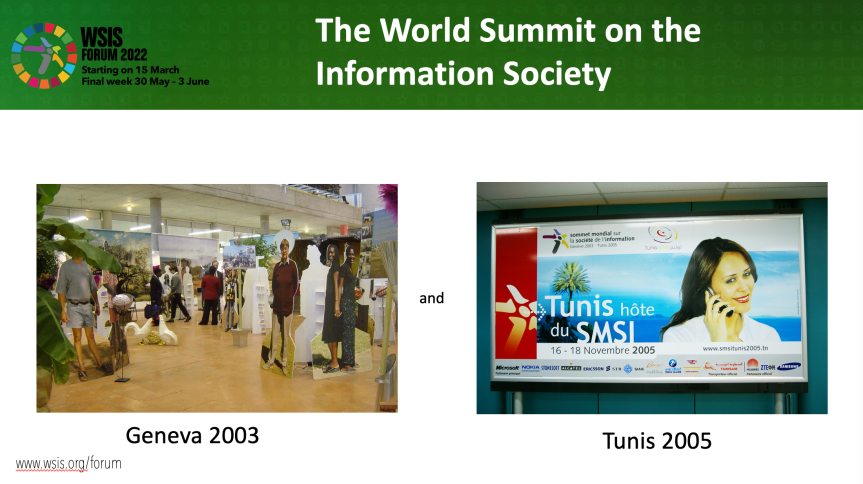
Members of the UNESCO Chair in ICT4D have been involved in the World Summit for the Information Society (WSIS) since its inception in 2003 (Geneva) and 2005 (Tunisia), and have participated in many of the subsequent Annual Forums held in Geneva.
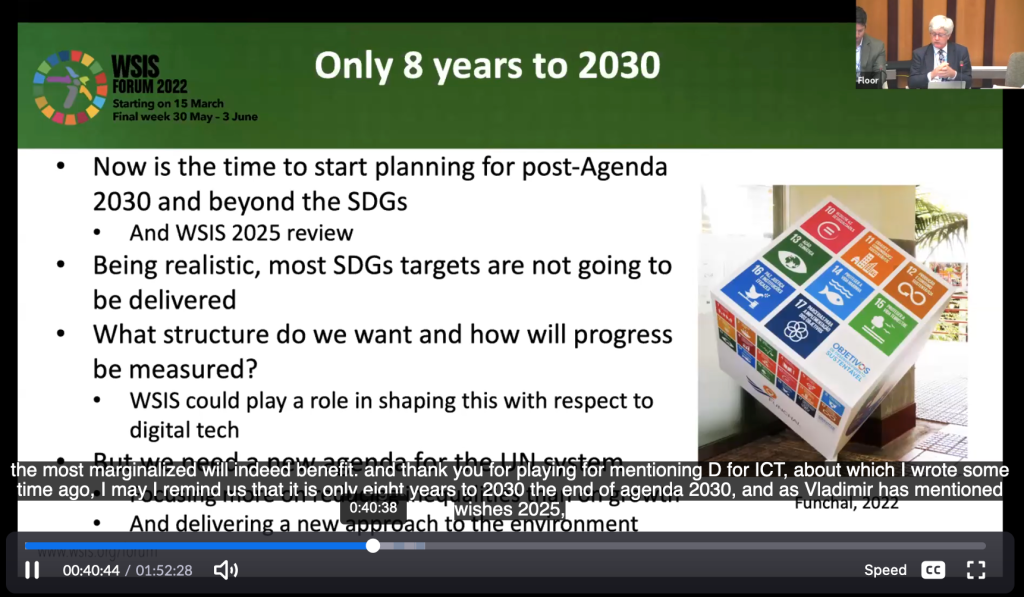
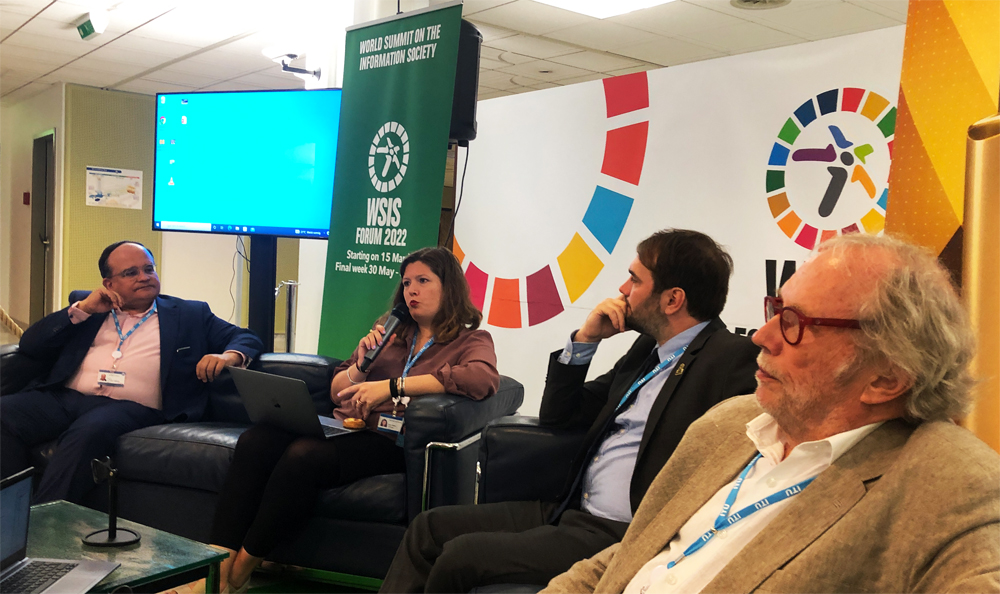
After two years of virtual WSIS events, it was a great pleasure to be back in Geneva during the week of 30th May-3rd June this year and excellent that so many of our Members, Affiliated Members and Partners could participate – both in person and online during the hybrid sessions. Congratulations to Gitanjali Sah and her team for putting on such an interesting and enjoyable week of events, which highlighted the great value of being there in person and holding conversations with old friends, as well as making new acquaintances.
Some of the highlights of our contributions included:
Paul Spiesberger (Affiliated Member and Chair of ict4d.at) served as a High Level Panel Facilitator throughout the event
Ahmed Imran (Affiliated Member and Director of RC-DISC at our partner, the University of Canberra), Tim Unwin (Chairholder) and others at the Academia Round Table on 1st June (Session 397)
Tim Unwin (Chairholder) Panellist in High-Level Dialogue on the Transforming Education Summit and the 2023 GEM Report on Technology and Education, 1st June (Session 298)
Tim Unwin (Chairholder) Panellist in Session 406 Academic perspectives on WSIS and the SDGs, 2nd June
Carlos Álvarez Pereira, Suay Ozkula, Paul Spiesberger, Knud Erik Skouby and Tim Unwin participating in Open Space Session on the Digital Environment System Coalition (Session 448), 2nd June
The WSIS Annual Forum remains one of the most valuable of the many duplicating and ovelapping digital technology events, conferences and summits organised by the UN and other agencies. It provides an important opportunity for governments, international agencies, companies and civil society to come together to discuss recent dvelopments in the broad field of digital tech for “development” focusing particularly around the Action Lines agreed almost 20 years ago by the UN system.
Members, Affiliated Members and Partners of the UNESCO Chair in ICT4D at Royal Holloway, University of London, look forward to paticipating in future WSIS events in the years to come.
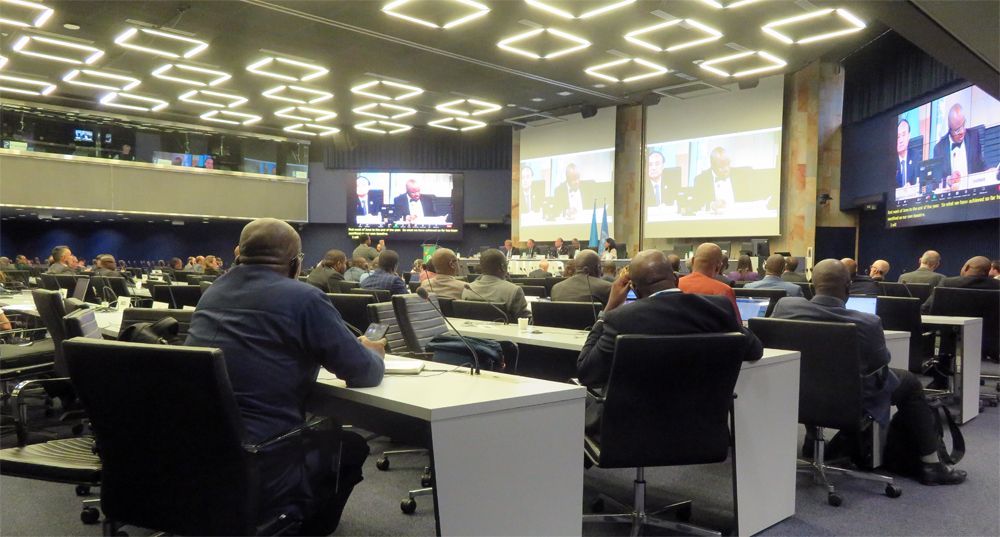
Members of the UNESCO Chair in ICT4D participated in the ITU’s World Radiocommunication Seminar 2016 (WRS-16) held in Geneva from 12th-16th December 2016. This provided an excellent opportunity to gain detailed updated information on both terrestrial and space services, covering technical and regulatory issues including publications, databases and tools for countries to use in managing radiocommunications.
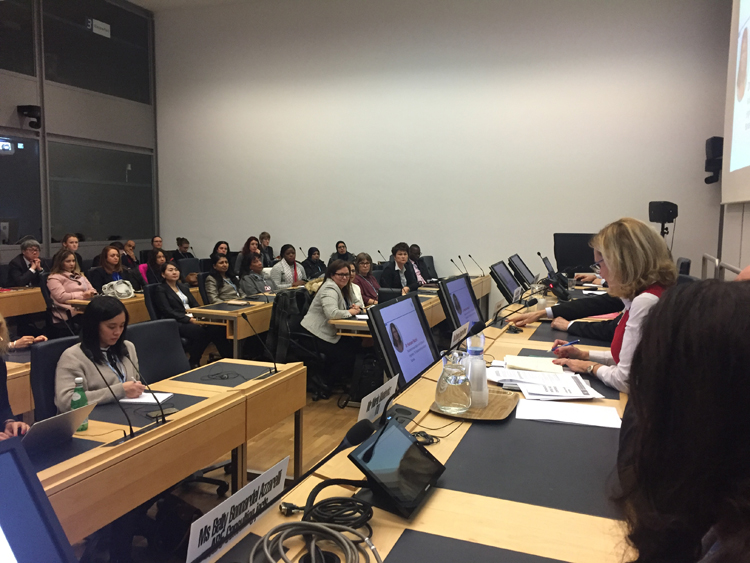
the big picture of women in the ICT/radiocommunication sector;
how to encourage women to take ownership of the group; and
the role that ITU should play in supporting this type of action.
As well as participating in the formal aspects of WRS-16 this was also an excellent opportunity to engage with national delegations and participants, especially from Pakistan and Kenya, as well as officials and friends in the ITU to discuss how the UNESCO Chair in ICT4D can further contribute to the ITU’s activities.
















 Members of the UNESCO Chair in ICT4D participated in the
  It also enabled us to engage in the kick-off meeting of the
  ICT4D Collective