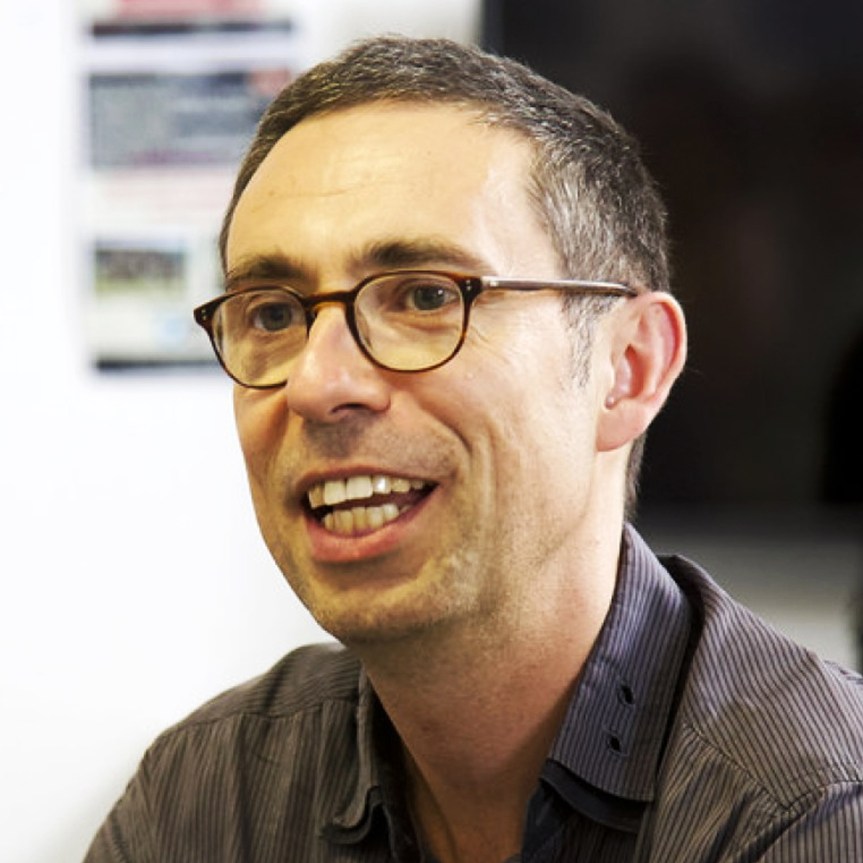
This is the twenty-third episode of our podcast based on the vignettes contributed by friends and colleagues to Tim Unwin’s new book Digital Technologies in an Unequal World: An Empancipatory Manfesto. In it, Ugo Vallauri shows how “it’s possible to give devices a second lease of life, to create abundance and digital access out of Big Tech’s deliberate attempts to make products obsolete, with extortionate pricing of spares, repair-averse design and increasingly using software as a weapon”. He shows how Restart Parties and Repair Cafés provide part of the answer to a more sustainable digitsal future, noting that “in Africa, Asia and South America repair remains vital: a necessity, not a privilege”.
All audio files relating to the book are also available on our podcast with a new episode every week.
Ugo is co-founder/co-director of The Restart Project, a charity which promotes repair to change our throwaway economy. He’s a co-founder of Right to Repair Europe, a coalition advocating for ambitious right to repair legislation. Ugo is a fellow of the Ashoka Foundation in Italy, with 20 years of experience in the not-for-profit sector
Full details of the book are available through the following links:
Digital Inclusion in an Unequal World (Episode 23) – Ugo Vallauri on “The Right to Repair” –
ICT4D Collective » ICT4D
Ugo is co-founder/co-director of The Restart Project, a charity which promotes repair to change our throwaway economy. He’s a co-founder of Right to Repair Europe, a coalition advocating for ambitious right to repair legislation. Ugo is a fellow of the Ashoka Foundation in Italy, with 20 years of experience in the not-for-profit sector Full details … Continue reading Digital Inclusion in an Unequal World (Episode 23) – Ugo Vallauri on “The Right to Repair”
This is the twenty-second episode of our podcast based on the vignettes contributed by friends and colleagues to Tim Unwin’s new book Digital Technologies in an Unequal World: An Empancipatory Manfesto. In it, Jamie Proctor argues that “to serve the needs of the world’s poorest and most marginalised it is essential to systematise … changes towards multidisciplinary teams, delivering iteratively, with a focus on citizens. Otherwise, the potential benefits of digital technology in the public sector will never be realised”.
All audio files relating to the book are also available on our podcast with a new episode every week.
Jamie’s background cuts across research, education and technology. He has worked in tech start-ups, across UK Government digital teams, and established a school construction NGO in Malawi. He wrote this contribution whilst seconded to EdTech Hub from FCDO, and maintains keen research interests in the development of climate resilient and sustainable school infrastructure.
Full details of the book are available through the following links:
Digital Inclusion in an Unequal World (Episode 23) – Ugo Vallauri on “The Right to Repair” –
ICT4D Collective » ICT4D
Ugo is co-founder/co-director of The Restart Project, a charity which promotes repair to change our throwaway economy. He’s a co-founder of Right to Repair Europe, a coalition advocating for ambitious right to repair legislation. Ugo is a fellow of the Ashoka Foundation in Italy, with 20 years of experience in the not-for-profit sector Full details … Continue reading Digital Inclusion in an Unequal World (Episode 23) – Ugo Vallauri on “The Right to Repair”
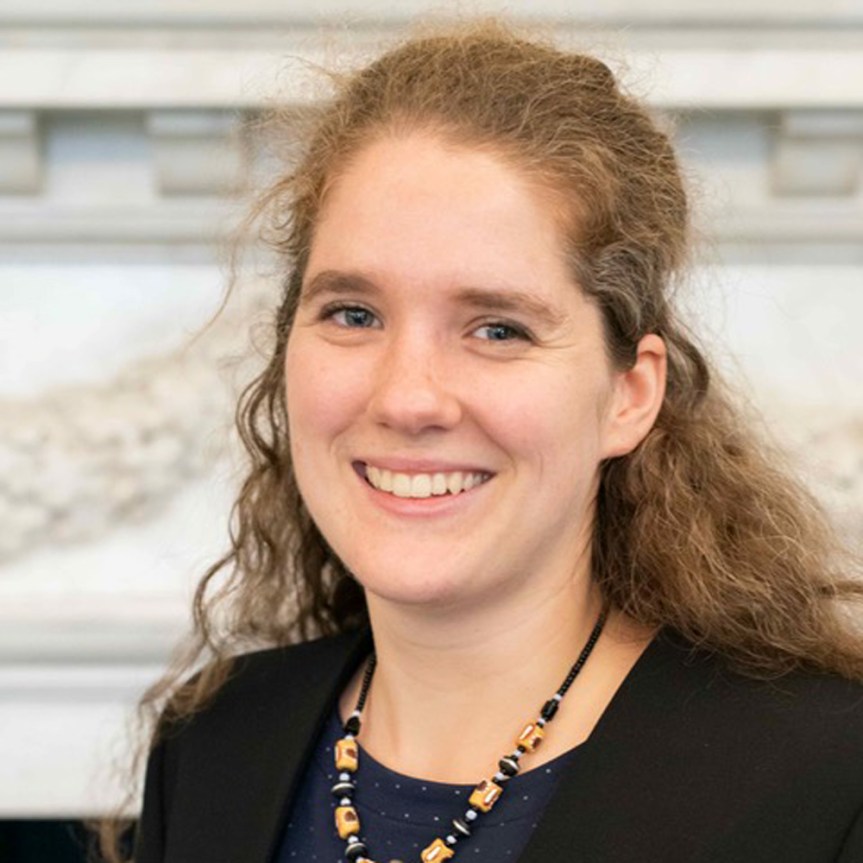
This is the twenty-first episode of our podcast based on the vignettes contributed by friends and colleagues to Tim Unwin’s new book Digital Technologies in an Unequal World: An Empancipatory Manfesto. In it, Ettie Unwin draws on her experience in using statistics and mathematical modelling of infectious diseases to argue powerfully that scientists (and by implication all of us) need to work with rather than on people living in economically poor parts of the world. As she says “Since the global burden of infectious disease is not equitable, it’s important to help train my future colleagues around the world in methods and tools so they can model transmission themselves”.
All audio files relating to the book are also available on our podcast with a new episode every week.
Ettie is a Senior Lecturer in Statistical Science at the University of Bristol where her research focuses on developing methodologies related to infectious disease transmission to improve global public health. She is passionate about co-creating research with partners in areas where the global burden of disease is highest, whilst sharing her technical knowledge when appropriate.
Full details of the book are available through the following links:
Digital Inclusion in an Unequal World (Episode 23) – Ugo Vallauri on “The Right to Repair” –
ICT4D Collective » ICT4D
Ugo is co-founder/co-director of The Restart Project, a charity which promotes repair to change our throwaway economy. He’s a co-founder of Right to Repair Europe, a coalition advocating for ambitious right to repair legislation. Ugo is a fellow of the Ashoka Foundation in Italy, with 20 years of experience in the not-for-profit sector Full details … Continue reading Digital Inclusion in an Unequal World (Episode 23) – Ugo Vallauri on “The Right to Repair”
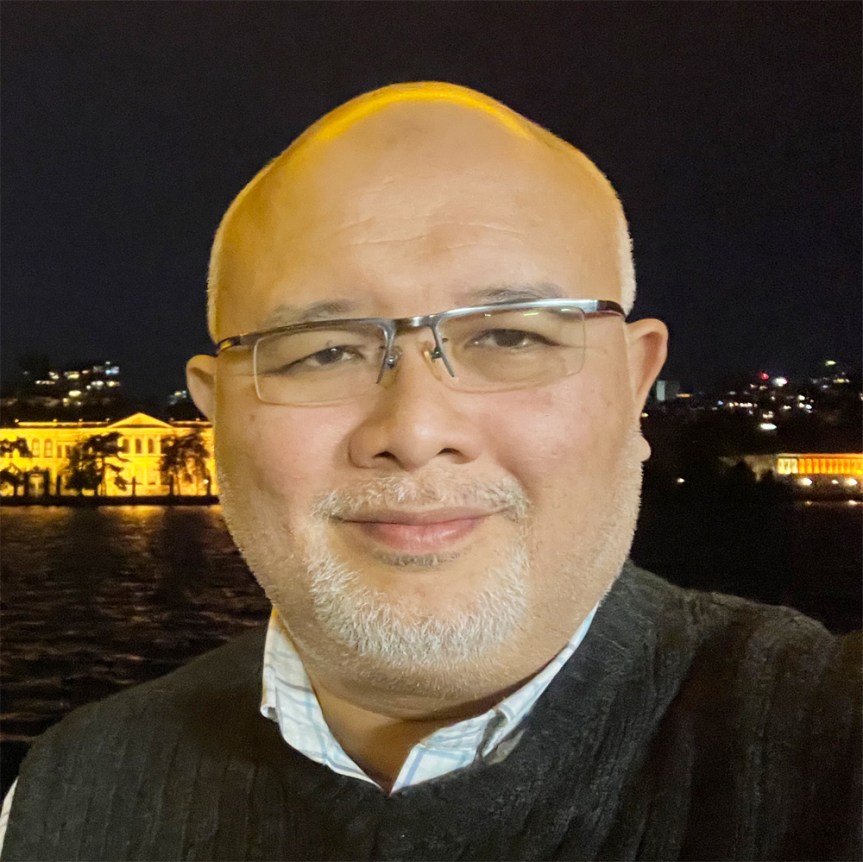
This is the twentieth episode of our podcast based on the vignettes contributed by friends and colleagues to Tim Unwin’s new book Digital Technologies in an Unequal World: An Empancipatory Manfesto. In it, Dato’ Mohamed Sharil Tarmizi draws on his experiences in Malaysia to reflect on what has changed over the last two decades in terms of how and why digital tech is being used, from the days of kedai.com which was seen as being a way to “bridge the digital divide” to the contemporary period when Malaysia is still providing free collective broadband to rural and underserved communities. He concludes that “the technology has evolved and yet inequalities still remain. In the end, it’s never about the technology but it’s about what technology can do for society. Let’s begin by agreeing on the societies we want, then apply the appropriate technologies to make them thrive”.
All audio files relating to the book are also available on our podcast with a new episode every week.
Sharil, from Malaysia, trained and practised as a lawyer, became a policy maker, went into corporate finance and then moved on to become a telco regulator and a trade negotiator. Thereafter, got involved in corporate restructuring, automotive, infrastructure and aviation, whilst dabbling in a spot of angel investing, startup mentoring, media and movie making. He is currently serving as the Chairman of the Civil Aviation Authority of Malaysia.
Full details of the book are available through the following links:
Digital Inclusion in an Unequal World (Episode 23) – Ugo Vallauri on “The Right to Repair” –
ICT4D Collective » ICT4D
Ugo is co-founder/co-director of The Restart Project, a charity which promotes repair to change our throwaway economy. He’s a co-founder of Right to Repair Europe, a coalition advocating for ambitious right to repair legislation. Ugo is a fellow of the Ashoka Foundation in Italy, with 20 years of experience in the not-for-profit sector Full details … Continue reading Digital Inclusion in an Unequal World (Episode 23) – Ugo Vallauri on “The Right to Repair”
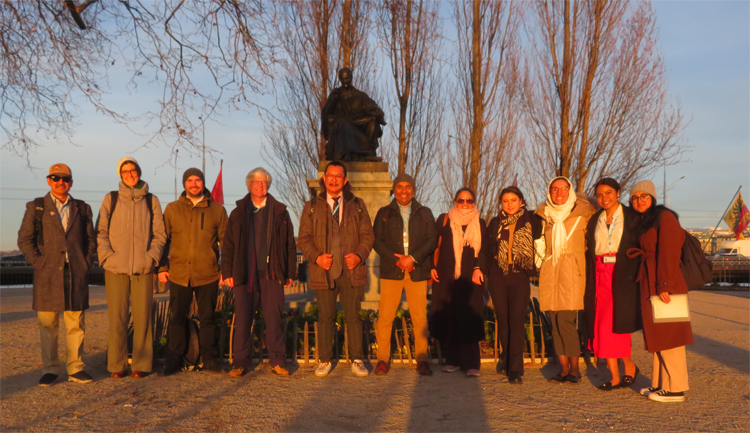
Particiants on the DESC walk photographes beneath the statue of Rousseau as the sun sets
The Digital Environment System Coalition (DESC) convened two sessions (403 and 204) on 16th and 18th March at this year’s WSIS Annual Forum held in Geneva. The first was a walk which we believe to be the first ever such event held during a WSIS annual forum, and the second was a more traditional session within the cavernous CIGG. Both sessions were convened by the UNESCO Chair in ICT4D at Royal Hollloway, University of London which provides the Secretariat to DESC, in association with INIT (the Inter-Islamic Network on IT), the WWRF (Wireless World Research Forum), ICT4D.AT, and RC-DISC (the Research Cluster for Digital Inequality and Social Change at the University of Canberra).
Experiencing digital environment interactions in the “place” of Geneva (Session 403): the DESC Walk
We experience things differently when we walk, when we talk together, and when we interact with the real physical environment. We feel the fresh air on our faces, smell the vegetation, hear the noise of running water, and touch the rough rocks on the slopes. We interact differently with each other. We pause and contemplate where we are. Our minds engage in ways that are so, so different from when we sit in large conference halls.
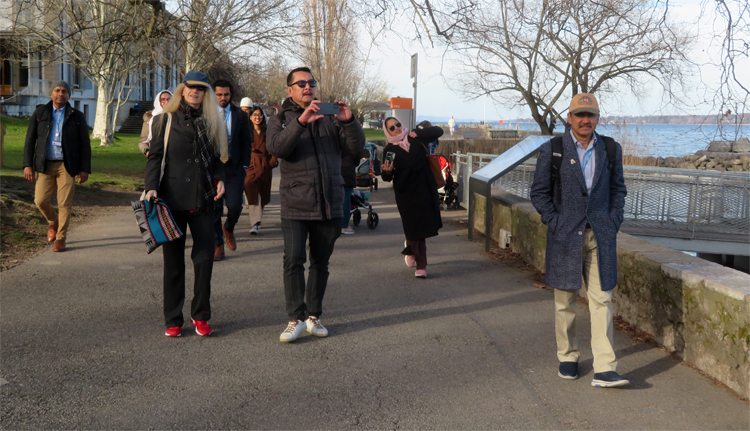
This DESC walk provided an opportunity for participants (i) to share their own research and practice relating to the interactions between digital tech and the environment, (ii) to discuss the positive and negative impacts of digital tech specifically on the biosphere, hydrosphere, atmosphere and lithosphere, and (iii) to make recommendations concerning the further development of YouthDESC. In essence, individual participants brought the group to a halt at locations that they felt were most appropriate for them along the walk and shared information about themselves and their research/practice, and we also stopped at five pre-planned locations to discuss each of the main themes as a group. Moderators of each main stop sought to encourage the participants to highlight three positive and three native interactions between digital tech and the environment.
Parc Mon Repos – the biosphere (led by Paul Spiesberger). Issues discussed included the positives of being able to share nature through digital images, use of remote sensed imagery to monitor the biosphere, and the use of digital tech to enhance agricultural production. Negatives included digital pollution of plants and green spaces, potentially adverse effects on human health (including mental health), and increased urban exploitation of rural environments through digital tech.
Poste Filial – YouthDESC (led by Tasfia Rahman). This began with a visit inside the building to discover the ways through which it is now necessary to use virtual/digital systems to post a physical/real card. We also recognized the important links between postal communication in the past and digital communication at present. The Instagram account of @YouthDESC was discussed, alongside the pros and cons of different social media platforms for engaging youth
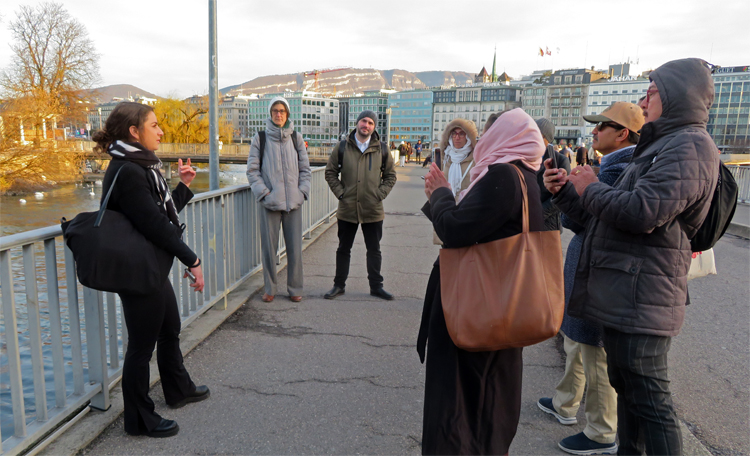
Pont des Bergues – the hydrosphere (led by Ahmed Imran). It was recognised that unlike the biosphere and lithosphere, the impact of digital tech on the hydrosphere is less immediately visible. However, negatives include the impact of deep sea mining for rare earth minerals, and the heating of water in cooling systems. The use of water warmed by the heat produced by servers was, though, also seen as a benefit.
Ile Rousseau – the atmosphere (led by Zumana Imran). Beneath the feet of the philosopher Rousseau, our thoughts turned to the atmosphere above us, and focused on the positives of the use of satellites for monitoring environmental change and enabling communication in isolated places, whilst also recognizing the harms of treating outer space as we used to treat the oceans (global commons), the impact on dark space, and space junk. It was also recognised that different cultures have differing views about the environment, and we must engage with indigenous communities.
Auditoire de Calvin – the lithosphere (led by Tim Unwin). As dusk came upon us, few people remained to walk up the steps to the Cathedral and Auditoire de Calvin, but we nevertheless discussed the impact of mining for minerals used in digital tech, the impact of waste especially in landfill, and also the potential benefits in land management.
Scenes from the DESC walk in Geneva, 16 March 2023
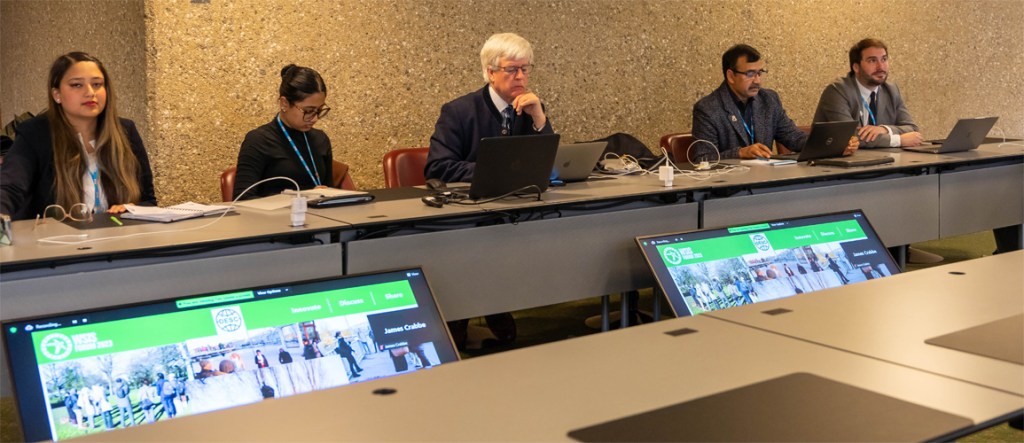
Reimagining the Interface between Digital Tech and the Physical Environment (Session 204)
This formal workshop session had three main aims:
to share an updated overview of DESC’s emerging model that challenges much existing work being undertaken on digital tech and climate change;
to provide an update on its ongoing activities since WSIS 2022; and
to do this in a lively and interactive way.
Official ITU photograph from WSIS Session 204
The session was structured as follows:
Introduction to DESC, highlighting the need to adopt a holistic approach focusing on the interaction between digital technologies and the totality of the physical environment (including the lithosphere, hydrosphere, biosphere and atmosphere – see diagram below) rather than just climate change. Indeed, a focus primarily on human-induced climate change is likely to lead to seriously adverse impacts on other dimensions of the physical environment.
Summaries of the key points of discussion explored during the DESC walk (WSIS Session 403) the previous day, presented by the five discussion moderators (including the YouthDESC session).
Highlights of two examples from the activities of DESC’s Working Groups emphasizing why these issues matter:
The indigenous DESC Working Group (Poline Bala’s sliodes were presented by Tim Unwin). This highlighted that indigenous peoples are insufficiently represented at events such as WSIS, and that they can contribute significantly to new ways of addressing the interface between digital tech and the physical environment
A video presentation by James Crabbe on the importance of omics for informing policy on deep sea mining.
This was followed by an introduction to the toolkit being developed by DESC for all those who have pledged to the ITU-led Partner2Connect initiative to enable them to consider and address the environmental impact of their proposed interventions.
The final element was a lively discussion around the issues raised, that included new commitments from participants to explore collaboration on implementing the DESC toolkit
DESC in Geneva
The general consensus from both sessions was that they were enjoyable and informative – and that DESC should offer to convene another walk in 2024 when we can delve once again into both the positive and negative impacts of the design and use of digital tech on the environment.
We are delighted that members of the UNESCO Chair in ICT4D at Royal Holloway, University of London, are involved in the following four sessions at this year’s WSIS Annual Forum in Geneva between 13th and 16th March 2023 (listed in chronological order):
Session 184: International Conference on Digital Transformation of Education: Road towards SDG 4 (Guest of Honour and Panellist), Thursday 16 March 09.00-09.45
Session 403: DESC Experiencing digital environment interactions in the “place” of Geneva (convenor) – this is a discussion-walk around Geneva commencing at the main entrance of CICG on Thursday 16 March from 16.00-18.30 (more details)
Session 204: DESC Reimagining the Interface between Digital Tech and the Physical Environment (convenor), Friday 17 March, 10.00-10.45 (more details)
Session 329: MIDEQ WP9 What migrants want: digital tech, inequality and migration (convenor), Friday 17 March, 11.00-11.45
Please do join us at these sessions, the last two of which will also be available for those wishing to join online. More information is available on the DESC sessions here.







 ICT4D Collective