
Members of the ICT4D Collective are actively involved in a wide range of initiatives at the interface between digital technologies and practice. This page provides quick access to some of these.
The Digital-Environment System Coalition (DESC)
F or too long, research on the inter-relationships between digital technologies and the physical environment has been partitioned into neat areas and specialisms that have prevented important things being said holistically about its impact. This has meant that the digital technology sector has invariably been able to make unfounded claims about its positive benefits for the environment and its contributions to the so-called Sustainable Development Goals. The UNESCO Chair in ICT4D is now bringing together researchers from across the world to build a coalition of excellence to unravel the complexities of these relationships and make rigorous policy recommendations to ensure that such technologies are used wisely in the interests of the human community and planet.
Safe, wise and secure use of digital tech
In recent years, several members of the ICT4D Collective have gone back to their roots and started 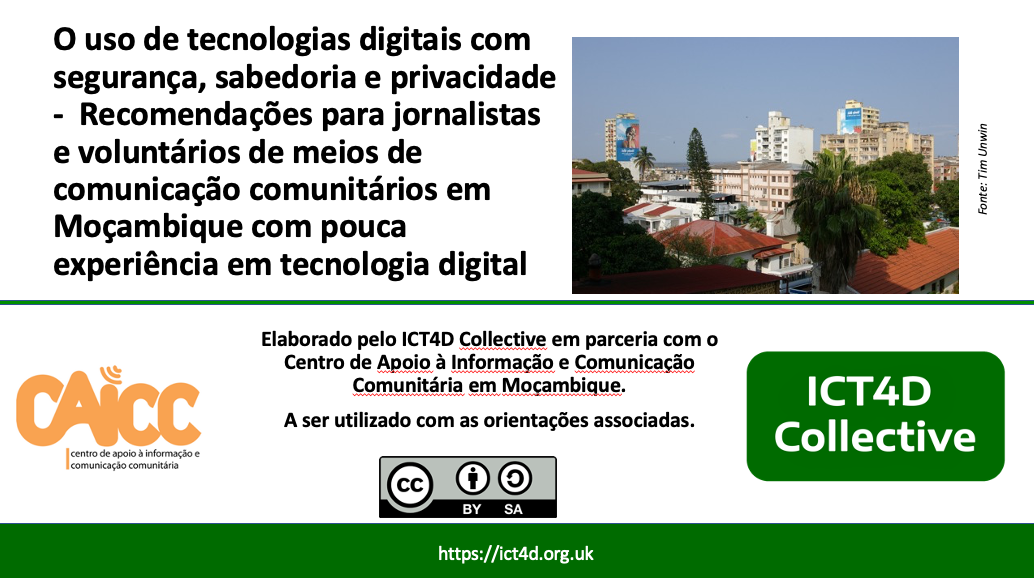 focusing once again on the critical importance of safe, wise and secure use of digital tech if people are to benefit from its positive aspects. Some of the most marginalised people in the world, with little or no training in the basic use of digital tech, are among the most vulnerable to the harms for which it can be used. Much of our present work in this area has come from the Collective’s involvement in the UKRI-GCRF funded MIDEQ Hub, where we worked with migrants and their organisations, particulalry in Nepal and South Africa, to develop resources that could be used to provide basic training in how they can use these technologies safely, wisely and securely. These are now being developed to serve the needs of many other groups of people across the world.
Technology, Inequality and Migration
 This link reports and shares knowledge and resources on the UKRI GCRF South-South Migration, Inequality and Development Hub (MIDEQ), led by Heaven Crawley of Coventry University, of which the UNESCO Chair in ICT4D was a partner, and the ICT4D Collective continues to be involved. Our interdisciplinary work focuses at the interface between technology, inequality and migration, and is led by Prof. G. “Hari” Harindranath, supported by Tim Unwin.
Technology and Education Post-COVID-19
 Members of the UNECSO Chair in ICT4D were involved in an exciting new initiative to develop a Report by September 2020 on practical guidance for governments on using digital technologies to enhance their education systems once the immediate crisis caused by the COVID-19 pandemic has passed (see Summary). The Report is short, succinct and practical, and also includes a series of brief Guidance Notes addressing the most important actvities that governments need to address to ensure the inclusion of some of the world’s poorest and most marginalised people. The work was funded by DFID and the World Bank through their EdTech Hub, and members of the Collective continue to be involved in taking this work forward.
TEQtogether
 TEQtogether was an initiative within the UNESCO Chair in ICT4D designed to change men’s attitudes and behaviours with respect to women and technology, and members of the Collective have continue to be involved in this important work since 2023. Digital Technologies can bring great benefits to individuals and communities. However, they also have a darker side, increasing inequalities and being widely used for abuse and harassment. This is especially true at the interface between women and technology. Women are not only often marginalised in the tech sector, but they are also frequently violated through technology.
Page updated 18 June 2024
 ICT4D Collective