Digital Inclusion in an Unequal World: An Emancipatory Manifesto

We are delighted to announce the launch of our web-pages for Tim Unwin’s new book, entitled Digital Inclusion in an Unequal World: An Emancipatory Manifesto, being published by Routledge in 2026. These contain:

Podcasts and audio

Many of the authors have contributed audio recordings of their vignettes. These are available here, but are also being shared on a regular basis through our blog and our podcast over the next six months. Do follow us on Apple Podcasts to listen to these inspiring examples of how digital tech can be used constructively by some of the world’s poorest and most marginalised people, but also the reasons why most such initiatives fail sufficiently to serve their interests.

Pre-order

This important book can be pre-ordered from Routledge using the link above, and for those who respond quickly there is a 20% reduction if you order before 23rd October 2025.

Prof. Harindranath’s reflections on an inspiring session at ITCILO’s Academy on Labour Migration

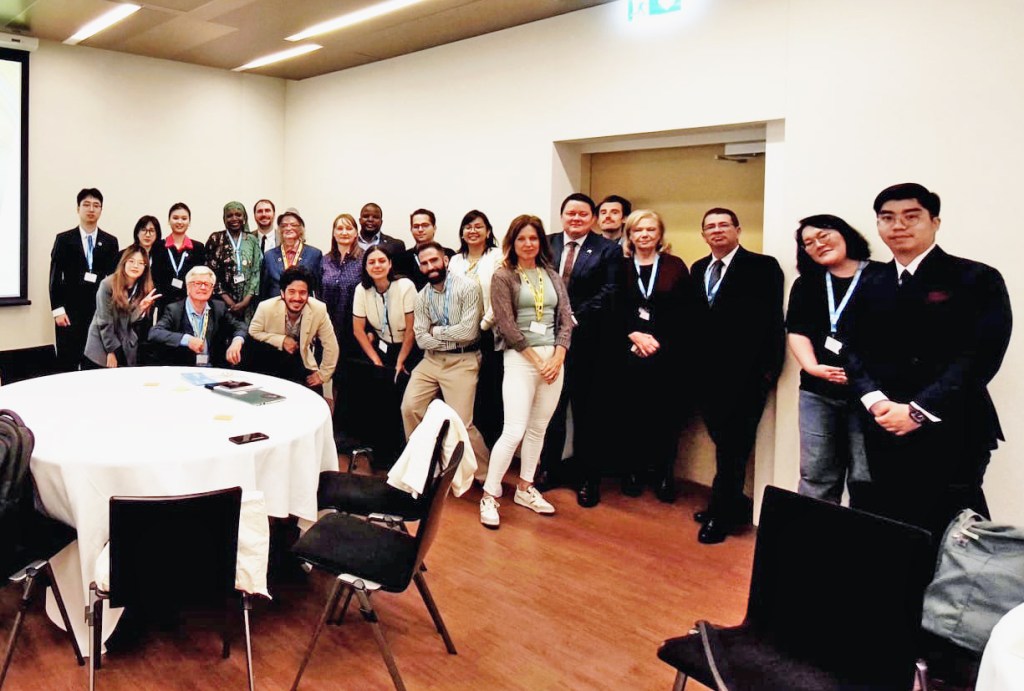
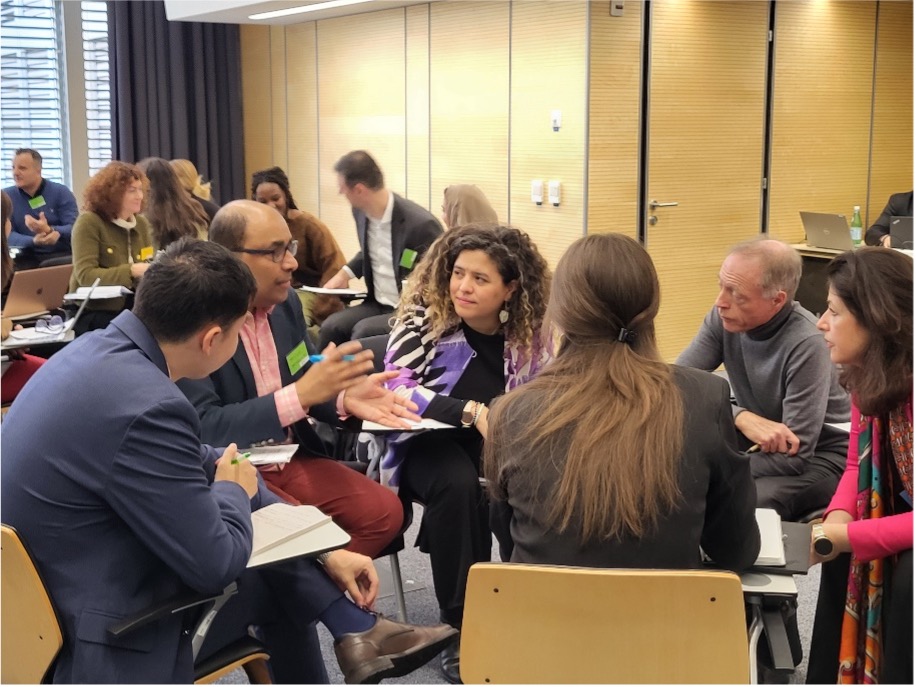
Today, I had the privilege of delivering a session titled “Digitalisation of Labour Migration Governance: Inclusive Solutions or Digital Solutionism?” at the ITCILO Academy on Labour Migration. The session brought together an incredible group of nearly 40 participants from diverse regions – Asia, Africa, the Caribbean, Pacific Islands, and Europe. This global audience included policy planners, government officials, workers’ and employers’ organisations, civil society representatives, activists, researchers, and journalists – all deeply engaged in the critical issues surrounding labour migration.

What stood out for me was the richness of the perspectives shared by participants on the role of digital technologies in this sensitive and complex domain characterised by huge power imbalances and varied digital capacities. Digitalisation of labour migration governance cannot be truly fair if it serves governments, employers and intermediaries and then disempowers vulnerable labour migrants, the very group it is meant to support. We must ensure that migrant voices are at the forefront of these efforts. Their experiences and needs are integral to shaping solutions that are equitable, inclusive, and just.

Let us keep working together to amplify and centre the voices of migrants in this important conversation.

Prof G. ‘Hari’ Harindranath

15/7/2025

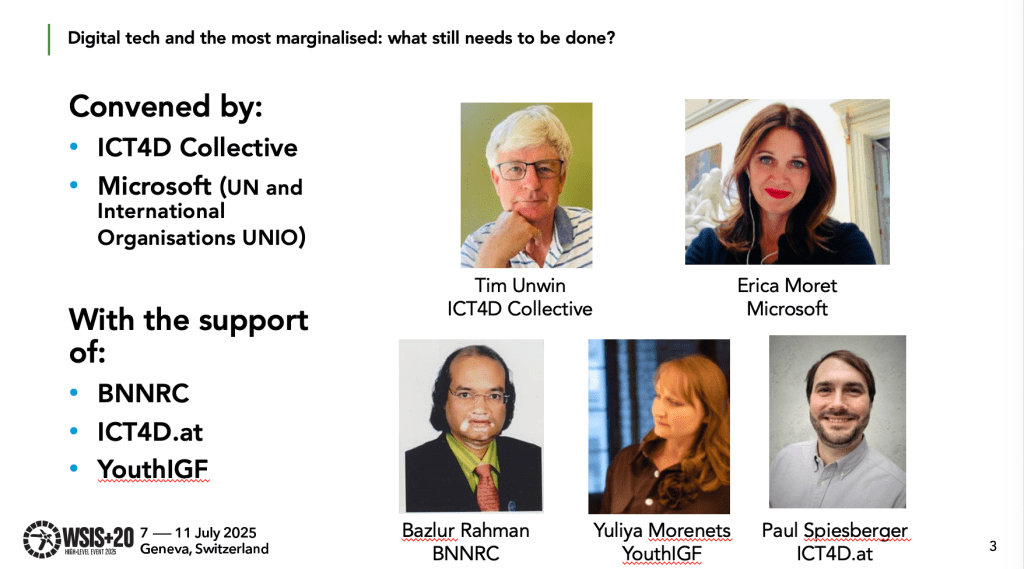
Digital tech and the most marginalised: what still needs to be done?

The ICT4D Collective and Microsoft (UN and International Organisations UNIO) (supported by Bangladesh NGOs Network for Radio and Communication, ICT4D.at, and YouthIGF) convened a very lively and interactive Session 360 this morning at the WSIS+20 gathering at Palexpo in Geneva. This began by recognising that digital tech will not be used successfully to deliver the SDGs (especially SDG10) by 2030, but then focused in a very positive way on what governments, the private sector and civil society can indeed do to try to ensure that the poorest and most marginalised can use digital tech to improve their lives.

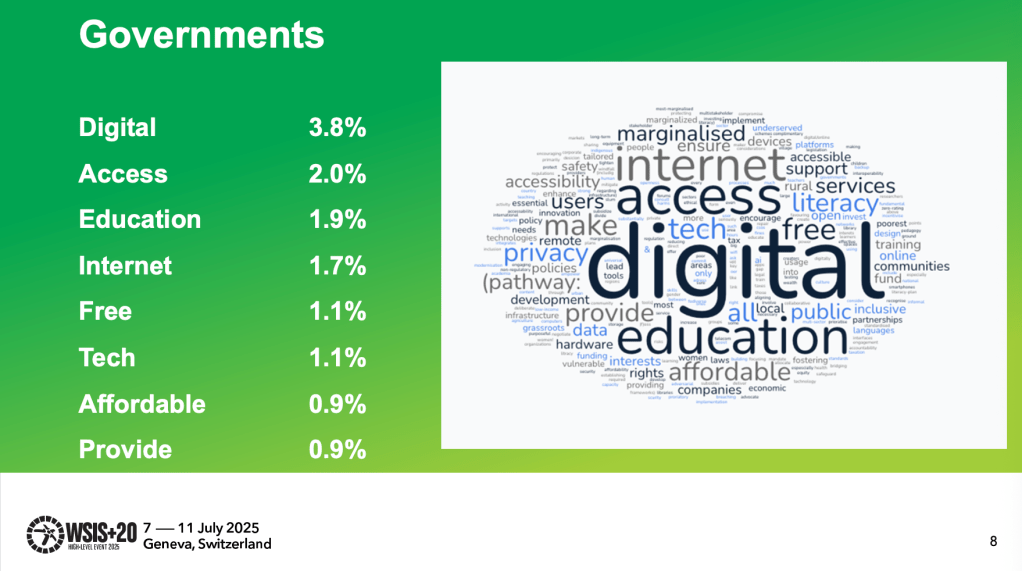
The session built on an online survey conducted in advance of the gathering to explore what people in our networks consider are the most important actions that can be done by governments, the private sector and civil society (as well as international organisations and academia). This is summarised in the slide deck used to guide the sessions (the whole deck is also available by clicking the image below).

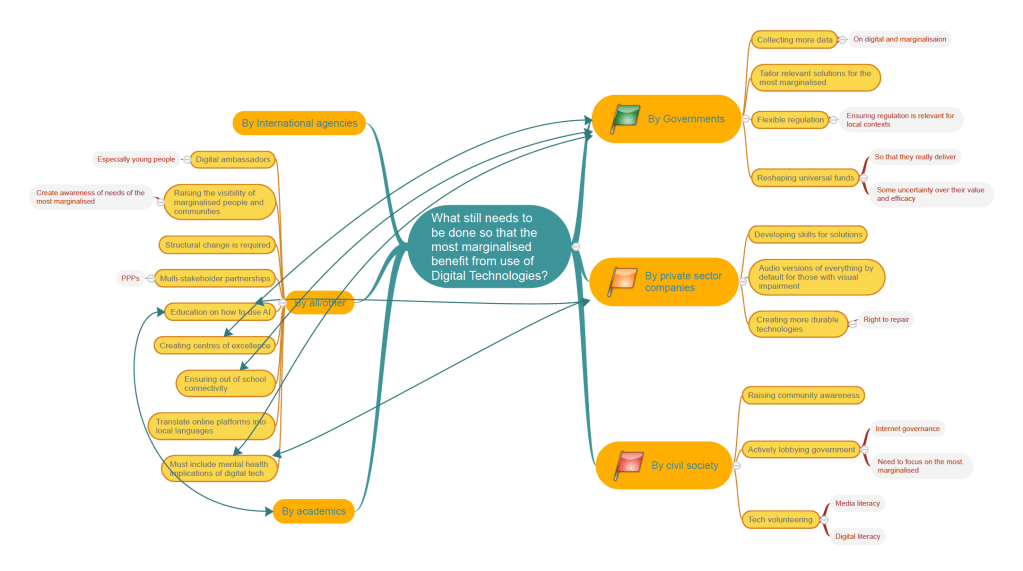
Lively introductory thought-provocations were given by Erica Moret (Microsoft), Bazlur Rahman (BNNRC), Paul Spiesberger (ict4d.at) and Yuliya Morenets (Youth.IGF), and the main focus of the session was then to create together a mind map from brainstorming by participants both in the room and also online (as well as using post-its). This generated a wide range of positive and constructive ideas for what we all need to do if we really care about helping the most marginalised use digital technologies to improve their lives. This discussion is summarised below (click on image for full sized .pdf file):

The session ended by participants re-committing themselves to doing something different in the interests of the poorest and most marginalised.

Join the ICT4D Collective at our session on digital tech and the most marginalised at the WSIS+20 High-Level Event in Geneva on 8th July

We are delighted to be jointly convening a session (306) at the WSIS+20 High-Level Event in Geneva on 8th July at 09.00 in Room L, Palexpo, Geneva. The joint convenors are the ICT4D Collective and Microsoft (UN and International Organisations UNIO), supported by Bangladesh NGOs Network for Radio and Communication, ICT4D.at, and YouthIGF.

Session Outline

The multistakeholder digital tech communities associated with the UN system seem unlikely to deliver on the SDGs by 2030, despite the efforts of those involved in developing and implementing the Global Digital Compact (2024). In particular, SDG10 on reducing inequalities remains insufficiently addressed, with much emphasis instead continuing to be placed on maximising economic growth through innovation. All too often the most marginalised, especially those with disabilities, LGBTIQ communities, women in patriarchal societies, the elderly, ethnic minorities and refugees, are in practice made yet more marginal through the adoption of the latest digital tech by those more powerful and richer than they are.

UNDESA, ECOSOC/CSTD, many other UN agencies, and the IGF process are all conducting widespread consultations about the future of “digital and development” and the WSIS Process, but these have still not sufficiently addressed the tendency for digital tech to be used to increase inequalities, rather than to address issues of inequality and equity. Our interactive session is the culmination of a consultation process during the three months before the annual WSIS Forum through which people across our different networks have contributed their ideas to what the five highest priorities should be for governments, the private sector, civil society and the UN system in creating greater equity in the use of digital tech. The findings of this process will be presented during the session, and participants invited during the session to add to the recommendations through the interactive development of a mind map on marginalization that will provide a very specific output to feed into the wider ongoing debate within the UN system about digital tech and equity.

Please make your voice heard beforehand

Everyone is invited to contribute before the session through a short (max 10 minute) online survey available at:  https://app.onlinesurveys.jisc.ac.uk/s/rhul/digital-equity-wsis2025. This will form the basis of our conversations in Geneva, and so even if you cannot attend in person please do copmplete this survey about what needs to be done to ensure that the poorest and most marginalised can indeed benefit from the use of digital tech.

Prof. Harindranath participates in the ILO’s 10th anniversary celebrations of the Fair Recruitment Initiative

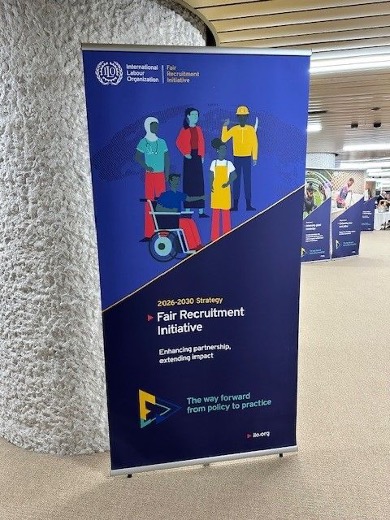
Prof G. ‘Hari’ Harindranath was honoured to be invited to contribute to the panel on ‘Leveraging digital innovations to enhance fair recruitment and combat abusive practices’ at the International Labour Organization‘s Global Conference on ‘Fair Recruitment Initiative: The Way Forward, from Policy to Practice’ held in Geneva between 19th and 20th May 2025. This event marked ten years of the ILO’s Fair Recruitment Initiative and brought together representatives from government, employers, trade unions and ILO’s UN partners including the IOM, WHO and UNHCR.

Digital technology is rapidly transforming the way migrant workers are recruited, bringing both new opportunities and serious risks. The interactive panel session examined emerging digital solutions that aim to promote fair recruitment – from tools used by workers to platforms leveraged by governments, inspectors and employers – and unpacked the associated risks and opportunities, and discussed actionable insights from participants on what works, what doesn’t, and how digital tech can be better harnessed to protect migrant workers.

Hari participated in a panel that also included representatives from the International Trade Union Confederation and The Adecco Group, one of the world’s largest human resources and temporary staffing firm.

Hari’s contribution questioned the uncritical application of digital tech in contexts of vulnerability that can cause harms, exacerbate existing inequalities and even create new ones. If digital technologies are to be used to advance fair recruitment of labour migrants, then it requires responsible digital practices that balance tech with supportive human interventions and a sustained focus on the safe, wise and secure use of digital tech by migrants.

Hari had previously been invited to contribute to the Global Forum on Migration and Development’s (GFMD) preparatory roundtables on ‘New Technologies and Digitalization: Improving Migration Management and Regular Migration Pathways’ in Geneva during February 2025 (and online in November 2024) in preparation for the 2025 GFMD Summit in Colombia.

Created in 2007, the Global Forum on Migration and Development (GFMD) is a state-led process connecting governments with civil society, the private sector, local and regional governments, youth, the UN system and other relevant stakeholders to helps shape the global debate on migration and development.

These significant policy engagement opportunities evidence the impact of our research-practice with vulnerable groups including migrants undertaken over the past six years, initially funded through a major UKRI GCRF grant and then through Royal Holloway’s Research England ODA and Social Purpose Research and Innovation Hub (SPRIH) grants (all in Nepal and South Africa) and through SSIA funding (in Brazil). Further details of this ongoing work can be found here (on the safe, wise and secure use of digital tech) and here (on our research-practice with migrants).

Prof. G. ‘Hari’ Harindranath, 29 May 2025

Our new identity as the ICT4D Collective

As of 1st August 2023, the UNESCO Chair in ICT4D at Royal Holloway, University of London has reverted to its original identity as the ICT4D Collective. We are a group of very diverse researchers and practitioners from across the world, bound together by our commitment to the highest possible quality of research-practice relating to the use of digital technologies in the interests of the world’s poorest and most marginalised people.

Meeting staff and students at the NIC's ICT and Electronics Innovation Lab in Pokhara,  Nepal, July 2023
Our last engagement as members of the UNESCO Chair in ICT4D: meeting staff and students at the NIC’s ICT and Electronics Innovation Lab in Pokhara, Nepal, July 2023

The Collective and the UNESCO Chair in ICT4D

The original ICT4D Collective was created in 2004, and evolved through an agreement in 2007 between UNESCO and Royal Holloway, University of London into the UNESCO Chair in ICT4D (Information and Communication Technologies for Development). UNESCO Chairs are groups of researchers in specific institutions undertaking work of direct relevance to UNESCO’s fields of competence, and they promote “international inter-university cooperation and networking to enhance institutional capacities through knowledge sharing and collaborative work”. Members of our UNESCO Chair have been very proud to have been associated with UNESCO for the last 16 years, and to have collaborated closely with many good friends in UNESCO’s Paris headquarters and field offices. We were also honoured that Houlin Zhao, the Secretary General of the International Telecommunications Union (ITU) between January 2015 and January 2023, and Jean Philbert Nsengimana, former Minister of Youth and Information and Communication Technology (MYICT) from Rwanda, were our Honorary Patrons.

The following are some of the things we have particularly enjoyed engaging in over the last 16 years:

  • Working together collegially in a truly multidisciplinary context, involving colleagues from Computer Science, Geography, Information Security, Law and Managament at Royal Holloway, University of London.
  • Creating one of the largest groups of postgraduates completing PhDs in the field of ICT4D during the late 2000s and early 2010s.
  • Crafting an extensive partnership network involving governments, the private sector and civil society, and sharing the lessons we have learnt about making partnerships successful.
  • Contributing our experiences in global discussions around the role of digital tech in international development, especially in the UN’s WSIS process (since its origins in 2003), and UNESCO’s many gatherings relating to education and technology.
  • Playing a leading role in the World Economic Forum and UNESCO’s Partnerships for Education initiative.
  • Working on the ground in support of diverse groups of marginalised people, especially those with disabilities, out of school youth, women in patriarchal societies, and migrants and refugees.
  • Being recognised as the 7th most influential global think tank in science and technology in the Go To Think Tanks Index Report for 2015 (we remained 15th in the 2020 index)

Quick links to aspects of our new identity

We are now re-energised as the ICT4D Collective, with 22 founding members drawn from 13 countries – we welcome new members who share our aims and principles. Quick links to our research and practice are available below:

An exciting future…

We all look forward to continuing the work started by the original ICT4D Collective almost 20 years ago, although we remain very sad that the new leadership team at Royal Holloway, University of London did not see value in the institution continuing to have a UNESCO Chair. Perhaps we represented voices from the past; perhaps we have been too critical and anarchic; perhaps we have just been honest and spoken truth to power. Whatever the reason, we will continue to have fun working together, we will continue to challenge the status quo, we will continue to point out the many harms caused by the use of digital tech, and we will continue to work with and support the world’s poorest and most marginalised peoples.

Digital Environment System Coaliton’s sessions at WSIS Annual Forum 2023

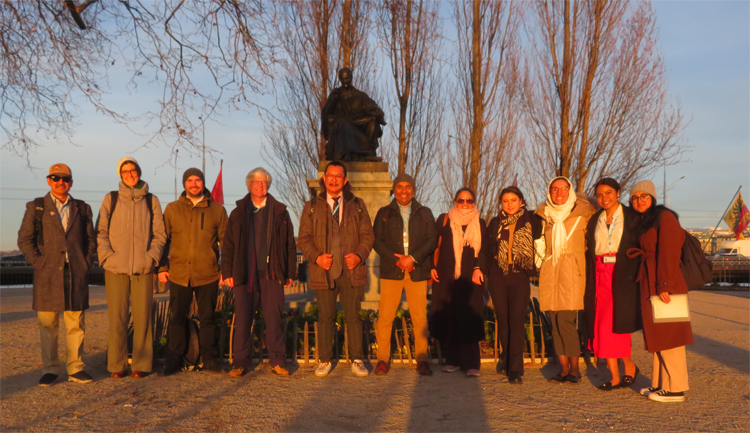
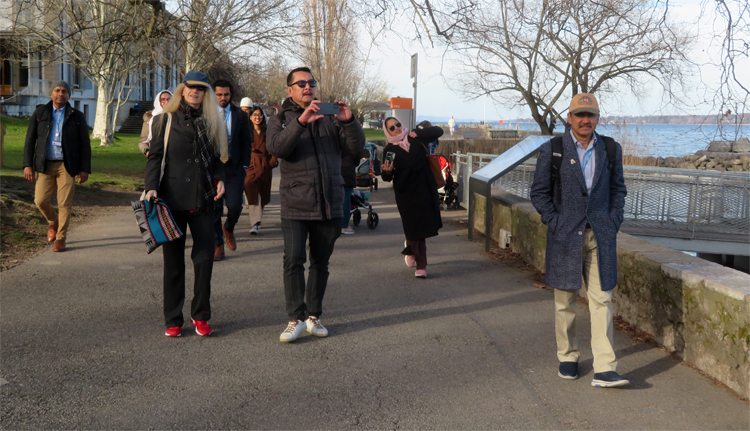
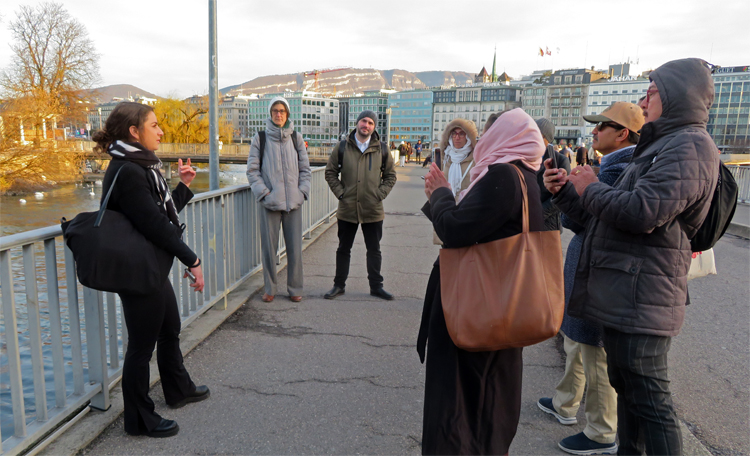
Participants under Rousseau's statue on the DESC Walk in Geneva, 16 March 2023

Particiants on the DESC walk photographes beneath the statue of Rousseau as the sun sets

The Digital Environment System Coalition (DESC) convened two sessions (403 and 204) on 16th and 18th March at this year’s WSIS Annual Forum held in Geneva. The first was a walk which we believe to be the first ever such event held during a WSIS annual forum, and the second was a more traditional session within the cavernous CIGG. Both sessions were convened by the UNESCO Chair in ICT4D at Royal Hollloway, University of London which provides the Secretariat to DESC, in association with INIT (the Inter-Islamic Network on IT), the WWRF (Wireless World Research Forum), ICT4D.AT, and RC-DISC (the Research Cluster for Digital Inequality and Social Change at the University of Canberra).  

Experiencing digital environment interactions in the “place” of Geneva (Session 403): the DESC Walk

We experience things differently when we walk, when we talk together, and when we interact with the real physical environment.  We feel the fresh air on our faces, smell the vegetation, hear the noise of running water, and touch the rough rocks on the slopes.  We interact differently with each other.  We pause and contemplate where we are.  Our minds engage in ways that are so, so different from when we sit in large conference halls.

This DESC walk provided an opportunity for participants (i) to share their own research and practice relating to the interactions between digital tech and the environment, (ii) to discuss the positive and negative impacts of digital tech specifically on the biosphere, hydrosphere, atmosphere and lithosphere, and (iii) to make recommendations concerning the further development of YouthDESC.  In essence, individual participants brought the group to a halt at locations that they felt were most appropriate for them along the walk and shared information about themselves and their research/practice, and we also stopped at five pre-planned locations to discuss each of the main themes as a group.  Moderators of each main stop sought to encourage the participants to highlight three positive and three native interactions between digital tech and the environment.

  • Parc Mon Repos – the biosphere (led by Paul Spiesberger).  Issues discussed included the positives of being able to share nature through digital images, use of remote sensed imagery to monitor the biosphere, and the use of digital tech to enhance agricultural production.  Negatives included digital pollution of plants and green spaces, potentially adverse effects on human health (including mental health), and increased urban exploitation of rural environments through digital tech.
  • Poste Filial – YouthDESC (led by Tasfia Rahman).  This began with a visit inside the building to discover the ways through which it is now necessary to use virtual/digital systems to post a physical/real card.  We also recognized the important links between postal communication in the past and digital communication at present.  The Instagram account of @YouthDESC was discussed, alongside the pros and cons of different social media platforms for engaging youth
  • Pont des Bergues – the hydrosphere (led by Ahmed Imran).  It was recognised that unlike the biosphere and lithosphere, the impact of digital tech on the hydrosphere is less immediately visible.  However, negatives include the impact of deep sea mining for rare earth minerals, and the heating of water in cooling systems.  The use of water warmed by the heat produced by servers was, though, also seen as a benefit.
  • Ile Rousseau – the atmosphere (led by Zumana Imran).  Beneath the feet of the philosopher Rousseau, our thoughts turned to the atmosphere above us, and focused on the positives of the use of satellites for monitoring environmental change and enabling communication in isolated places, whilst also recognizing the harms of treating outer space as we used to treat the oceans (global commons), the impact on dark space, and space junk.  It was also recognised that different cultures have differing views about the environment, and we must engage with indigenous communities.
  • Auditoire de Calvin – the lithosphere (led by Tim Unwin).  As dusk came upon us, few people remained to walk up the steps to the Cathedral and Auditoire de Calvin, but we nevertheless discussed the impact of mining for minerals used in digital tech, the impact of waste especially in landfill, and also the potential benefits in land management.

Scenes from the DESC walk in Geneva, 16 March 2023

Reimagining the Interface between Digital Tech and the Physical Environment (Session 204)

This formal workshop session had three main aims:

  • to share an updated overview of DESC’s emerging model that challenges much existing work being undertaken on digital tech and climate change;
  • to provide an update on its ongoing activities since WSIS 2022; and
  • to do this in a lively and interactive way.

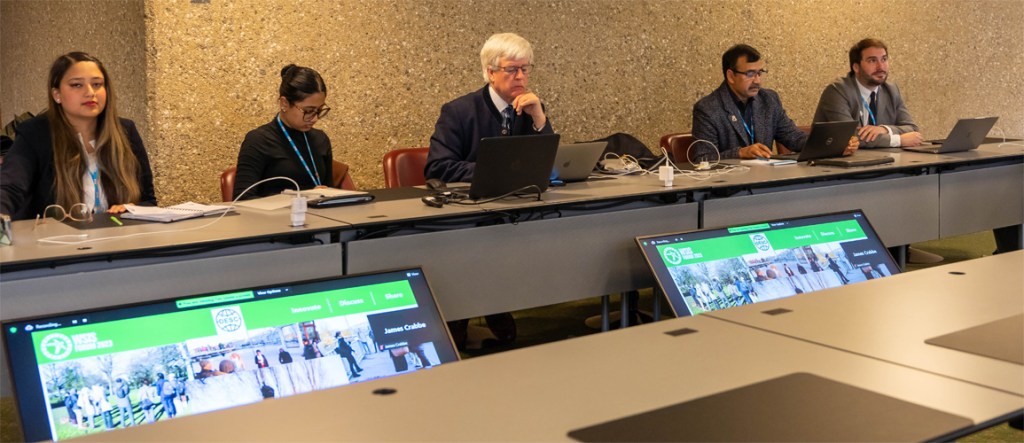
Official ITU photograph from WSIS Session 204

The session was structured as follows:

  • Introduction to DESC, highlighting the need to adopt a holistic approach focusing on the interaction between digital technologies and the totality of the physical environment (including the lithosphere, hydrosphere, biosphere and atmosphere – see diagram below) rather than just climate change.  Indeed, a focus primarily on  human-induced climate change is likely to lead to seriously adverse impacts on other dimensions of the physical environment.
  • Summaries of the key points of discussion explored during the DESC walk (WSIS Session 403) the previous day, presented by the five discussion moderators (including the YouthDESC session).
  • Highlights of two examples from the activities of DESC’s Working Groups emphasizing why these issues matter:
    • The indigenous DESC Working Group (Poline Bala’s sliodes were presented by Tim Unwin).  This highlighted that indigenous peoples are insufficiently represented at events such as WSIS, and that they can contribute significantly to new ways of addressing the interface between digital tech and the physical environment
    • A video presentation by James Crabbe on the importance of omics for informing policy on deep sea mining.
  • This was followed by an introduction to the toolkit being developed by DESC for all those who have pledged to the ITU-led Partner2Connect initiative to enable them to consider and address the environmental impact of their proposed interventions.
  • The final element was a lively discussion around the issues raised, that included new commitments from participants to explore collaboration on implementing the DESC toolkit

DESC in Geneva

The general consensus from both sessions was that they were enjoyable and informative – and that DESC should offer to convene another walk in 2024 when we can delve once again into both the positive and negative impacts of the design and use of digital tech on the environment.

What migrants want: digital tech, inequality and migration’ – MIDEQ WP9 convenes thematic workshop at WSIS 2023, Geneva.

Following the success of our online thematic workshop held during the World Summit on the Information Society (WSIS) 2022 meeting, the MIDEQ WP9 (digital tech, inequality and migration) team convened a hybrid thematic workshop at the WSIS Annual Forum 2023 in Geneva on 17th March examining ‘what migrants want’ in relation to the use of digital technologies as opposed to the numerous apps that are supposedly designed for them. Building on our ongoing research (see https://ict4d.org.uk/technology-inequality-and-migration/ and https://www.mideq.org/en/themes/digital-technologies-and-inequality/), we explored how co-design with migrants can help craft digital interventions that can usefully address migrant-defined inequalities.

The session, which aligned especially with SDG10 and WSIS Action Lines C3, C4, C5, C7(iii, iv,v), C8 and C10, was structured around our digital interventions from Nepal and South Africa using a series of short-form videos ‘created by migrants for migrants’ as a framing device for the discussion. The contributions highlighted many inequalities faced by migrants and how digital tech can meaningfully address them as well as how digital tech can support personal life choices, offer networking opportunities, and become a peer-to-peer learning tool. The overarching theme was the need for all actors at the interface of digital tech and migration to be mindful of the need to ensure the safe, secure and wise use of digital tech by migrants.

Despite increasing evidence of the challenges to the beneficial use of digital tech by vulnerable migrants, actors such as tech companies, international and local organisations continue to design technologies aimed at migrants without due regard to their unintended consequences. International organisations and fora such as WSIS that are at the forefront of digital inclusion must recognise not just the opportunities offered by digital tech for migrants but also the risks and harms associated with them. This is especially important given the pervasive structural inequalities and limited digital capabilities that characterise many migrant contexts.

WP9 co-lead Prof G Hari Harindranath led the session with Prof Tim Unwin and Dr Maria Rosa Lorini while Bryce Hartley from GSMA (online) and Julien Varlin from ILO Geneva served as discussants. The highly interactive hybrid session was attended by senior government officials and representatives from international organisations, CSOs and tech companies as well as researchers.

We also used the in-person WSIS Forum in beautiful Geneva as an opportunity to discuss pathways to impact for our work with colleagues at IOM and ILO.

Prof G. ‘Hari’ Harindranath

20/3/2023

The UNESCO Chair in ICT4D at the WSIS Annual Forum 2023

We are delighted that members of the UNESCO Chair in ICT4D at Royal Holloway, University of London, are involved in the following four sessions at this year’s WSIS Annual Forum in Geneva between 13th and 16th March 2023 (listed in chronological order):

  • Session 184: International Conference on Digital Transformation of Education: Road towards SDG 4 (Guest of Honour and Panellist), Thursday 16 March 09.00-09.45
  • Session 403: DESC Experiencing digital environment interactions in the “place” of Geneva (convenor) – this is a discussion-walk around Geneva commencing at the main entrance of CICG on Thursday 16 March from 16.00-18.30 (more details)
  • Session 204: DESC Reimagining the Interface between Digital Tech and the Physical Environment (convenor), Friday 17 March, 10.00-10.45 (more details)
  • Session 329: MIDEQ WP9 What migrants want: digital tech, inequality and migration (convenor), Friday 17 March, 11.00-11.45

Please do join us at these sessions, the last two of which will also be available for those wishing to join online. More information is available on the DESC sessions here.

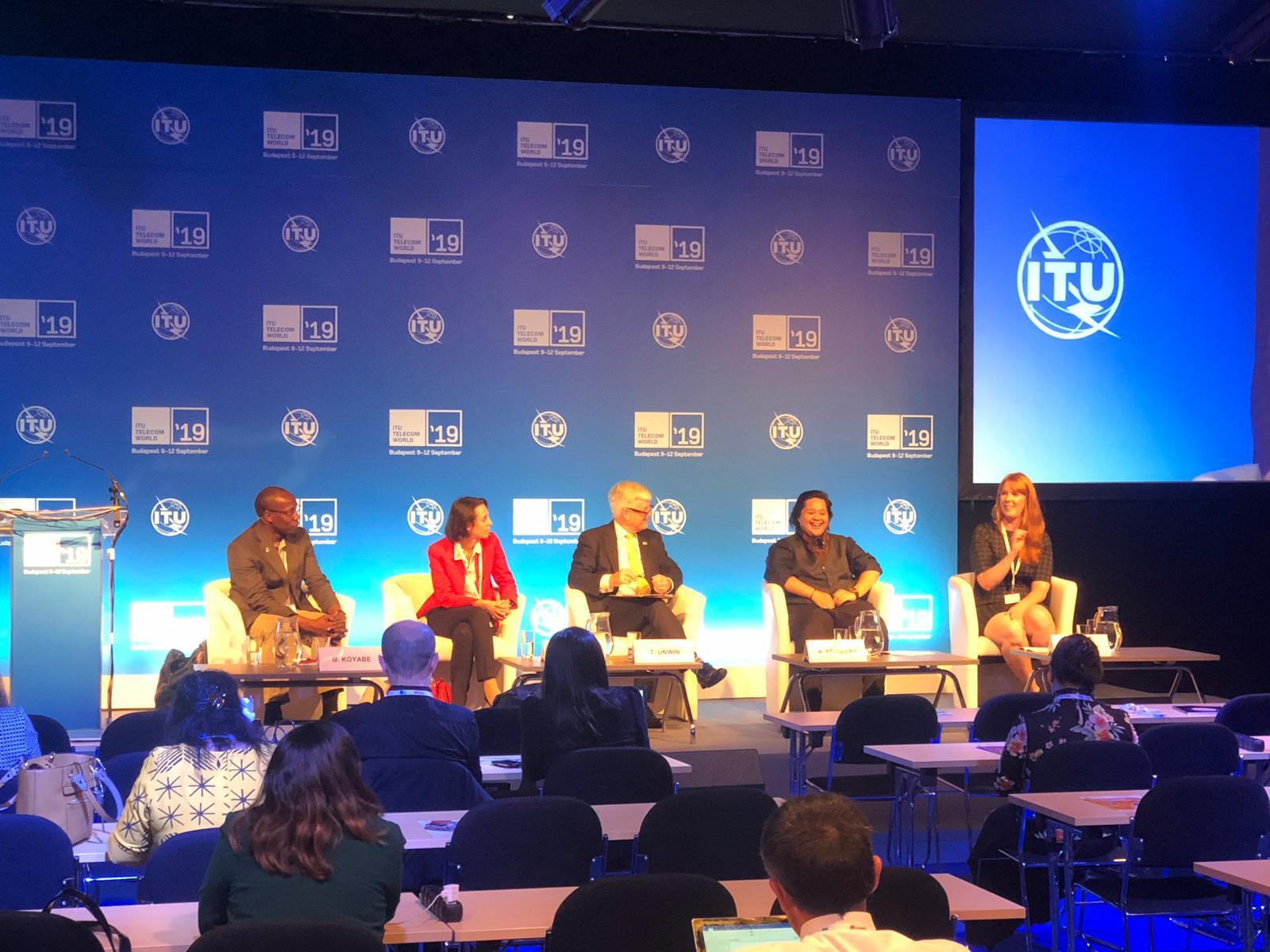
The UNESCO Chair in ICT4D at ITU’s Telecom World 2019 in Budapest

This year’s Telecom World event convened by the ITU and hosted by the Hungarian Government from 9th-12th September in Budapest was one of the most interesting and useful such events in recent years.  The Forum programme contained many thought provoking presentations and discussions, and the government’s hospitality was generous, featuring an inspiring musical evening and a drone display over the Danube.  There was also a very diverse exhibition, with particularly impressive displays from China about the Digital Silk Road.

David
David Banes speaking at ITU Telecom World

The UNESCO Chair in ICT4D was delighted to participate in and contribute to several sessions.  In particular, David Banes was a speaker in an important session on Accessibility matters: dismantling the barriers of disability with technology on 12th September.  This session noted that technology can enable better access to health, education, government services and the job market for all those affected by disabilities, but also asked  what more can be done, in both emerging and developed markets? It explored how existing solutions can be scaled and adapted, and sought to identify whether there is  a business case for digital inclusion solutions?

23eaf6ed-e0e1-456d-915f-e10a2f72881a
Tim Unwin moderating AI and gender session (Source: ITU)

Our Chairholder (Tim Unwin) also moderated two sessions, on Diversity by design: mitigating gender bias in AI and the launch of the ITU-CISCO Digital Transformation Center Initiative, as well as speaking in the Huawei sponsored session on Fixed wireless technology for affordable broadband development.  These provided a good opportunity to highlight the work of the UNESCO Chair in ICT4D and also our TEQtogether initiative changing men’s attitudes to women in technology.

UNESCO Chair in ICT4D’s response to the UN Secretary-General’s High-Level Panel on Digital Cooperation call for contributions

We share below in full our response to the recent call for contributions by the UN Secretary-General’s High Level Panel on Digital Cooperation. Whilst we have sought to respond to these questions in good faith, we have serious concerns about the process and its likely impact.  Some of these are summarised in Section IV below.  Unfortunately the consultation seems very flawed in design, and we do not believe that it will have any significant positive impact on the use of digital technologies by poor and marginalised people and communities.

However, should you also hold any of the views and opinions below, do please also reflect these in your submissions to the Panel.

The headings in bold (and italics) below are those provided by the Panel – our responses are listed in normal font below.

I. Values & Principles:

a) What are the key values that individuals, organizations, and countries should support, protect, foster, or prioritize when working together to address digital issues?

1) The most important value is that of RESPONSIBILITY – at every scale from the UN, through governments and companies, down to individuals.  Scientists are responsible for the technologies that they develop; countries are responsible for the regulatory environments they create; the UN is responsible for the examples of good practice and advice that agencies share with governments; companies are responsible for the harm that their technologies do.  For too long, the UN focus has been on rights, but rights without responsibilities are problematic.

2) RESPECT for the OTHER.  All too often, digital technologies are imposed (through marketing, sales, government action etc.) without sufficient recognition of the real needs of others.  Clearly, the private sector is interested in being able to sell the same product to as many people as possible, even though this might not be in the best interests of many of those people.  However, it is very important that technologies are designed with the interests of users at heart, and users have diverse interests.

3) TRANSPARENCY.  This value is problematic, because it can be seen as being in conflict with privacy (below).  However, transparency is crucially important in contexts such as regulatory decisions pertaining to spectrum auctions, the use made of personal data by social media corporations and others, and the monitoring of citizens by governments.

4) PRIVACY (see also Transparency above).  The notion of privacy varies in meaning and understanding across the world, although a “Western” conceptualisation of the privacy of the individual has come to dominate much global discourse on this matter.  Accordingly, information and data that are deemed to be “private” should not be accessible in the public domain.

5) SECURITY.  When designing digital services and technologies, it is important to understand how these have the potential to impact the security of different stakeholders.  Whatever approach is used, critical security questions need to be addressed at each stage of the digital design: Who or what is being secured? Who or what is doing the securing? Why is the subject being secured? Who or what is the subject being secured from?

6) THE GOLDEN RULE.  In essence, this can be summarised as doing to others as you would have done to yourself; it can also be considered as doing no harm.  Despite considerable discussion by philosophers about “universalism” this is probably the only universally accepted value across most of the world’s cultures and societies.  It has important implications with respect to digital technologies.  The behaviour of senior executives in global corporations who send their children to be educated in “digitally-free” schools, and yet make and sell technologies for use in schools would seem to run counter to this value.

7) TRUST is important at many levels when working together on digital issues.  All too often digital partnerships fail because insufficient emphasis is placed on trust in their initial creation.  Trust is also absolutely essential in global negotiations around such issues as Internet governance and digital security.

b) What principles should guide stakeholders as they cooperate with each-other to address issues brought about by digital technology?

The principles essentially derive from the values noted in 1(a)

1) Above all else, the principle of “INCLUSION” should be at the forefront when we are “working together to address digital issues”.  The needs of the poorest and most marginalised should be prioritised, especially in UN, civil society and government agendas.   Digital technologies marginalise individuals and communities unless they are designed to be inclusive.  Specific attention should be paid to working with people with disabilities, out of school youth, women and girls (especially in patriarchal societies), and refugees.

2) Closely allied to the value of inclusion, is the need to prioritise a REDUCTION IN INEQUALITIES rather than an increase in economic growth.  For too long, the UN, governments, private sector companies and civil society have all worked in the belief that economic growth is the main way to reduce poverty.  Such policies and practices have failed to recognise that in most instances economic growth fueled by digital technology has actually increased inequalities at a range of scales.  This is not only morally wrong, but it has important implications for peace, prosperity and social cohesion.

3) WITH THE POOR.  In the past, far too much effort has been placed on using digital technologies “for” the poor and marginalised.  Technologies are designed and developed usually in the richer countries of the world, and then promoted as being useful in the reduction of poverty.  This approach is fundamentally flawed.  Instead digital technologies should be designed WITH the poor.  Indeed, the poorest and most marginalised should be at the heart of determining the needs that these technologies should serve, the sorts of technologies that are developed, and how they are used.

4)  DRAWING ON EXPERIENCE.  Far too many uses of technology in development practice reinvent the wheel.  Insufficient attention and understanding is placed on understanding the successes and failures of the past; this is costly and all too often replicates failure.

5) True PARTNERSHIP.  Many technology initiatives claim to work in partnership, but all too often such partnerships fail to deliver in the interests of the poorest and most marginalised.  This is frequently because those involved do not fully understand the complexities and principles of delivering successful partnerships.  Much more effort is required in ensuring that when partnerships are used they are indeed effective

6) MITIGATING HARM.  Much global attention, especially by UN agencies, not least through the WSIS process, is focused on showing how ICTs can be used positively to deliver the SDGs.  However, this is only part of the story.  ICTs can equally be used to do harm.  Therefore, all initiatives using digital technologies for “development” should pay as much attention to mitigating harm as they do to doing good.

7) LANGUAGE matters.  The words we use not only reveal the way we think, but they can also shape the thinking of others.  They therefore need to be used carefully.  Much focus in the tech sector is on connecting the “next” billion; but this will only increase inequality because the poorest and most marginalised will be left behind.  However, we should not aim to connect the “bottom” billion because this is pejorative; instead we should call them the “first” billion because they are most important.  Hence our focus should always be on the “first billion” when we think about and deliver initiatives designed to support the poorest and most marginalised.

8) A shift from the INDIVIDUAL TO COMMUNAL interests.  For too long, the emphasis of tech companies, governments and indeed the UN (as in INDIVIDUAL human rights) has been on the individual.  However, there are strong arguments that shifting the emphasis to communal interests would create a fairer and more equal society.  The working out of this principle can be seen in the tensions, for example, between the USA (more individualistic) and the EU (more communal) in negotiations relating to digital technologies.

9) Widespread and informed PUBLIC ENGAGEMENT about the kind of digital future that our societies want.  This is particularly important with respect to debates over AI and cyborgs.  Some fear that it is already too late to prevent “pure” human beings from becoming extinct as they are replaced by machine-humans or human-machines; others argue that this does not matter, and that humans have always used machines for their own advantage.

10) DESIGN AT SCALE.  The model of private sector companies and civil society organisations funding and delivering small pilot scale projects in the expectation that they can then be rolled out globally is fundamentally flawed.  All too often, those promoting these pilots bemoan that governments will not fund them to go to scale and be sustainable.  The fundamental problem here is that most were never in the first place designed at scale, and it is therefore scarcely surprising that no-one can find the necessary budgets for them to be rolled out more widely.

11) FOCUS ON WHAT WORKS WELL and not just on innovation.  Innovation is important, but most innovations fail.  It is therefore at least as important for donors and governments to fund what is known to work quite well, and then make it even better and more widespread, rather than focusing only on innovations (many of which will fail, and thus reflect a waste of money).

c) How can these values and principles be better embedded into existing private and/or public activities in the digital space?

There is a huge literature on this.  Section 5 below highlights some of the more valuable work that the panel should read.  If there is only one book you have time for, you should read Tim Unwin’s (2017) Reclaiming Information and Communication Technologies for development (OUP).

1) The role of  PRIVATE sector companies.  The private sector cannot be expected to deliver on the needs of those who cannot pay for its goods and services.  The role of companies is to make profits for their owners and shareholders.  Many governments and UN agencies see companies primarily as sources of additional revenue, often through their Corporate and Social Responsibility (CSR) budgets.  However, more often than not, the real benefits of involving private sector companies in technology for development initiatives are in their ability to deliver on the ground, their focus on ensuring ‘profit’, and thus on ensuring sustainability.

2) The role of the PUBLIC SECTOR.  The public sector (governments) is theoretically the only sector (of the three: public, private and civil society) that should have the interests of all of their citizens at heart.  Hence, they must play a crucial role in serving the interests of their most marginalised citizens.  A real challenge here is that many of those in governments are seen as being self-serving, and in such circumstances citizens often say that they trust companies more than they do their governments.  Given the absolutely crucial role of governments, much more needs to be done to help train politicians and civil society (and indeed UN agencies) about digital technologies, so that they can take wise decisions in the interests of all.

3) REGULATION.  In balancing the interests of the private sector and governments, good regulation has a key role to play.  All too often, though, ICT and Telecommunication regulators have erred on the side of the private sector rather than their poorest citizens.  This balance needs carefully to be changed, so that more affordable and more extensive access can be made available to digital technologies.  As is well known, access by itself is not enough to ensure that the poor can empower themselves through ICTs, but without access they are unable even to begin to use technologies in their own interests

4) OPEN and PROPRIETARY solutions and INTELLECTUAL PROPERTY RIGHTS (IPR).  The balance between open and proprietary solutions is complex and varies in different contexts.  There are strong arguments that anything that is funded by governments should be open and accessible to all.  However, IPR can act as an incentive for people to create new solutions from which then can benefit.  This can in turn motivate them to gain digital literacy and information security skills that they need to be self sufficient.  For the sake of collaboration and development, it may also be useful to make more intellectual property available for free to them, and at the same time not take and register their cultural symbols, traditions, designs, unique products and services to patent and copyright them in some developed country system.

5) A focus on the POOREST AND MOST MARGINALISED.  Above all, if we wish to use digital technologies for all, we must always ensure that they are designed in a way that is inclusive and does not further marginalise the most marginalised.  The evidence of the past, however, suggests that this is unlikely to happen.  It is the rich and powerful who have always used technologies primarily to serve their interests and remain in power.

II. Methods & Mechanisms

a) How do the stakeholders you are familiar with address their social, economic, and legal issues related to digital technologies? How effective or successful are these mechanisms for digital cooperation? What are their gaps, weaknesses, or constraints? How can these be addressed?

This question is ridiculously broad, and relates closely to other questions, so there is a danger of simply repeating what we have already stated.  Members of the UNESCO Chair in ICT4D work with governments, the private sector, civil society and academia, and some of us have >40 years of experience in using digital technologies in these sectors However, in brief, we would make the following observations on mechanisms for digital co-operation.

1) On EFFECTIVENESS.  Most attempts to build partnerships to deliver effective digital technological solutions in the interests of the poorest and most marginalised have failed.  There are many reasons for this (see literature noted in V below), but among the more importance are:

  • a failure to apply basic well-known principles of partnership and cooperation;
  • a failure of trust;
  • a failure of appropriate planning;
  • a failure to deliver on commitments;
  • self-interest rather than an interest in the well-being of the poor; and
  • a failure of leadership.

To stimulate co-operation, it is important to ask critical questions about what benefits digital service and technology provide people with (see literature in V below), and it is also essential to understand the many barriers (access, skills, knowledge, affordability, relevance) to accessing those benefits and how different barriers shape access for different communities.

2) GAPS, WEAKNESSES AND CONSTRAINTS.  In part these relate directly to the first part of this question.  However, gaps, weaknesses and constraints include:

  • competitive rather than collaborative interests;
  • lack of knowledge about effective partnership delivery;
  • lack of trust-building;
  • lack of cultural understanding and awareness;
  • excessive arrogance, and lack of humility;
  • poor leadership;
  • failure to establish what stakeholder interests really are;
  • lack of transparency and openness; and
  • focus on economic growth rather than reducing inequalities.

It should be emphasised that a lack of funding is NOT usually a barrier or constraint.  A good well-designed and appropriate initiative can always find ways of being funded.  Indeed, it is not usually the funding, but rather the will of those involved actually to deliver, that is the biggest problem!

3) How can these be ADDRESSED.  At the danger of repeating answers given elsewhere, the following would provide some solutions:

  • enhanced education about digital technologies;
  • improved training of government officials and politicians;
  • widespread public debate and involvement in decisions over digital futures;
  • specific training in partnership building and cooperation, and involving experienced partnership brokers in delivering partnerships sustainably;
  • ensuring a joined-up UN approach (what, for example, does the High-Level Panel on Digital Cooperation really actually add to the many UN-wide initiatives ongoing in the field of digital technologies?).  The CEB and HLCP are, for example, doing valuable work in trying to develop such UN-system-wide strategies;
  • greater involvement of poor and marginalised people and communities at all stages from the design to the use of digital technologies;
  • giving greater power (and respect) to Regulators; and
  • focusing more on the impact that digital technologies have on inequality than on economic growth.

b) Who are the forgotten stakeholders in these mechanisms? How can we strengthen the voices of women, the youth, small enterprises, small island states and others who are often missing?

1) The list of implied forgotten stakeholders in the question (women, the youth, small enterprises, small island states) is itself revealing, because it reflects a very top-down approach to these issues and ignores the most marginalised people and communities.  We would add:

  • people with disabilities (we hope His Excellency Mohammad Al Gergawi will champion this on the panel);
  • refugees;
  • indigenous and isolated communities;
  • out of school youth and “street children”;
  • the LGBTIQ community; and
  • the elderly

2) How to STRENGTHEN THE VOICES.  This is indeed a really important but difficult question.  The usual arguments are that: democratic processes can involve them; the Internet Governance Forum (IGF) is a mechanism through which their voices are expressed; social media platforms can be used; and we should draw on the experience of those who have deep working knowledge of their needs and wishes, such as civil society organisations.  But none of these have really yet worked effectively (see Unwin, 2017 – in Section V –  for a discussion of these issues of voice, and further references cited therein).  There is also no one-size-fits all solution.

Some suggestions:

  • on “women” – we need to change men’s attitudes and behaviours to woman in/and technology, thereby enabling women to have greater voice (see TEQtogether, Section V)
  • on small island states – very intractable – not only because of small size and isolation, but also because they usually have few people with the skills and expertise and they cannot spend all their time out of the country “giving voice”.  Solutions include: dramatic cut-back on the number of events relating to digital technologies (there is already far too much duplication and overlap in conferences and summits); dramatic improvement in virtual meeting technology; substantial efforts at capacity development…
  • on youth – again there are real problems in identifying “representative youth”.  All too often youth representatives replicate existing power structures in the countries from which they come.  Furthermore, they are often also often treated very patronisingly – their voices should not only be listened to, but also really acted upon.  We also need more interaction between the elderly and the young.  Reverse/360 degree mentoring can be valuable in this context.

c) What new or innovative mechanisms might be devised for multi-stakeholder cooperation in the digital space?

Why always look for the new, when the old could work if better delivered?  There is a huge literature on technology partnerships and cooperation, but few people take the time to read it.  The lessons are very well known.  The trouble is that many people actually want to reinvent the wheel, often because they want to claim something for themselves as being new, but also often because they think they do not have time to learn how to deliver what they want.

There is also a problem with terminology.  Most people now use the term “multi-stakeholder”, when what they actually mean is “multi-sector”.  Multi-stakholder only means having many stakeholders, which could all be from, for example, the private sector!  In general usage, though, the term is usually now used to organisations, cooperation or processes that involve the private sector, the public sector and civil society – and so in such instances should properly be called “multi-sector”.  As noted above, language is very important.

Some existing partnership and cooperation good practices are noted below.  Geldof et al (2011) noted five broad factors as being important in successful ICT4D partnerships, and these also apply for any kind of cooperation in the digital space:

  • “Success is increased when detailed attention is paid to the local context and the involvement of the local community in partnership implementation.
  • It is important for such partnerships to have clear and agreed intended development outcomes, even where constituent partners may themselves have different reasons for being involved in the partnership.
  • Sustainability and scalability of the intended development intervention need to be built into partnership design at the very beginning.
  • Successful partnerships are built on trust, honesty, openness, mutual understanding and respect.
  • A supportive wider ICT environment needs to be in place, both in terms of policy and infrastructure, if such partnerships are to flourish and deliver effective development outcomes”.

In general eight key principles are important for effective multi-sector cooperation or partnerships in the field of digital technologies:

  1. A political and infrastructural environment that is conducive to the implementation of partnerships and cooperation. Without this, there is little point in starting.
  2. Engagement of all relevant stakeholders as early as possible in the initiative.
  3. The involvement of a high level champion, as well as leaders of all of the entities involved.
  4. The identification of clear and mutually agreed objectives for the partnership or cooperation at the very start.
  5. Consistent monitoring and evaluation of the partnership or cooperative process and its intended outcomes. Again, this must be done from the beginning by ensuring a baseline study exists to enable impact and outcomes to be measured effectively.
  6. A clear and realistic resourcing framework, whereby each partner is explicit about the resources that they are willing to make available to the partnership or cooperation, as well as their expectations of the benefits of being involved in the partnership. Mechanisms must also exist for the inclusion of additional partners at stages during the process where new needs are identified.
  7. An ethical framework that emphasises a focus on transparency, and helps build trust within the partnership or cooperation.
  8. A management office and/or partnership broker to ensure the day-to-day and effective management and delivery of the partnership or cooperation.

This is not new, but is rarely undertaken in practice.  Perhaps it would be new to change our approaches away from the “fetishisation” of innovation and focus instead on what we know works.

III. Illustrative Action Areas

The Panel plans to explore, among others, the following areas where greater digital cooperation is required:

  • inclusive development and closing the digital gap
  • inclusive participation in the digital economy
  • data
  • protection of human rights online, particularly of children, women and marginalized communities
  • human agency and voice/participation in shaping technological choices and architecture
  • digital trust and security
  • building the capacity of individuals, institutions and governments for the digital transformation.

a) What are the challenges faced by stakeholders (e.g. individuals, Governments, the private sector, civil society, international organizations, the technical and academic communities) in these areas?

Again there is a wealth of good research and practice in these areas.  The panel would be advised to read some of this literature.  The values and principles noted above in our responses to Section 1 are also highly pertinent here.

It is interesting that you do not ask WHY the many challenges exist.  Only by asking this question can you hope to consider mechanisms to deal with the many ones that exist.  So, we offer just a few of the more important inter-related reasons:

  • individual interests and greed
  • competition for market share
  • competition between and within organisations and especially UN agencies
  • arrogance
  • failure to trust
  • failure to listen to the needs of “the other” and especially the poorest and most marginalised
  • failure of governments to serve the interests of all of their citizens
  • lack of transparency
  • inadequate leaders and champions

b) What are successful examples of cooperation among stakeholders in these areas? Where is further cooperation needed?

There are remarkably few really good examples of successful cooperation and partnership in the interests of the poorest and most marginalised.  Much depends on how success is defined.  Some famous initiatives (such as the NePAD e-Schools Project in Africa a decade ago) have often been described as successes (from the perspective of individual stakeholders), when they were actually complete failures with respect to enhancing education of children systemically across Africa.

It is interesting that the question posed here is “Where is further cooperation needed?”.  If existing cooperation is poor, then it is clear that we should not have further such cooperation, but instead need to change the nature of such cooperation, as suggested in IIIa above.

c) What form might cooperation among stakeholders in these areas take? What values and principles should underpin it?

This question has largely been answered by responses to Section I on values and principles.  There are very many guides to good cooperation and partnership that the Panel should read if they are not already aware of their content.  The references included in the material cited in Section V will provide plenty of food for thought.

In addition, though, it should be emphasised that we have specifically outlined above some of these points in relation to digital security and trust. Another aspect to consider is the starting point for the design of digital technology and services. Some principles for engendering trust in digital design are again outlined in the references in Section V under “Security”.

IV. Do you have any other ideas you would like to share with the Panel?

Unfortunately the questions in this consultation are somewhat broad and repetitive.  Most have already been answered in the very extensive literature that exists, some of which we list below in Section V.  We wonder how much time panel members actually have to read some of the most important texts on the subject?  The answers to most of the questions herein are well-known; the challenge is to act upon this knowledge.  It is a challenge of “will”.

We also noted above our concerns about the role of the High-Level Panel on Digital Co-operation, and remain unconvinced that it is the appropriate vehicle through which real change can be delivered.  There are already UN bodies and structures that could readily have fulfilled this role.  Why was there the need to create yet another high-level  body?  The structure of the Panel is also problematic if it intends to understand and deliver on the key issues noted above.  Whilst efforts have clearly been made to get reasonable gender and regional balances, the panel is heavily made up of elite people, and has a strong private sector emphasis.  Few members are from very poor or marginalised backgrounds, and although many might claim to know about poverty and marginalisation, few have really experienced it.

Moreover, the poor design of this “consultation/survey” generates concern whether the analysis will make a significant difference to global policy or practice.  We have nevertheless responded in good faith, and hope that our concerns over the likely impact are misplaced.

V. Please provide your numbered references or links to additional reports/documents here.

On ICTs FOR DEVELOPMENT

  • The work of the UNESCO Chair in ICT4D https://ict4d.org.uk
  • Unwin, T (2017) Reclaiming Information and Communication Technologies for Development, OUP
  • Unwin, T. (ed.) (2009) Information and Communication Technologies for Development, CUP
  • Sharafat, A. and Lehr, W. (eds) (2017) ICT-Centric Economic Growth, Innovation and Job Creation, Geneva: ITU

On ICT PARTNERSHIPS

  • Geldof, M., Grimshaw, D., Kleine, D. and Unwin, T.  2011.  What are the key lessons of ICT4D partnerships for poverty reduction?  London: Department for International Development.
  • Unwin, T. (2015) MultiStakeholder Partnerships in Information and Communication for Development Interventions, in International Encyclopedia of Digital Communication and Society, Chichester: Wiley, 634-44.
  • Unwin, T. (with Alex Wong) Global Education Initiative: Retrospective on Partnerships for Education Development 2003-2011, Geneva: World Economic Forum, http://www3.weforum.org/docs/WEF_GEI_PartnershipsEducationDevelopment_Report_2012.pdf

On SECURITY:

On CHANGING MEN’S ATTITUDES AND BEHAVIOURS TO WOMEN AND TECHNOLOGY

Digital technologies and the FUTURE OF EDUCATION AND LEARNING IN DEPRIVED CONTEXTS

ITU and UNESCO Chair in ICT4D session at WSIS Forum 2018: International decision-making in ICT – where are the women?

The ITU is strongly committed to achieving gender equality across its organisational structures, and has been one of the driving forces for achieving gender equality in and through ICTs across the world, not least through its involvement in creating the EQUALS initiative.

One of the key international gatherings convened by the ITU has been the series of World Radiocommunication Conferences held periodically to reach international agreements on Radio Regulations, with new and revised Resolutions and Recommendations.  Traditionally, these have been very male dominated, and the ITU has therefore taken steps to encourage greater involvement of women at all levels in its decision-making processes.  One aspect of this has been the creation of the Network of Women for WRC-19 (NOW4WRC19), led by Dr. Hanane Naciri, which aims to encourage increased participation of women in the conference being held in 2019.  Its main objectives are to have a better gender balance among delegates, to prepare women for key roles in WRC-19, and to grow the women’s community capacity and contribution.

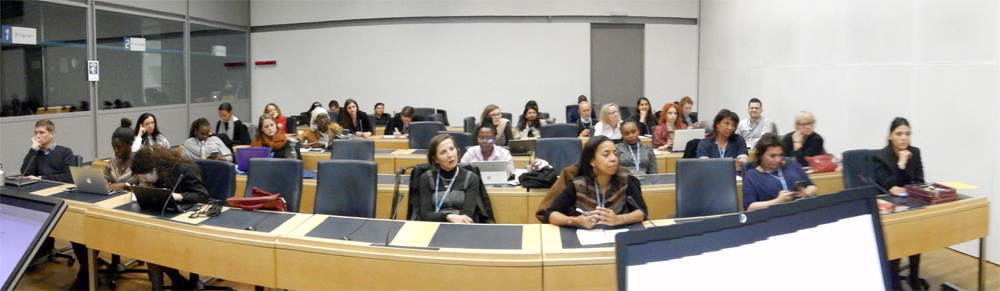
As part of this process, the ITU and the UNESCO Chair in ICT4D convened Session 113 at the WSIS Forum 2018.  This began with a lively panel discussion, opened by Dr Hanane Naciri (Radiocommunication and Software Engineer, Radiocommunication Bureau, ITU), with Sahiba Hasanova (Vice-Chairman, ITU-R Study Group 4 / Leading Adviser, Ministry of Transport, Communications and High Technologies, the Republic of Azerbaijan), Caitlin Kraft-Buchman (CEO/Founder Women@theTable, Geneva, Switzerland) and Brigitte Mantilleri (Director of the Equal opportunities office of the University of Geneva).  The speakers shared some of their experiences of leadership in the field of ICT, commented on the challenges facing women who wish to participate in such events, and suggesting what needs to be done to involve more women at all levels in such processes (summary).

workshop

Building on these inspirational introductions, participants then shared their experiences, insights and suggestions for what still needs to be done to ensure that women contribute fully and appropriately to international ICT decision making, and especially to WRC-19.  Twelve themes were identified, and these were captured in a mind map which is available on the ITU and UNESCO Chair in ICT4D sites:

  • Top leadership and champions: it is essential that top leadership supports the increased participation of women, and that champions are identified who can promote such participation;
  • Ensuring that women are in powerful positions: women need to be supported throughout their lives, and particularly encouraged to take leadership roles;
  • Building and promoting networks: it is essential that we work together in intergenerational networks that can support and advise women participating in such decision-making activities;
  • Involving men: we must have male feminists as well as female ones who are willing to help change attitudes and cultures of oppression;
  • Training: more effective training programmes are necessary, particularly ones that help men to understand the relevant issues;
  • Organisational structures: addressing elements of organizational culture is key, and it is important to equip women to survive and flourish in the environments where they work;
  • Awareness and communication: the need to provide much more information about how women can contribute to such decision-making gatherings, and to confront people who have negative behaviours;
  • Changing norms: the need to address and revisit many underlying assumptions;
  • Incentivisation: the need to provide incentives to organisations and individual women to participate in such events;
  • The role of recruitment: recruitment agents can play a key role in ensuring balanced interview panels and processes, and in supporting a charter code of practice on gender;
  • Remember that inclusion is not the same as diversity: diversity is not enough and we need to be inclusive to ensure that women feel comfortable in whatever environment they find themselves; and finally
  • Recognising it may not happen overnight: given how slow change has been so far, we need to recognize it may not happen swiftly, but we must develop the momentum so that it will happen as quickly as possible.

Participants were committed to supporting EQUALS and working with the ITU to ensure that there is much greater involvement of women at all levels in WRC-19.