Innovating Cyber Security Engagement

Volume 2    Issue 4    April 2017

Introduction

Much of what we call “cyber security” has its roots in an area of study and practice called “IT security”, which can be described as the protection of computer produced data and information and the associated protection of the infrastructure that makes possible the production, circulation, protection and curation of that data. However, the protection of data is no longer solely a question of IT security. The widespread adoption of digital technology across all strata of society and the increasing reliance by governments and industry to engage with citizens through digital media brings data protection into the realm of everyday life. If data protection is to make sense to people, IT security must clearly link to the human security needs and concerns that affect the individual. By approaching data protection in this way, we are looking at and responding to the challenge of the protection of data in a more holistic manner that includes the social, political, cultural and economic as well as the technical. This is often termed “cyber security”.

Engagement innovation

To understand cyber security in terms of what it means in people’s every day lives, Royal Holloway has developed a programme of creative security engagement methods that are playful, participative, open- ended and democratic, and are designed to support and structure conversations about digital security. They tease out how digital security relates to other parts of everyday life and create spaces in which people can actively discuss what cyber security means to them.

Case Study

Creative security methods have been deployed as part of e-safety programmes. For example, a community centre in a lower socio- economic area of Sunderland (North East England) wanted to include e-safety as part of an education and engagement programme designed for local young people. The youth workers at the centre decided to focus on e-safety in the context of parental advice and the role they would like parents to play. It was agreed that creative methods would be used to enable this discussion. The researcher worked as a facilitator to help the youth workers and young people to develop the conversation through the co-creation of a wall collage.
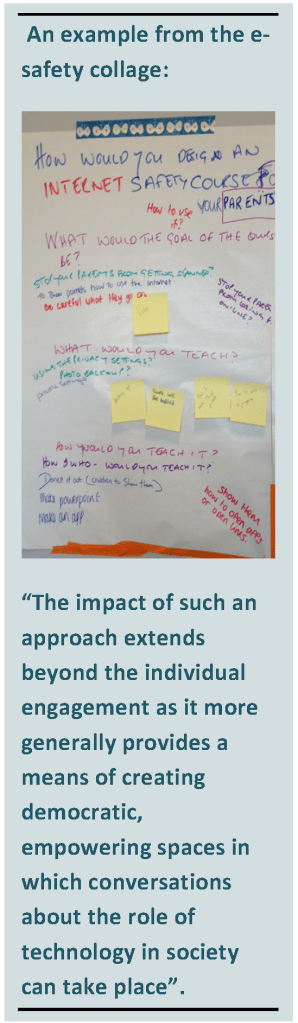
The wall collage was co-constructed using the following process:

  1. The facilitator spent time observing the space and talking to the community.
  2. The facilitator worked with the youth workers and young people to create a series of open questions that reflected the e-safety interests of the community.
  3. The facilitator arrived at the Centre to start the project with some stimulus images and a large wall space.
  4. The facilitator worked alongside youth workers to ask the open questions with small groups of young people.
  5. The young people generated material for the wall collage.

The e-safety engagement was deemed a success because of the level of sustained engagement from the young people, showing that the topic was important to participants as well as being enjoyable as a mode of engagement. The young people produced a wall collage that demonstrated that they knew about e-safety issues but that there wasnot always a “right path”. Their narratives further showed that parents could be a security threat as well as a support.

The narratives gave youth workers an important steer on what type of e-safety support was most needed. This type of approach also enables information security researchers from different disciplinary backgrounds to collaborate by developing a shared understanding of the real-world security problems faced by a community. In particular, the approach enables a common understanding of the security concerns from the perspective of the individual.

Localising and Contextualising Access Technologies

Volume 2    Issue 3    March 2017

The World Health Organisation (WHO) has highlighted the importance of prioity assistive technologies to ensure the needs of people with a disability are met globally. Addressing this need requires a combination of innovative new solutions and the localisation in new communities of existing ones.  Localisation can be described as the linguistic and cultural adaptation of digital content to the requirements of a specific cultural market and GALA suggest that is beyond simply translation and includes other conventions such as date, time, currency, number formats, text, images, colour symbols, flow of information and product functionality. In order to complete such localisation there is a need to understand the differences between cultures and the problems that are likely to occur as a result. In seeking to address the global needs for assistive and accessible technologies such processes need to be recognised and considered. In truth, any definition of Universal design that fails to take account of culture and language cannot truly be referred to as Universal.

Our work in developing a framework for this in the Arab world has been based upon the practical experience of localising over 40 assistive technologies to support Arabic, working with developers to transition their technology, and with investment to mitigate any risks. The framework established has been effective in delivering in both the commercial and Open Source spheres. Full details of the Mada framework are available online alongside a downloadable summary of the key factors, which include the need to: 1) address design; 2) understand the language; 3) outline and address technical issues; 4) consider individual needs; and 5) deliver through partnerships

There is value in the clear discovery of requirements and local needs, generating a design that respects culture and language and recognises any impact on content. Great care should be taken with translation, which may be strengthened through the addition of a glossary and by engaging with both local translators and linguists.

Developers recognise a need to establish a consistent style regardless of the local version of a product. Later localisation is facilitated if a clear style guide for design is developed which includes the use of universal graphics and icons wherever possible. Testing with potential users, provides feedback that forms the basis of further development including both maintenance and updates. In the Tawasol project, (creative commons symbol dictionary for Arabic speakers) the engagement of users was central to design. The community was at the heart of the process of review and testing through a combination of approaches including face to face and focus group sessions to discuss and vote on design options, alongside an online voting and management system that allowed users and professionals to give continuous feedback.

The delivery of successful, innovative technology solutions for people with a disability requires full consideration of these issues and implementation of suitable processes. Used effectively they can help reduce the cost of transfer, and in the case of Open Source solutions lead to a well managed, distributable solution that is cost effective and will have impact.

The ICT4D community has an opportunity to address these issues in a systematic manner. In seeking to support the production of quality cost effective solutions there is much that can be done together to map the availability of necessary components for localisation. The availability of available text to speech engines, word prediction tools and algorithms, speech recognition API’s and symbols for communication all provide the bulding blocks upon which new solutions can be built. Where such direct tools do not yet exist then there is a need to stimulate the production of the resources upon which these are built. Frequency of words lists in the form of a usable corpus are essential and the work of language communities to build a shareable phonetic speech corpus is an excellent example of the ways in which research can directly impact upon the creation of solutions.

Such building blocks significantly reduce the cost of localisation. They directly engage language and cultural communities in the production of products and they stimulate local innovation and development. The use of Open licences for such resources can do much to enable digital empowerment for people with a disability. Sharing the availability of research and resources can accelerate that process significantly.

Post-Conflict and ICTs: Coverage, Stupidity or What Else?

Volume 2    Issue 2    February 2017

Many countries are using information and communication technologies (ICTs) in their government organisations.  In the current geopolitical situation of some world regions, there are emerging challenges related to situations of post-conflict.  These situations often involve the reintegration of ex-combatant and victim groups to the economic, cultural and social spheres of life. How to ensure adequate appropriation and empowerment of these groups via ICTs involves a complex set of issues to address by different actors.

The tip of the iceberg for ICT experts and policy makers is the legacy of initiatives whose initial aims were to transform societies into citizen-centred ones.  In post-conflict situations, a transition to citizenship by the above groups requires thinking of long-term measures to first re-establishing a sense of belonging to society and secondly restoring trust in government organisations.  Developing countries could have advanced in rolling out communications, telephone and internet networks to several geographical areas.  They could have made available online many services and platforms to organisations and citizens.   But have they tackled the root causes that led people to become marginalised in the first place?  Are the methods promoting participative decision making inclusive of people and their concerns for a better life together?

In 2007 I became interested in the evaluation of e-government in Colombia and wanted to explore how this phenomenon was pervading government organisations at national, regional and local level(s) of decision making and what opportunities could be discerned to enhance citizens’ participation.  After some interviews and analyses during 2007 and 2011, it became clear to me that e-government was in need of adopting a more systemic view of how the use of ICTs is conceived of, planned and implemented (Córdoba-Pachón and Orr, 2009; Córdoba-Pachón, 2014, 2015).

There are opportunities for citizens’ participation which could be enhanced by enabling the purposes of ICT to be openly discussed and if necessary reformulated before any policy or investment is finalised.  A systemic view of e-government required also to explore if and how citizens’ participation (does not) take place so that the causes of their (un) willingness to appropriate and feel empowered by ICTs could be identified and addressed.  These could be basic problems of access to public services, corruption or economic marginalisation.

In 2016, the Colombian Government had already envisaged a clear direction for the role of information and communication technologies (ICTs) to support post-conflict. According to a newspaper article in El Tiempo, ICTs were seen as fundamental to improve among other sectors the business, agricultural and educational.   Education in the use of ICTs as well as through ICTs for ex-combatants and victims is to be contracted with public and private institutions.  Also, according to El Espectador, competitions for ideas for digital products are being sponsored or funded by the Colombian National Department for Science, Technology and Innovation.

Still, legacy thinking about ICTs could be reinforced.  Investments on coverage, service penetration and achievement of measurable service goals seem to benefit government at the potential expense of marginalised groups. It is still assumed that they are to become users and that they somehow are ‘stupid’ and subordinated to experts (Rose, 2003). Centralisation, coverage and standardisation seem to privilege a market-oriented view of populations.

Alternative views about the role(s) of ICTs to support post-conflict are needed.  These could be developed collaboratively by different political actors.  The support of academics would be to enable them to design meaningful and holistic plans to enable inclusive reintegration both locally and in relation to what happens elsewhere.  In this regard, systems methodologies and creativity ideas could offer some support for stakeholders to work together and be supported rather than directed by ICT experts or policy makers.  The door is open for ICT4D researchers and practitioners to venture to involved or influenced by the UNESCO chair explore the multifarious complexities of post-conflict situations in the global arena and provide adequate thinking and practice to benefit the most vulnerable.

Big Data for Anti-Poverty Policies

Volume 2    Issue 2    February 2017

The idea of datafication, intended as rendering many non-quantified processes into data, has become ubiquitous in business intelligence. Mayer-Schonberger and Cukier (2013) refer to big data as “a revolution that will transform how we live, work and think”. Given the pervasive nature of datafication, it makes sense to ask whether/how this can affect anti-poverty action and research on a global scale.

Since 2011, I have conducted multiple rounds of fieldwork, to monitor the evolution of the computerisation of anti-poverty programmes from back-end digitisation to biometric recognition of users. My interest in datafication sparked from the observation that data has become, over time, an integral part of the making of the nation’s anti-poverty policy.

Anti-poverty programmes are often devised as safety nets to protect the poor and vulnerable against livelihood risks. These programmes range from food security to employment guarantees, and with the advent of the Internet and mobile technologies, they have already been pervaded by many diverse forms of digitisation. However, datafication of anti-poverty programmes is radically different from digitisation.  Digitisation refers to the adoption of digitality in existing processes, whereas datafication is a process in which data become the basis for administering the programme. For example, this can be used to ascertain and assign entitlements such as food or cash to particular people on the basis of poverty status.

Examples of anti-poverty programme datafication abound worldwide. Cash transfer programmes across Africa are moving to mobile money, assigning entitlements on the basis of user data. Perhaps the most powerful example of this is that of India, where the Unique Identity Project, or Aadhaar (meaning “foundation”), proposes to collect the biometric data of all residents, storing them in a  central database.

India’s Aadhaar project is the biggest biometric project worldwide, and a good example of ICTs and datafication for development. Aadhaar provides a unique 12-digit number to those who enrol, capturing their fingerprints and iris scan. Its purpose is that of semplifying delivery of social services, enabling rapid identification of those entitled. Biometric details are linked to citizens’ data, hence a fingerprint is enough to access subsidised foodgrains or other benefits.  My research on Aadhaar reveals two important points about the datafication of anti-poverty programmes. First is their technical rationale, and second are the political consequences that the new data architecture produces.

The technical rationale lies in fighting exclusion errors, which exclude entitled users from service provision, and inclusion errors, meaning inclusion of the non-entitled. Aadhaar’s datafication discriminates the poor from the non-poor, so that a non-entitled citizen cannot receive social safety benefits. It also gives users an identity, so that poor citizens without documents can have access, though this effect is sometimes blocked by malfunctioning technology (Shagun & Aditi 2016).

The main finding of my research on Aadhaar, though, focuses on its usage in India’s main food security system, and is that the programme has visible effects on the design of anti-poverty policies. Aadhaar has the function of transforming India’s anti-poverty agenda, based on subsidies for the poor, into a system in which cash will be directly transferred to them. This embodies the Central Government’s intention to do away with subsidies, substituing them with a free-market system based on bank accounts. As it has been designed, the move is hence likely to yield strong consequences on the wider development of the nation’s anti-poverty policy.

Big data bring together a set of actors – from development managers to recipients – which needs to be made sense of as development becomes more and more data-based. In particular, datafication can do much more than streamlining existing anti-poverty programmes. Aadhaar in India, for example, is entrenched in social policies that can deeply transform the inner architecture of the social security system. As ICT4D researchers, in the study of such phenomena, it is hence important to ask if datafication is actually expanding poor people’s entitlements, or if it generates ambiguous effects on their access to social safety schemes.

Gender and ICTs – a Long Way still to Go…

Volume 1   Issue 3   December 2016

The launch of “EQUALS: The Global Partnership for Gender Equality in the Digital Age” by the ITU and UN Women in September 2016 is to be welcomed.  However, it highlights that much still remains to be done at the interface between technology and gender, despite all of the efforts made over the last two decades. We suggest that there are four key areas where further action is necessary.
First, the word “gender” is all too often equated simply with “women”, and ignores the diversity of genders encapsulated in the acronym LGBTIQ (Lesbian, Gay, Bisexual, Transgender, Intersex, Queer and Questioning).  Indeed, whilst women are frequently marginalised through ICTs, the challenges faced by gay and lesbian people are often at least as bad, as witnessed by the hacking to death of gay activists who used online media in Bangladesh in 2015 and 2016.  Using “gender’ rather than “women” for initiatives that explicitly focus on women also seems to devalue the very important work that still needs to be done to enable and empower women to use ICTs safely and productively.

Second, we are dismayed that the harassment of women at international ICT events still remains commonplace, as exemplified by recent high profile incidents.  Undoubtedly, this is in part related to the male domination of the ICT sector more generally, which is itself something that the EQUALS initiative seeks to address.  However, such male behaviour is unacceptable, and conference organisers need to address it unequivocally.  We call upon all conference organisers who have not already done so to put in place clear guidelines on expected behaviours and actions taken should they be broken.  The Geek Feminism Wiki has an excellent conference anti-harassment policy template that could serve as a model for organisers to build on.

Third, there is good evidence that online sexual harassment is much more widespread than is often thought, particularly in the conservative societies of North Africa, the Middle East and South Asia as reported by the BBC in their recent stories on sex, honour and blackmail in an online world.  Our own ongoing research in Pakistan has highlighted the very extensive amount of sexual harassment using mobile devices there.  Whilst women suffer most from such harassment, it is important to note that men too are harassed.  Interestingly, preliminary results from our online survey suggest that although social media are used for harassment, most often it occurs through calls and text messages.  The implications of posting images on social media have recently been highlighted by the apparent honour killing of Pakistani model Qandeel Baloch, but this is just the tip of an iceberg, with many women in Pakistan living in fear of retribution should family members see imagery that others may have posted.  Most worryingly, our survey shows that 40% of respondents think that when women are sexually harassed through their mobile devices, they are usually or sometimes to blame for it.
Finally, we argue that men need to become much more involved in challenging the unacceptable ICT related behaviours of other men. Initiatives led by women for women have not yet made the necessary inroads into changing male behaviour, although they have often provided valuable advice about safe online behaviour for women and support for those who have been abused online.  Multimedia resources can be used very effectively to share advice and information online, and men should be encouraged to stand up and complain publicly when they witness unacceptable behaviour. Likewise, there is a growing movement for men not to participate in conference panels or sessions in which women are not also involved. Organisations such as the National Organization for Men Against Sexism (NOMAS) and Men Stopping Violence also provide an example of what can be done to develop grassroots male initiatives to counter sexism.

Very much more needs to be done, though, if women and men are to benefit equally from the appropriate use of ICTs.  This is an agenda that requires urgent attention, and it is something that everyone involved in ICT4D can, and should, act upon.

Digital Innovations for Financial Inclusiveness

Volume 1   Issue 2   November 2016

Digital innovation is often seen as something that does not happen in developing regions, because, so it is argued, radical innovations require advanced resources, considerable finance and the right infrastructure, which can only be managed by large organisations that are absent in developing regions. However, digital innovations for financial inclusiveness in developing countries have the potential to change this perspective.

Collaborative entrepreneurship financing is one of the areas where technological advancements in ICTs, social capital and economic capital can be combined to bridge inequalities in the global digital economy.  Safaricom’s M-Pesa in Kenya for example offers peer-to-peer transfer options comparable to what banks in developed countries have traditionally done.  BKash in Bangladesh is similar, allowing users to transfer money or make payments using their mobile wallets or agent shops. Such solutions do not try to replicate what already exists in developed countries, but they build on what is available in emerging economies: a high level of mobile penetration without many smart devices, strong social capital links and local cultures.

The traditional model in developed countries where payments are effected using a debit card, a credit card, a PayPal account or mobile payment apps all connected to a bank account does not work in cash-based emerging economies. In these regions only 3% of the population uses digital payment options  according to a report on ‘Digital Finance for All – Powering Inclusive Growth n Emerging Economies’ by McKinsey Global Institute (2016). Yet, from the same report referring to the World Bank’s Financial Inclusion Index (Findex), digital transactions between developed and developing regions are expected to be balanced by 2025 thanks to the use of low-cost mobile technologies for financial inclusion, expecting 91% of adults in emerging economies to have access to some form of financial account compared to around 55% today.

Differences in digital innovations for entrepreneurship financing and inclusiveness in emerging economies deserve more attention from researchers.  Those looking at crowdfunding, for example, need to explore hybrid models between, for example, the Village Fund by the Government of Thailand matching locally-sourced donations, and mobile wallet solutions. Research on platforms such as Kickstarter for reward-based crowdfunding in the USA, or Kiva, a US-based charity for micro-finance for development might be a good starting point, but they do not explain why similar platforms in emerging regions such as Idea.me in Latin America, DemoHour in China or Zoomal in Arab countries do not have the same popularity despite serving larger regions. Does “culture” matter in these circumstances?

Today we live in an increasingly cashless society. Transactions are becoming streams of information transferred and secured via digital devices and big data analytics is putting increasingly more value on information produced in networks. Exploring synergies using existing ICT infrastructures, embracing differences between developed and developing countries without necessarily trying to change them, promoting open and inclusive innovation and redefining financial inclusiveness beyond money could all really bridge gaps in the global digital economy.
Background and collaboration opportunities

Since 2014 I have been researching on crowdfunding platforms for entrepreneurship in an international context, publishing with Prof Paul Robson in Entrepreneurship and Regional Development on ‘Social identity and signalling success factors in online crowdfunding’ , and presenting comparative studies in international conferences like eChallenges 2015 or LAEMOS 2016. To understand and addresses current changes, closer collaboration between multidisciplinary researchers, businesses and policy-makers working on ICTs for development is necessary. I am currently exploring a research project proposal on digital innovations and ICT solutions for entrepreneurship in emerging economies, which builds on the UNESCO Chair in ICT4D’s network of organisational partners such as ITU, UNCTAD, and the British Council, as well as connections with researchers and practitioners in Central Africa, North Africa, Latin America and South-East Asia. I would welcome collaboration with researchers and practitioners working on digital innovations for financial inclusiveness and entrepreneurship in developing countries. It would be good to explore this topic together as well as the broader scope of our work at the UNESCO Chair in ICT for Development at Royal Holloway University of London.

ICT Solutions in Proactive Disaster Mapping

Volume 1   Issue 1   October 2016

Prompted by Dunn et al.’s (1997) article in Area that examined the appropriateness of GIS for ‘development’ (scare quotes in the original) I delivered a presentation on GIS4D for the 2015 ICTD conference in Singapore together with Ollie Parsons from the GSMA. A 20-year-old article on GIS (Geographic Information Systems) might seem an odd choice of topic, except perhaps to re-visit times past.  In this case, however, many of the issues brought up by the original GIS4D article are still unresolved.  Old questions are constantly being re-worked in new guises.

For example, what is GIS?  Does it include people or is it fundamentally just software?  If it includes people, where do they fit in, and how is their participation enrolled?  Once participating, do ‘experts’, or indeed expert systems tend to take over?  And last (but not least), can computers incorporate cultural systems and beliefs?

The latest round of debate revolves around GIS for disaster management.  In Haiti, Nepal, and Liberia, earthquakes and disease have recently occurred.  Logistically, one of the biggest problems is how to target areas for immediate assistance.  For example, where is an Ebola victim located?

Existing base-maps in many areas are simply lacking information.  The advantage we have today over past iterations of participatory GIS in response to local needs is the existence of open source and free mapping tools such as OpenStreetMap (OSM).  After disasters, OSM tends to fill in very quickly.

The problem we raised at the Singapore ICTD conference is that maps produced quickly in response to a disaster may fill an immediate need, but the maps themselves will be around for a long time.  Quickly produced disaster maps are not always very accurate or complete, and can consequently be misleading.

Now, ‘proactive’ disaster mappers are trying to fill in the maps before disasters occur, often using drones or Google Earth imagery to do so.  The problem here is that very little thought has been given to ‘classic’ issues of cartography such as scale, extent, and density of coverage; appropriateness of field protocols, positionality, and frequency of update.  These are all important considerations for GIS disaster mapping (Tomaszewski, 2015).

The purpose of this short briefing then is to put the question to you, the reader, as the presenters put it to their Singapore audience: are there more sensitive ways of doing disaster mapping that avoid ‘blackboxing’ communities (i.e. associating specific locales with disaster), and that look more towards long term mapping needs?

This is also a question of impact and collaboration which, in turn, revolves around multi-disciplinarity and new ways of being inclusive.  The involvement of local knowledge keepers, experts, and residents should combine with that held by outside experts, anthropologists, and mappers more in tune with cultural protocols and long term commitments that academic ethnographers have long held dear.

Mapping needs to be more ethnographic, but not only that.  Maps will become more robust, and hold more meaning for both the etic (outsider) and local sensibilities, if they combine geographic and emic (insider) views alongside each other. This will lead to more positive long-term impacts, and can hopefully avoid algorithmic (search engine) tagging of places with negative connotations.

More work needs to be done in this area, even as new disasters arise, with appropriate and necessary (but measured) responses that consult the maps and sensibilities for better ‘ground truthing’ what they depict.

References:

Dunn, Christine E., Atkins, Peter J., and Townsend, Janet G.  1997.  GIS for Development: A Contradiction in Terms?  Area.  29.2.  151-159.

Tomaszewski, Brian.  2015.  GIS for Disaster Management.  CRC Press.