This appointment will be crucial for the entire future of UNESCO – so, though, it was worth copying this directly from UNESCO’s site at http://en.unesco.org/news/nine-nominations-received-post-director-general-unesco
Nine Nominations received for the post of Director-General of UNESCO

Paris –The Chairperson of the Executive Board of UNESCO, Mr. Michael Worbs, today officially announced the names of the nine candidates received for the post of Director-General of UNESCO.
The nominees are listed below in the order of receipt of their candidature, within the deadline set by the Executive Board.
| Name of candidate |
Date complete file received
|
Proposed by |
| Mr Polad BÜLBÜLOGLU
|
09.03.2017
|
Azerbaijan
|
| Mr PHAM Sanh Chau
|
13.03.2017
|
Viet Nam
|
| Ms Moushira KHATTAB
|
13.03.2017
|
Egypt
|
| Mr Hamad bin Abdulaziz AL-KAWARI
|
14.03.2017
|
Qatar
|
| Mr Qian TANG
|
14.03.2017
|
China
|
| Mr Juan Alfonso FUENTES SORIA
|
15.03.2017
|
Guatemala
|
| Mr Saleh AL-HASNAWI
|
15.03.2017
|
Iraq
|
| Ms Vera EL-KHOURY LACOEUILHE
|
15.03.2017
|
Lebanon
|
| Ms Audrey AZOULAY
|
15.03.2017
|
France
|
The Director-General is nominated by the Executive Board and appointed by the General Conference for a period of four years. These nine candidates will be interviewed during the 201st Board session on Wednesday 26 and Thursday 27 April 2017. The person to be nominated by the Executive Board shall be chosen by secret ballot, during a vote that will take place during the Board’s 202nd session in October 2017. Subsequently, the Chairperson of the Board shall inform the General Conference, during its 39th session in November 2017, of the candidate nominated by the Board. The General Conference shall consider this nomination and then elect, by secret ballot, the person proposed by the Executive Board.
Information pertaining to the candidates, together with the procedure for the nomination of the Director-General of UNESCO, is available on the Executive Board website at: http://en.unesco.org/executive-board/dg-candidates-2017.
 The UNESCO Chair in ICT4D would like to take this opportunity to wish all of our members and colleagues a very successful year ahead in 2017. Given the events of 2016, the next year seems likely to be highly volatile on the geopolitical front, but hopefully we can all move together effectively to enable more of the world’s poorest and most marginalised to benefit appropriately from ICTs.
 Members of the UNESCO Chair in ICT4D participated in the
 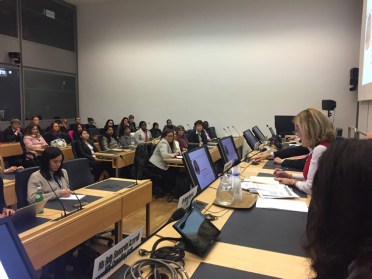 It also enabled us to engage in the kick-off meeting of the
 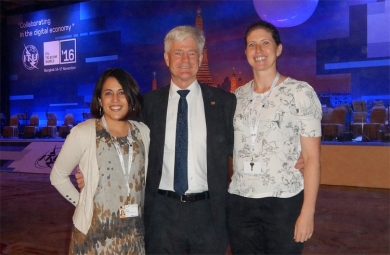 The UNESCO Chair in ICT4D featured prominently at the ITU’s
 This was an opportunity for me to explore the relevance to the European context of some of my ideas about ICTs and inequality gleaned from research and practice in Africa and Asia. In essence, my argument was that we need to balance the economic growth agenda with much greater focus on using ICTs to reduce inequalities if we are truly to use ICTs to support greater European integration. To do this, I concluded by suggesting that we need to concentrate on seven key actions:
 The ITU is preparing a new book, provisionally to be entitled “ICT4SDGs: Economic Growth, Innovation and
 I have been invited to lead on a 6,000 word chapter, provisionally entitled “Sustainability in Development: Critical Elements” that has an initial summary as follows: “the chapter identifies how ICTs engage with the sustainability agenda and the various elements of the ecosystem (such as: education, finance/capital, infrastructure, policy, market, culture/environment, opportunities) and the stakeholders that are indispensable for ensuring resilient and sustainable development activities in developing countries in spite of some chronic shortages coupled with fast changing and fluid situations that can negatively hamper the efforts”.